The Appraisal Process of a Sword Dealer — Inside the Evaluation Practices Sword Shops Follow, from Authentication to Price Setting
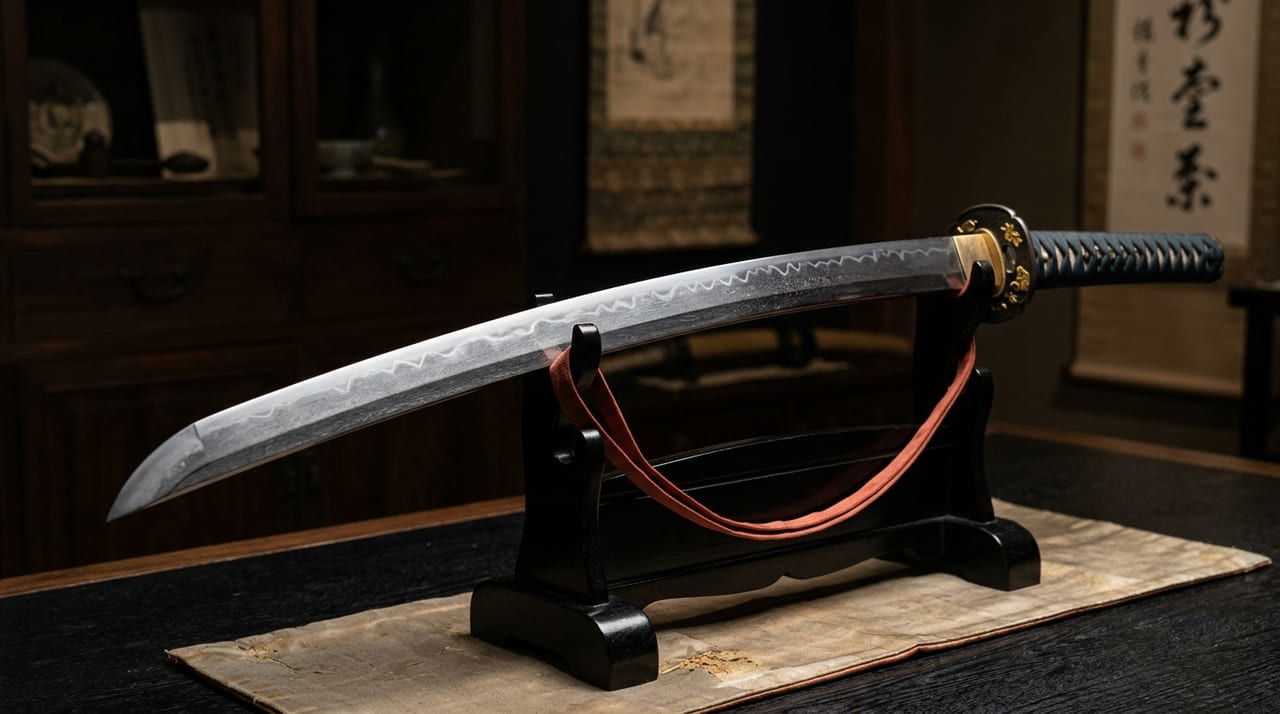 * Image is for illustrative purposes only.
Table of Contents
What Is a Sword Dealer's Appraisal?
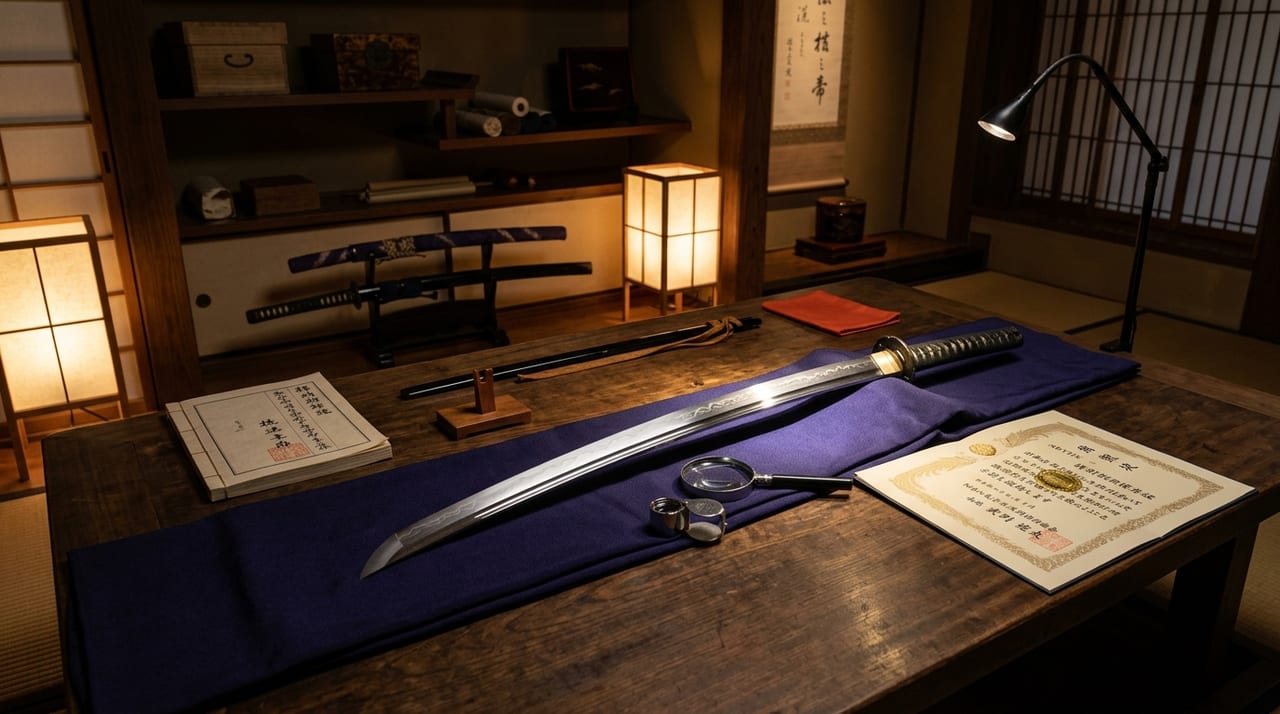
In the buying and selling of nihontō, an "appraisal" is the process by which a sword dealer (katana-ya) evaluates the monetary value of a sword brought in. Unlike general antique appraisals, appraising a nihontō requires a four-layer structure: statutory verification (confirming the registration certificate and matching the registration number), authentication, condition evaluation, and assessment of market trends. Even veteran sword dealers never set a price based on market intuition alone.
For those seeking an appraisal, understanding this four-layer structure is meaningful. It clarifies which stages tend to take time and what documents to prepare in advance, providing a useful mindset for first-time visitors to a sword dealer's shop. An appraisal may be completed in a single exchange, or it may require additional verification and a response at a later date; refraining from pressing for an immediate answer ultimately leads to a more satisfying evaluation.
Step 1: Registration Certificate and Legal Verification
The first step in an appraisal is confirming the sword registration certificate (issued by the prefectural Board of Education). Under the Act for Controlling the Possession of Firearms or Swords and Other Such Weapons (Jūtōhō), unregistered swords may not in principle be possessed, and the sale of a registered sword must be accompanied by its registration certificate (Act for Controlling the Possession of Firearms or Swords and Other Such Weapons (e-Gov Laws Search), Article 3, Paragraph 1 and Article 18). The sword dealer checks one by one whether the registration certificate number matches the blade's characteristics (nagasa, sori, shape, and presence of mei).
If the information on the registration certificate does not match the actual sword, the appraisal is temporarily suspended, and the customer is guided through the re-registration or amendment procedures with the prefectural Board of Education as needed. It is not uncommon for issues to come to light at this stage, and attentive handling here determines the dealer's trustworthiness.
When a sword has been inherited or transferred, it is not unusual for the registration certificate to remain in the name of the previous owner. In such cases, the dealer first prioritizes matching the certificate to the sword, then explains whether a name transfer is required and where to apply. Simply confirming the whereabouts of the registration certificate before bringing the sword in can make a significant difference to how smoothly the appraisal day proceeds.
Step 2: Authentication and Appraisal Points
Once the registration certificate has been verified, the dealer authenticates the blade. There are three main appraisal points.
Observing the jigane: The jigane provides clues to the sword's region of origin, period, and school through the surface grain, nie (visible martensite crystals), utsuri, and other features. The jigane derived from tamahagane has a distinctive "activity," and an experienced eye can distinguish it from modern machine-made steel at a glance.
Examining the hamon: The hamon is the pattern formed by yaki-ire (quenching), and its characteristics differ by school and region. The shape — such as gunome, chōji, or suguha — is confirmed, and the condition of the ashi and nioiguchi is also evaluated. Whether past togi has disrupted the hamon is another important check.
Authenticating the mei: The dealer determines whether the mei on the nakago is the tōkō's own work or a later addition or forgery. The style of the characters, the manner of engraving, the condition of the rust, and the number and position of the mekugi holes are all assessed together. Swords bearing the mei of a famous tōkō require the most caution in authentication; if an NBTHK kanteisho is attached, its contents are also taken into consideration.
These three points are not judged in isolation; conclusions are drawn by cross-referencing them comprehensively. If the jigane and hamon characteristics are consistent but something about the mei feels off, re-examination takes place; conversely, authenticity is never determined on the basis of the mei alone. Even when a sword already comes with a kanteisho, the dealer verifies all three points with their own eyes before considering the appraisal value.
Step 3: Condition Evaluation
After authenticity has been confirmed, the sword's condition is evaluated on approximately a five-level scale. The main evaluation items are as follows.
- Presence of blade chips or cracks: Chips and fractures caused by use or improper storage
- Degree of rust: Ubu-sabi (natural patina) is acceptable, but progressing red rust significantly diminishes value
- State of togi: Whether the polish is old or recent, and traces of the polisher's skill
- Condition of shirasaya and koshirae: Whether the storage shirasaya fits properly; if koshirae is present, the condition of the fittings is also evaluated
- Whether the nakago is ubu: An "ubu nakago" — a nakago that has not been shortened and ground down — is of high value
One particular concern in condition evaluation is the effect of the storage environment. A sword kept in a humid location for a long period may have rust advancing inside the saya unnoticed, and the dealer checks the entire blade after drawing it from the saya. Conversely, swords that have been maintained regularly (with uchiko and oil application) tend to have a stable condition evaluation, and communicating the maintenance history at the time of appraisal helps support the assessment.
Step 4: Determining the Market Price
After the condition evaluation is complete, the dealer calculates the purchase price (or, in the case of consignment, the estimated selling price) based on market trends. The information primarily referenced is as follows.
- Recent domestic auction results (Token Shibata, Yahoo Auctions specialist items, etc.)
- Comparison with shop inventory prices for swords of the same school and period
- Trends in overseas collector markets (international auctions such as Bonhams and Christie's)
- The NBTHK kanteisho grade (Hozon Tōken, Tokubetsu Hozon, Jūyō Tōken — the price range differs significantly by grade)
The purchase price is often approximately 40–60% of the expected retail price. This reflects the costs of restoration and polishing, inventory risk, and sales commissions. Customers may feel the offer is lower than expected, but this difference represents the cost of bringing the sword to market and the value of the dealer's expertise.
When a price is presented, it is not unusual for multiple dealers to offer different appraisal values for the same sword. This is because the emphasis placed on particular periods and schools, the customer base served, and current inventory all cause the evaluation criteria to differ subtly. Rather than treating a single appraisal figure as the absolute standard, approaching the transaction by asking about the rationale presented — which factors the dealer weighted most heavily: jigane, hamon, condition, or market results — leads to a more satisfying deal.
Frequently Asked Questions About Appraisals
Does an appraisal cost money?: Many sword dealers offer in-shop appraisals free of charge. However, additional costs may arise for work that follows the appraisal, such as obtaining a kanteisho or commissioning togi. It is reassuring to confirm in advance what is and is not included at no charge.
What should I do if I am not satisfied with the appraisal value?: Rather than judging on the basis of a single dealer's figure, you can ask another dealer for a comparison estimate. It is natural for assessments to vary depending on the dealer's area of expertise and current inventory, and it is advisable to compare multiple appraisals before entrusting the sword to a dealer you are satisfied with.
Should I carry out maintenance or polishing myself before bringing the sword in?: Amateur polishing or maintenance can instead damage the blade and lower the evaluation. Even if you are concerned about rust or soiling, it is recommended to bring the sword to the dealer in its current state — including any ubu-sabi — without attempting any intervention.
How long does an appraisal take?: Matching the registration certificate and checking the external appearance often take place more or less on the spot in the shop, but if careful verification of authenticity or provenance is needed, a reply may come at a later date. If you need a quick sale, it is a good idea to communicate this in advance.
Making the Most of an Appraisal
A sword dealer's appraisal is not merely "presenting a purchase price" — it is a specialized process for bringing swords into proper circulation. Having appraisals done at multiple dealers and obtaining an official kanteisho from NBTHK or a similar body before the appraisal leads to maximizing value at the time of sale. Only when a sword has the right knowledge and appropriate distribution channels behind it can its cultural and economic value coexist. TOUKENZA's online catalog disseminates sword information informed by this context of appraisal and distribution, and inquiries via the contact form are welcome.
When requesting an appraisal, bringing not just the blade but a complete set of accessories — shirasaya, koshirae, the registration certificate, and, if possible, documents showing the sword's provenance — makes it easier to receive a more precise evaluation. Information about the provenance and the circumstances of acquisition does not necessarily translate directly into the appraisal figure, but it is worth communicating to the dealer as supporting material that reinforces the authentication and condition evaluation.