Japanese Sword Dealers in the Age of Reviews and Word of Mouth — Trust-Building Practices and the Reputation Management Strategies Chosen by Established Shops
 * Image is for illustrative purposes only.
Table of Contents
Japanese Sword Dealers in the Internet Age — The Challenge of Trust
The Japanese sword market has undergone rapid change in recent years. Transactions conducted through appraisers and art dealers in a closed market were once the norm, but online marketplaces, social media, and person-to-person sales have now become commonplace. While this opening of the market has increased transparency, it has also created new problems. What trust strategies should sword dealers adopt in the age of word of mouth and reviews?
The Dangers of Dependence on Word of Mouth and Reviews
Before the spread of the internet, a sword dealer's reputation rested on "the age of their sign," "name recognition within the industry," and "word passed among customers." Customers naturally gravitated toward prominent local dealers, and dealers who sold fraudulent goods would see their reputation spread through the industry and eventually be driven out — a gradual self-purifying mechanism was at work.
Today, however, even a newly entered dealer can become a "popular dealer" in no time through clever review manipulation and exaggerated marketing. Conversely, even an established shop that has operated with integrity will need enormous time and effort to repair its reputation once negative reviews appear online. Word of mouth is both "the most powerful evaluation system" and "the most fragile foundation of trust."
Reputation Management Strategies Adopted by Established Sword Dealers
Many of the prominent established sword dealers in Tokyo, Kyoto, and Osaka have adopted the following strategies in response to these environmental changes.
The first is a "low profile." They avoid excessive information sharing on social media and prioritize in-person transactions at their physical stores. They post only basic information and their track record online, disclosing specific product details and market price information only to customers who actually visit. This strategy naturally attracts "customers with a discerning eye," and the quality of transactions is preserved as a result.
The second is "emphasis on expertise." They turn their appraisal experience, purchasing networks, and unique insights into content and share it continuously on platforms such as note and YouTube. This allows them to establish a position not merely as "a merchant" but as "a researcher of swords," building a foundation of trust that does not rely solely on word of mouth.
The third is "transparency in transactions." They set out procedural rigor as a business principle — not handling swords of unknown provenance, requiring confirmation of the firearms and swords registration certificate, and having items with potential forgery appraised in advance — and make this explicit to customers. The fees and time involved in that process are a "cost of trust" for the customer and are easy to justify.
The fourth is "multiple channels." They maintain ongoing relationships with auction houses, museums, and university research departments, preserving "channels where public evaluation is added" beyond online sales. This allows them to avoid the risk of being judged solely by their online reputation.
Responding to Counterfeits and Suspect Items
As the online market expands, the importance of authenticating genuine pieces has grown. In particular, fraudulent counterfeits sometimes circulate, such as falsified firearms and swords registration certificates, re-carved mei (signature), and "assembled swords" in which a blade has been placed in a different koshirae (mounting).
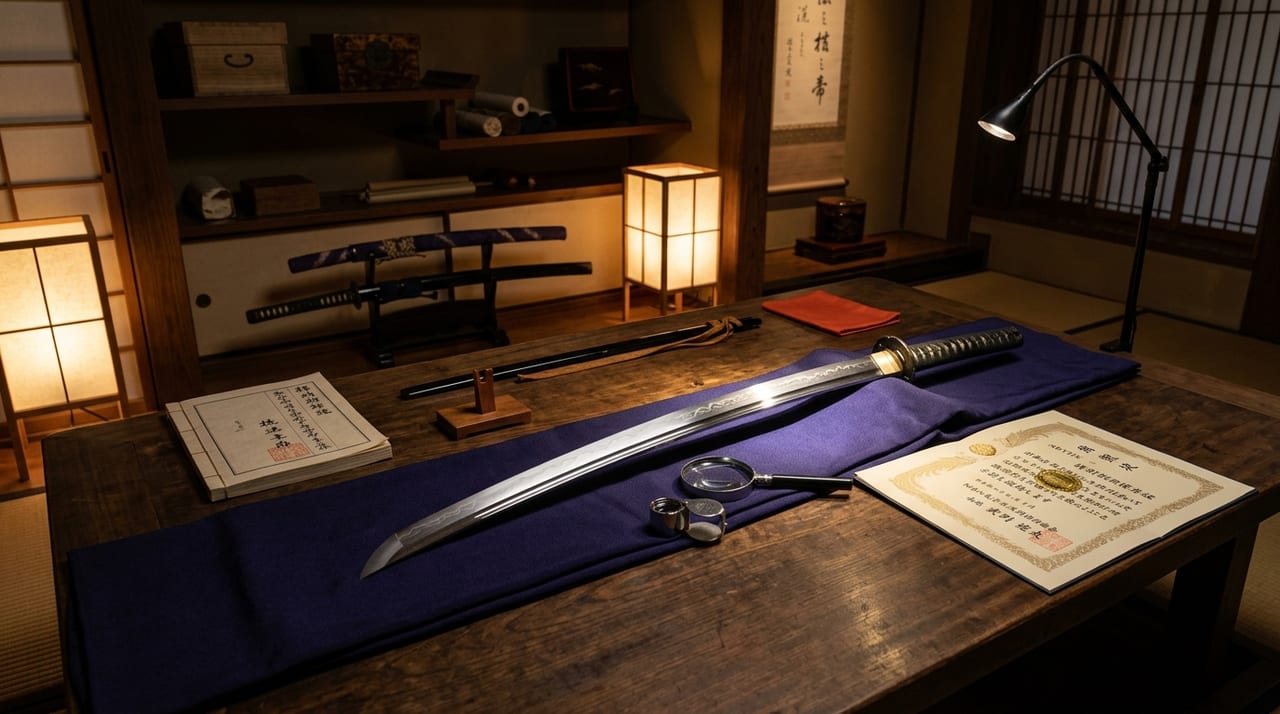
Established sword dealers adopt a strategy of "using official appraisal bodies" to counter such threats. For swords of unclear provenance or items priced significantly below market value, they have the piece appraised in advance by NBTHK or the All Japan Swordsmith Association (AJB), and sell it with the kanteisho (appraisal certificate) attached. This process takes time and money, but the result is that "the trust of handling genuine goods" is cultivated.
Coexistence of New Entrants and Established Dealers
With the emergence of online marketplaces, the barrier to entry has dropped considerably. It is not uncommon for enthusiastic collectors to enter the trade as sword dealers, armed with their knowledge. Among these new dealers, a growing number respond to individual customer needs with great care and provide "concierge-like service" rather than simple buying and selling.
At the same time, established shops continue to fulfill roles that individual dealers cannot handle — "years of industry experience," "a history of dispute resolution," and "prevention of the inflow of stolen or illegal goods." For a healthy market to form, the vitality of new entrants and the reliability of established dealers must complement each other.
Mindset for Consumers
When purchasing a sword, it is important not to rely on word of mouth alone, but to cross-reference multiple sources of information (official websites, kanteisho (appraisal certificate), the dealer's track record, and academic background). For high-priced items in particular, one should consider not only the dealer's size and history, but also what kind of "dispute experience" the dealer has had and how they improved afterward.
Ultimately, in the internet-age market, "trust" is the greatest commodity, and it is the dealers who seek to protect that trust over the long term who will ride out the waves of attrition.