History of Tōkō in Shikoku——Regional Kaji Culture and the Lineages of Renowned Craftsmen in Awa, Sanuki, Tosa, and Iyo
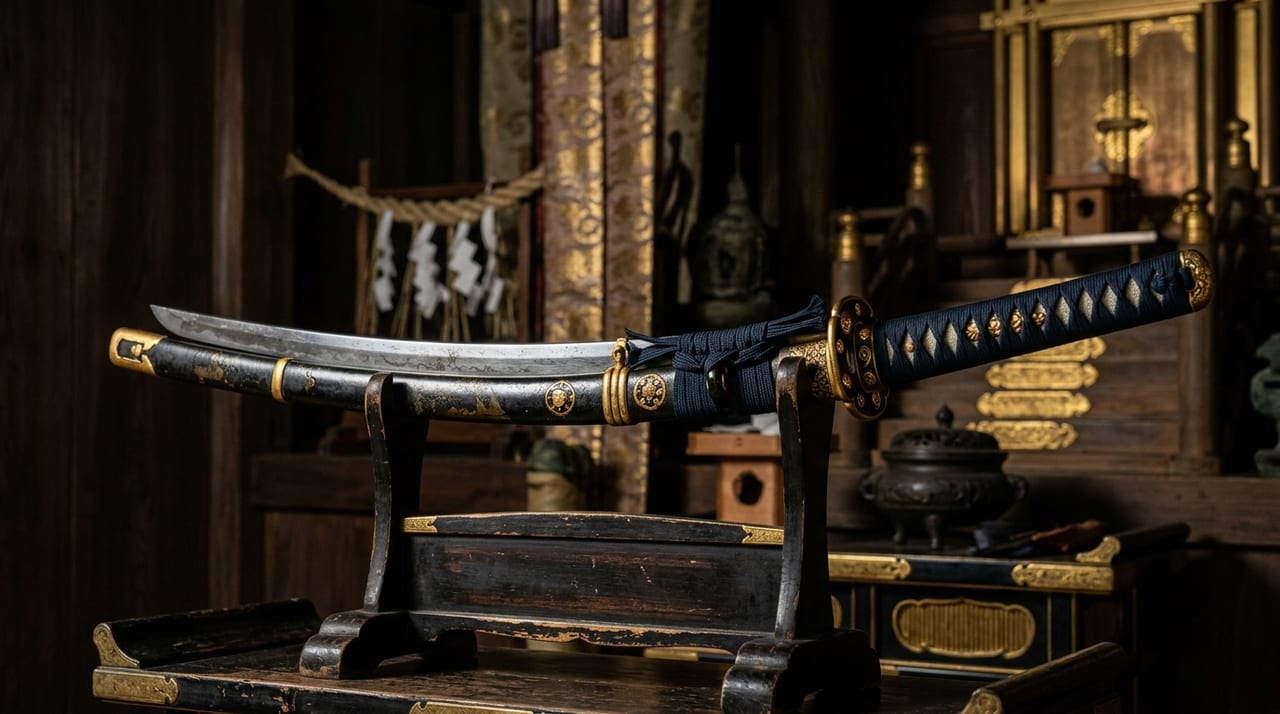 * Image is for illustrative purposes only.
Table of Contents
Sword Culture of Shikoku——The Blades of an Unknown Island
The five major production centers recognized as sources of nihontō (the Gokaden: Yamashiro, Yamato, Bizen, Sōshū, and Mino) are all located on Honshū. Shikoku — Awa (Tokushima), Sanuki (Kagawa), Tosa (Kōchi), and Iyo (Ehime) — has lagged behind these major production centers in terms of the historical recognition of its tōkō, and scholarship has tended to fall behind as well. Yet each province possessed its own kaji traditions and distinctive tōkō who, through the transportation networks of the Seto Inland Sea, maintained relationships of influence with Bizen and Yamashiro while cultivating an independent sword culture. By carefully tracing the history of Shikoku swords, the richness of the regional diversity of nihontō comes into view.
Awa (Tokushima)——The Lineage of Retained Tōkō of the Tokushima Domain
The province of Awa (present-day Tokushima Prefecture) was the domain of the Tokushima han, ruled by the Hachisuka clan, and during the domain administration period retained tōkō supplied swords. Many swords survive that display the style of the "Masakiyo of Awa" lineage, known among Awa's tōkō, carrying on the techniques of the Bizen-den.
Awa was known as a production center for Tokushima indigo, and the economically fertile soil supported demand for warrior culture. Demand for swords came not only from domain lords and the warrior class; a culture also emerged in which wealthy merchants such as indigo traders collected swords as works of art, raising the momentum to seek works of a high artistic standard from craftsmen. Extant Awa swords frequently bear the inscription "Ashū jū" in the mei, and one can read in this the pride of craftsmen proclaiming their place of origin.
During the Nanbokuchō period, warriors on the side of Emperor Go-Murakami made Awa an important military base, and there was a period when demand for military swords surged sharply. Awa's tōkō of this period raised their profile by supplying swords to the Southern Court side, helping to establish Awa's status as a production center.
Sanuki (Kagawa)——Kotohira-gū and the Culture of Dedicated Swords
The province of Sanuki (present-day Kagawa Prefecture) was an economic and cultural center from ancient times as a strategic point of maritime traffic. What deserves particular notice in Sanuki's sword culture is the culture of dedicated swords at Kotohira-gū (Konpira-san). Kotohira-gū, where mariners and merchants from across the country dedicated swords as prayers for safe passage, holds a large number of dedicated swords, among which are works by Sanuki's tōkō. Through dedicated swords, Sanuki's tōkō gained opportunities to achieve nationwide recognition.
Those for whom records survive as Sanuki's tōkō are a group who cut the mei "Sanshū jū," with works from the mid-Edo period onward being particularly numerous. Works survive by tōkō who, while strongly influenced by the neighboring province of Bizen, sought a jigane expression uniquely their own. Among the tōkō who developed under the retained tōkō system of the Takamatsu domain (the Matsudaira clan), there are examples who traveled to Sendai and Edo to hone their craft, deepening their skills through exchanges with master craftsmen from various provinces.
Sanuki is widely known as a symbol of udon culture, but in the sword industry too, "Shōdoshima whetstone" played an important role. Togishi from across the Seto Inland Sea region used whetstones produced on Shōdoshima, and Sanuki has an aspect of contributing to sword culture more through the polishing industry than through sword forging. Considering that the quality of whetstones determines the final beauty of a sword, Sanuki's contribution deserves renewed appreciation in the history of swords.
Tosa (Kōchi)——The Yamauchi Clan's Retained Tōkō and the Swords of Martial Resolve
The province of Tosa (present-day Kōchi Prefecture) maintained its own warrior culture as the Tosa domain until the Bakumatsu period, ever since Yamauchi Kazutoyo entered the province after the Battle of Sekigahara. The most important name in the history of Tosa's tōkō is "Tosa Yukikuni." Yukikuni was a tōkō who was active in Tosa in the early Edo period, had a deep relationship with the Yamauchi clan, and left works known by the mei "Tosa no Kami Yukikuni."
Tosa's sword culture has a characteristic of "martial resolve." It is well known that during the Bakumatsu period the loyalist patriots of the Tosa Kinnōtō — Sakamoto Ryōma, Takechi Hanpeita, Okada Izō, and others — carried swords in their activities, but many of those swords were works by Tosa tōkō or swords obtained from other production centers. In the torrent of that era, Tosa swords became one with the will of the patriots and were inscribed in history.
In the mountainous interior of Tosa, kaji craftsmen actively produced agricultural and forestry tools, and there were many tōkō who worked on a concurrent basis, also forging swords. This background has led to the assessment of Tosa swords as "practical and unpretentious." Many extant Tosa swords display a bold and powerful style, and the form that prizes practicality over ornamentation directly reflects the unyielding spirit of Tosa.
Iyo (Ehime)——The Tōkō Network of Imabari, Matsuyama, and Uwajima
The province of Iyo (present-day Ehime Prefecture) was the largest province in Shikoku and, under the domain systems of Imabari, Matsuyama, and Uwajima, nurtured a diverse tōkō culture. The most renowned among Iyo's tōkō is the group commonly referred to as the "Kanemitsu lineage of Iyo," and there are records of tōkō who learned techniques from Kanemitsu of the Bizen Osafune school migrating to Iyo.
Each domain supported sword culture in its own distinct way.
- Matsuyama domain (Matsudaira clan): Throughout the Edo period, it actively retained tōkō and supported sword demand both in terms of strengthening the arming of domain warriors and collecting works of art.
- Imabari domain: Together with the Saijō domain, it prospered as a hub of Seto Inland Sea trade, and that wealth spurred sword-collecting culture.
- Uwajima domain: It possessed its own cultural refinement, and collecting activities with an eye toward the artistic aspects of swords were carried out.
The characteristics of Iyo's tōkō include a jihada flowing in itame and a bright hamon. This is attributed to the use of iron materials unique to Iyo while being influenced by the neighboring Bizen and Sanuki, and provides the pleasure of appreciation as a distinctive character when compared with other production centers.
Contemporary Reappraisal of Shikoku Swords
Works by Shikoku's tōkō often lag behind those of the major Gokaden production centers in terms of market recognition. However, as scholarship advances, the distinctiveness of Shikoku swords — a character that reflects regional materials, culture, and the tastes of the warrior class — is being reassessed. Regional sword enthusiast societies are continuing research on local tōkō, and surveys of butsutō (swords dedicated to temples) in relation to the Shikoku Eighty-Eight Temple Pilgrimage are also progressing.
Works by regional tōkō are often available at more accessible price points than swords from renowned production centers, and they are sometimes positioned as an introduction to sword collecting.
Summary
The sword culture nurtured by each of Shikoku's provinces — Awa, Sanuki, Tosa, and Iyo — possesses its own history and character, even while remaining in the shadow of the Gokaden. The distinctive features of each province may be summarized as follows.
| Region | Representative tōkō | Characteristics |
|---|---|---|
| Awa (Tokushima) | Masakiyo of Awa | Style carrying on the techniques of the Bizen-den; mei reading "Ashū jū" |
| Sanuki (Kagawa) | Sanshū jū | Culture of dedicated swords at Kotohira-gū; contribution to the polishing industry through Shōdoshima whetstones |
| Tosa (Kōchi) | Tosa Yukikuni | Martial character; aspect as the swords of loyalist patriots |
| Iyo (Ehime) | Kanemitsu lineage of Iyo | Jihada flowing in itame and bright hamon |
The swords of Shikoku, produced through the complex interweaving of regional industry, faith, politics, and warrior culture, are valuable evidence of the rich regional diversity of nihontō. As interest in Shikoku swords grows, understanding of nihontō culture as a whole will deepen further.