Scientific Analysis of Nihontō — Forging Secrets Revealed by X-ray, CT, and X-ray Fluorescence Analysis
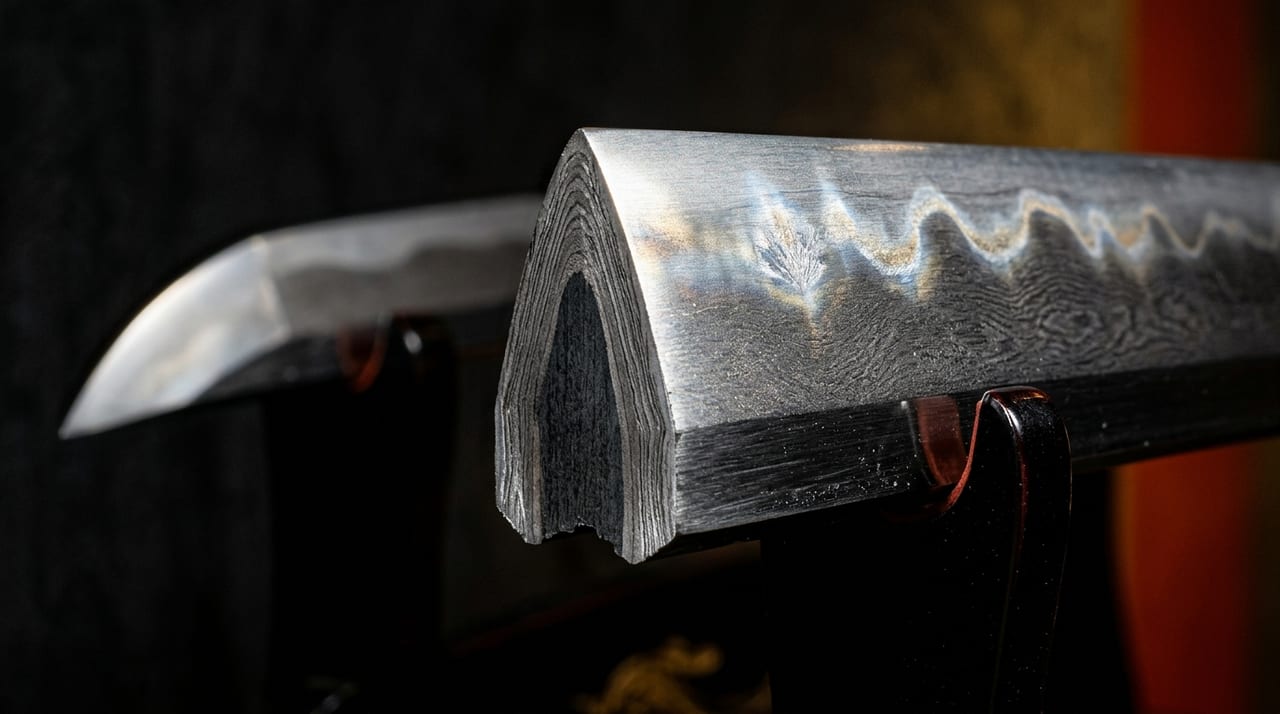 * Image is for illustrative purposes only.
Table of Contents
The Age of Science "Reading" the Nihontō
For a long time, the appraisal of nihontō relied on the trained eye and experience of experts — visual inspection observing the jihada (grain pattern of the steel), hamon (temper line), form, and the rust color of the nakago (tang). However, since the latter half of the 20th century, advances in physics and chemical analysis have rapidly driven the development of techniques for non-destructive analysis of the internal structure of nihontō. As of 2026, scientific analysis has become an indispensable tool in the examination of swords held in museum collections, authentication, and research into manufacturing methods.
This article introduces the main analytical methods used in the scientific examination of nihontō and the discoveries they have yielded. The principal methods are organized in the following table.
| Analysis Method | What It Reveals |
|---|---|
| X-ray radiography | Layer structure from orikaeshi tanren (folding), detection of repair traces such as suriage (shortening) and re-quenching |
| CT scanning | Three-dimensional visualization of the composite construction using shingane (core steel), kawagane (jacket steel), and hagane (edge steel) |
| X-ray fluorescence analysis (XRF) | Identification of iron sand origin and period of production from the ratio of trace elements such as titanium and vanadium |
| Electron microscopy / EBSD analysis | Microstructural analysis of the steel structure (martensite, etc.) that produces the hamon (nioi and nie) |
X-ray Radiography — Visualizing the Invisible Internal Structure
The most fundamental scientific analysis method is X-ray radiography. While ordinary photography uses the reflection of light, X-rays have the property of penetrating matter and can therefore visualize the cross-sectional structure of a blade, internal cracks, and traces of repair.
The most important information revealed by X-ray imaging of nihontō is the "layer structure from orikaeshi tanren (folding)." Repeating the process of folding and forging tamahagane forms a layered structure within the steel. This layering can be inferred to some extent from the hamon and jihada (grain pattern of the steel), but X-ray imaging allows for a more accurate understanding of the internal layer distribution.
X-rays are also effective for detecting traces of repair. Swords that have been altered in later eras — through suriage (shortening of the nakago) or re-quenching of the cutting edge — are detected as patterns of uneven internal density. Such information also provides important grounds for judging the authenticity of a mei (signature).
CT Scanning — Three-Dimensional Analysis of Internal Structure
As an evolution of X-ray radiography, three-dimensional analysis using CT (computed tomography) has spread rapidly in recent years. CT scanning is a medical technology that uses X-rays taken from different angles to generate cross-sectional images through computer processing; this same technology has also been applied to the investigation of cultural properties.
A particularly noteworthy achievement in CT analysis of nihontō is the "visualization of composite construction." The composite structure combining steel materials of different carbon content — shingane (core steel), kawagane (jacket steel), and hagane (edge steel) — had been difficult to confirm through traditional visual inspection, but CT analysis has made it possible to clearly show the joint surfaces and distribution.
In a joint survey conducted by RIKEN and the Tokyo National Museum, CT analysis of kokuhō (National Treasure) swords revealed cases in which complex steel arrangements were discovered that differed from the composite construction previously estimated through traditional appraisal. Scientific data updated the "understanding through tradition" held for a century.
X-ray Fluorescence Analysis (XRF) — Identifying Origin from Elemental Composition
X-ray fluorescence analysis (XRF: X-ray Fluorescence) is a non-destructive technique for analyzing elemental composition by directing X-rays of a specific wavelength at a material and measuring the secondary X-rays (fluorescent X-rays) emitted.
In XRF analysis of nihontō, it has been found that the trace element content profiles of the following elements in the steel differ by place of origin.
- Titanium (Ti)
- Vanadium (V)
- Silicon (Si)
- Phosphorus (P)
- Sulfur (S)
- Manganese (Mn)
A particularly important discovery is the "correspondence between iron sand origin and trace elements in steel." The titanium and vanadium content ratios differ between the iron sand used in the tatara (traditional smelting) of Oku-Izumo (Shimane Prefecture) and the iron sand used in Bizen and Mino. It has been confirmed that these differences remain in trace amounts in the forged sword, providing a scientific basis for identifying place of origin.
In applications to authentication, the notably different elemental compositions of steel in kotō (pre-Nanbokuchō), shintō (Edo period), and Shōwa swords (machine-made) are utilized. Swords with false mei (signatures) made using Shōwa electric furnace steel have elemental ratio profiles that do not match those of ancient or early modern tamahagane, making identification by XRF analysis possible.
Electron Microscopy / EBSD Analysis — Analyzing the Microstructure of Steel
The combination of scanning electron microscopy (SEM) and electron backscatter diffraction (EBSD: Electron Backscatter Diffraction) allows steel crystal structures to be observed at a microscopic scale. The distributions of various structures — martensite, ferrite, pearlite, and others — are visualized.
Research that elucidated the nature of the hamon — nioi and nie — at the level of microstructure was a landmark achievement in nihontō research. Nie produces a granular luminosity visible to the naked eye, but electron microscope observation has confirmed it to be an aggregate of martensite particles with diameters of several tens of micrometers.
A research group at the Tokyo Institute of Technology conducted EBSD analysis on hamon samples from kotō, shintō, and gendaitō and quantified the differences in crystal structure by period and school. It was a study that attracted attention as an attempt to provide a scientific basis for hamon appreciation, which had previously been considered "intuitive."
The Limits of Scientific Analysis and the Indispensability of the Human Eye
While scientific analysis has revolutionized nihontō research, its limitations are also recognized. X-ray and CT imaging can visualize internal structure, but they cannot yield an aesthetic judgment of "whether this sword is beautiful." Even if XRF indicates the tendencies of an origin, the final judgment of attribution — "whether this sword is the work of Chōgi" — still rests on the experience of specialists.
Science narrows hypotheses, detects inconsistencies, and provides objective data. However, the "value" of a nihontō is comprehensively assessed through traditional appreciation and aesthetic sensibility. Scientific analysis and visual inspection are not in opposition but rather in a mutually complementary relationship. Cutting-edge research today continues to seek an approach that integrates both.