The Science of Rust — The Formation Mechanisms of Ubusabi, Akasabi, and Kurosabi on Japanese Swords, and the Technology of Conservation Treatment
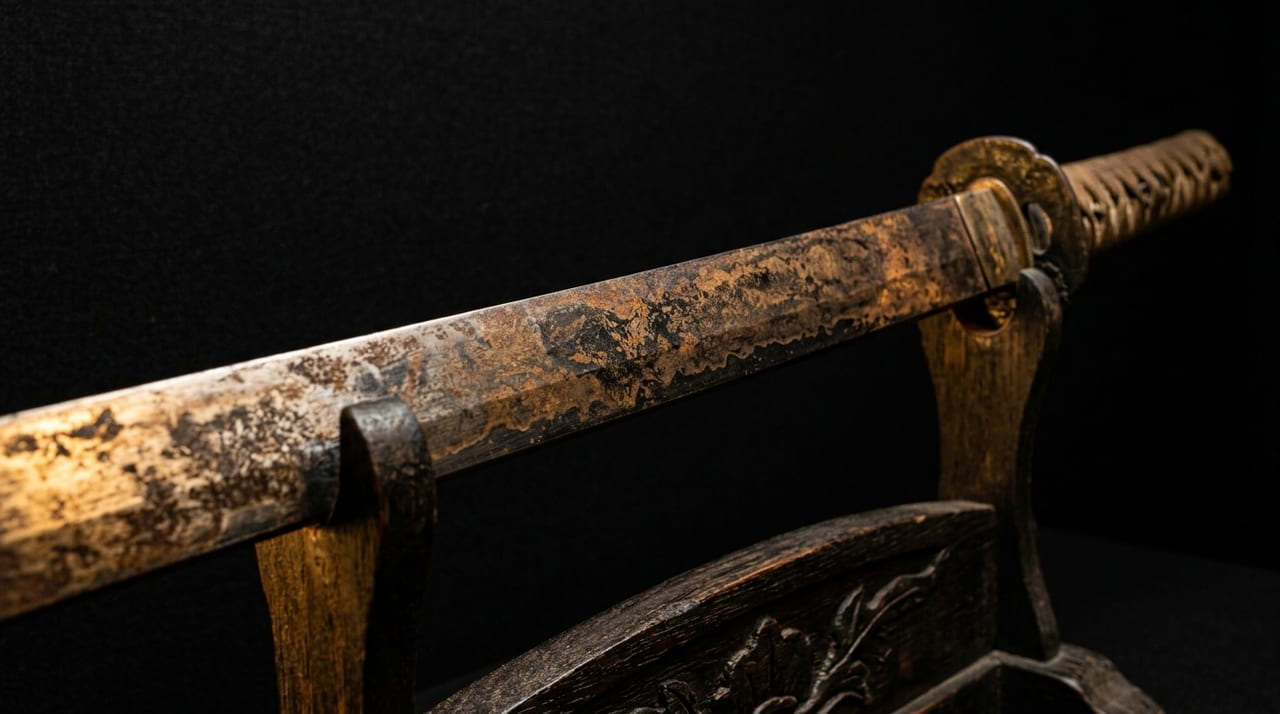 * Image is for illustrative purposes only.
Table of Contents
What Is Rust? — The Phenomenon of Iron Oxidation
The rust of metals is a phenomenon in which iron (Fe) reacts with oxygen (O₂) and water (H₂O) in the air to produce oxides and hydroxides. This chemical change is also called "corrosion," and is generally understood as a harmful phenomenon that degrades metals.
However, in the world of Japanese swords, the assessment of "rust" is not one-dimensional. Certain types of rust that develop on old swords not only do not diminish value but are highly regarded as "proof of provenance," while rust caused by improper storage can render a blade irreparably damaged. To understand this difference, one must know the chemical nature of rust.
Ubusabi — A Stable Layer Built Up Over Time
"Ubusabi" refers to a dark-brown to grayish-black rust layer that develops on the nakago of kotō that have been left untended for long periods. While it is undeniably rust at first glance, it is considered in sword appraisal to be "an important source of information indicating the sword's provenance" that should be protected.
Chemically, the main component of ubusabi is iron tetroxide (Fe₃O₄, magnetite), which forms a stable oxide layer. Because the magnetite layer is dense and compact, it functions as a "passivation layer" that protects the interior iron from further corrosion. In other words, ubusabi is a "self-defense layer of iron" formed over a long period of time.
The reason ubusabi is valued in sword appraisal lies in its stability. Ubusabi formed over hundreds of years cannot be reproduced by artificial means in a short period. By observing the ubusabi on the nakago, one can infer the time the sword has weathered, the storage conditions, and whether later modifications such as suriage have been made. This is why togishi avoid polishing the nakago and protect the ubusabi.
Akasabi — The Main Culprit of Corrosion That Eats into Iron
The orange to reddish-brown rust that one generally associates with the word "rust" is "akasabi." Chemically, iron(III) oxide (Fe₂O₃, hematite) is the representative main component, and FeOOH (goethite and other hydrated iron oxides) is also included among its constituent components. These form rapidly in the presence of moisture.
Akasabi has a porous and brittle structure with low adhesion to the iron surface. Because it does not function as a protective film, oxygen and moisture from outside continue to reach the interior, accelerating corrosion — the so-called state in which "rust begets rust."
The main conditions under which akasabi develops on Japanese swords are as follows.
- High-humidity environments (relative humidity of 70% or above): Moisture condenses on the surface, and electrochemical corrosion progresses.
- Skin oils and salt from hands: Chloride ions contained in fingerprints act as a catalyst for rust.
- Depleted rust-prevention oil: An oil film from chōji oil or camellia oil suppresses oxidation, but when the oil evaporates corrosion advances rapidly.
- Acidic atmosphere: Acidic substances such as sweat and wood gases (formic acid, acetic acid) function as catalysts.
When akasabi develops on the blade surface or jigane, even after removal a roughened surface called "sabihada" remains, severely hindering appreciation of the jihada and hamon. Advanced akasabi requires removal by polishing, but each polishing thins the blade. Akasabi is the greatest enemy that "shortens the life" of swords.
Kurosabi — A Controlled Oxidative Protective Layer
Although it is also a corrosion product of iron like akasabi, "kurosabi" has entirely different properties. Its main component is magnetite (Fe₃O₄), forming a dense layer with high adhesion.
The formation of a magnetite layer under natural conditions is an extremely slow process (tens to hundreds of years), but artificially it can be intentionally produced through "black dyeing" or "black firing." The technique of applying phosphate treatment or high-temperature steam treatment to iron products to form an artificial kurosabi layer of magnetite, thereby preventing subsequent corrosion, is widely used in modern industry as well.
The "yasurime no kurome (blackening of yasurime)" applied to the nakago of swords is a traditional rust-prevention treatment applying this principle. In the world of antiques, there is also a technique called "tsukurisabi (constructed rust)," in which the nakago is intentionally rusted to conceal the original appearance of the base metal.
Rust Countermeasures for Togishi and Conservators — Practical Anti-Rust Techniques
We organize below the techniques practiced by togishi and conservators in rust prevention and rust treatment of Japanese swords.
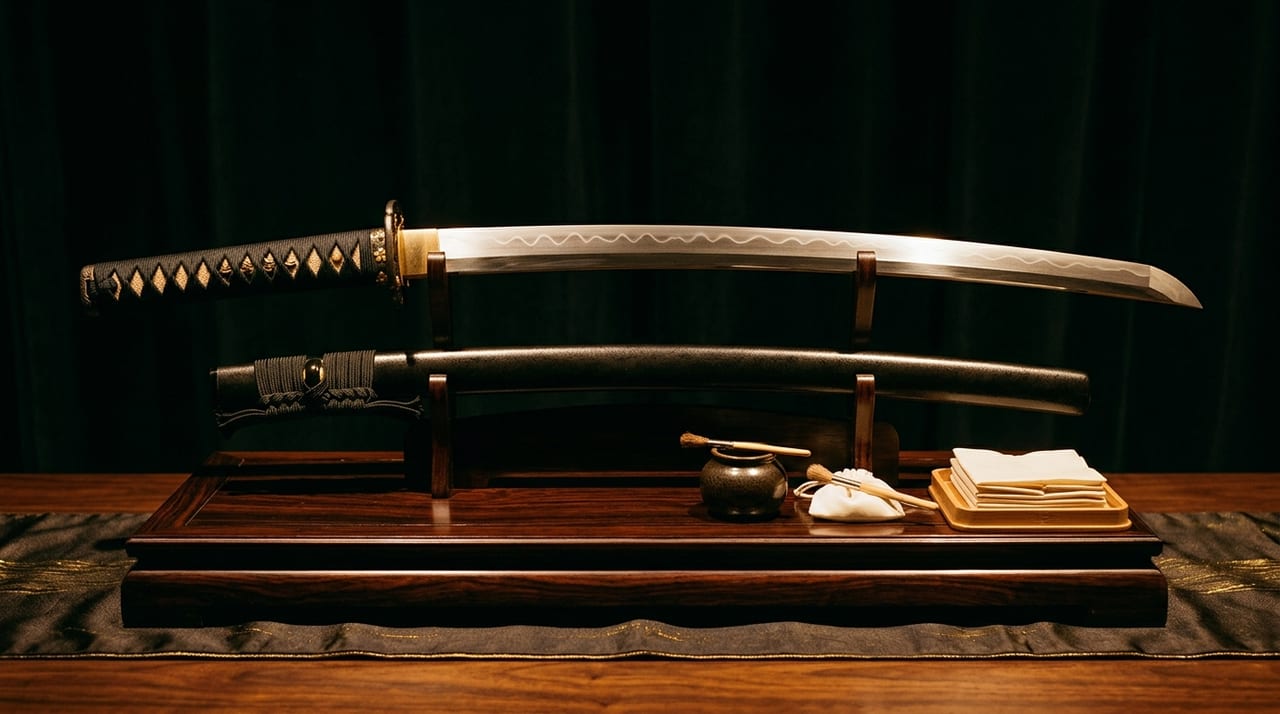
The Basics of Rust Prevention — Oil Application: A trace amount (thin film) of chōji oil (chōji abura) or hakuyū (white oil) is applied to cut off contact with oxygen and moisture. Excessive oil attracts dirt and promotes corrosion, so an appropriate amount is required. Regular replacement is recommended (roughly once every two to three months in summer, and once every six months in winter as a guideline).
Handling Early Akasabi — Neru-fuki and Uchiko: Mild akasabi (spot rust / early-stage rust) can sometimes be removed by gently wiping with medical-grade cotton or neru (flannel) cloth. Polishing with uchiko completely removes oil and temporarily dries the blade, improving the adhesion of subsequent oil application.
Treatment of Severe Rust — Polishing: Akasabi that has penetrated the blade surface or corrosion of the jigane has no fundamental solution other than polishing by a togishi. Since polishing reduces the thickness of the blade, avoiding unnecessary polishing leads to the longevity of the sword. The ethic of "minimum necessary polishing" is valued in the world of togishi.
Management of Storage Environment: A stable environment with a relative humidity of 50 to 60% and a temperature of 10 to 25°C is considered ideal. Storage in a tōbukuro (sword bag) or katanabako (sword box) is effective for shielding from outside air, but care must be taken not to seal them too tightly, as wood gases can accumulate and create an acidic atmosphere.
Reading a Sword's Provenance from Rust
The distribution pattern of rust can serve as a clue for "reading" the storage history of a sword. When akasabi is present only on a specific part of the nakago, one can infer a situation in which that part was exposed to moisture (such as condensation forming inside the saya). When the entire blade surface is uniformly rusted, long-term neglect (depleted oil plus high humidity) is suspected.
Research is also advancing in scientific rust analysis — X-ray diffraction (XRD) and infrared spectroscopy (IR) — to estimate the age of formation from the composition of rust. At present, it has not yet reached a level where one can distinguish "rust from hundreds of years ago" from "rust from decades ago," but chemical analysis of rust composition is being utilized as supplementary information in authenticity appraisal.
Rust, which at first glance is a "negative" phenomenon, in the world of Japanese swords contains positive information such as "provenance," "time," and "state of preservation." This paradoxical evaluative perspective demonstrates the depth of Japan's sword culture, which regards the Japanese sword not merely as a weapon or tool but as a "living entity containing time."
Differences among Ubusabi, Akasabi, and Kurosabi — Quick Reference
| Category | Ubusabi | Akasabi | Kurosabi |
|---|---|---|---|
| Main component | Stable layer mainly composed of iron tetroxide (Fe₃O₄) | Iron(III) oxide (Fe₂O₃) and hydrated iron oxide (FeOOH) | Iron tetroxide (Fe₃O₄, magnetite) |
| Color | Dark brown to grayish-black | Orange to reddish-brown | Black |
| Structure | Dense and stable | Porous and brittle | Dense with high adhesion |
| Progression | Unlikely to progress (functions as a protective layer) | Progresses ("rust begets rust") | Unlikely to progress (functions as a protective layer) |
| For the sword | On the nakago, holds value as proof of provenance | The greatest enemy. Early treatment is necessary. | Used on the nakago as a rust-prevention treatment (kurome) |
| Treatment | Protect without removal | Very early stage: wipe with neru cloth; if advanced, consult a togishi | Removal unnecessary |
Frequently Asked Questions
If a Japanese sword rusts, is it acceptable to remove the rust yourself?
Removing akasabi from the blade surface with sandpaper, abrasives, or commercially available rust removers is strictly prohibited. This destroys the jihada and hamon, greatly diminishing the sword's artistic value. One should limit oneself to lightly wiping very early-stage spot rust with neru cloth, and beyond that the iron rule is to consult a togishi. For a sense of the costs and the process for requesting polishing and restoration, please also refer to the guide on nihonto restoration and restoration coordination.
Is it acceptable to remove rust from the nakago?
It must absolutely not be removed. The ubusabi on the nakago is itself the proof of provenance created over hundreds of years, and is first-rate material for period determination and authenticity appraisal. A sword whose nakago has been worked on suffers a major decline in appraisal value.
How often should maintenance be performed to prevent rust?
The basic practice is to replace the rust-prevention oil (chōji oil, etc.), with a guideline of once every two to three months in summer and once every six months in winter. The more humid the season, the shorter the interval. For long-term storage, maintaining a stable environment with a relative humidity of 50 to 60% is more important than oil.
Is kurosabi something that is intentionally applied?
On the nakago alone, it is intentionally applied as a traditional rust-prevention treatment (kurome) to protect the yasurime. Kurosabi is not applied to a blade surface that has been polished to a mirror finish.