Impurity Removal and Refining of Tamahagane — Material Management from tatara Smelting to the Tōshō's Hands
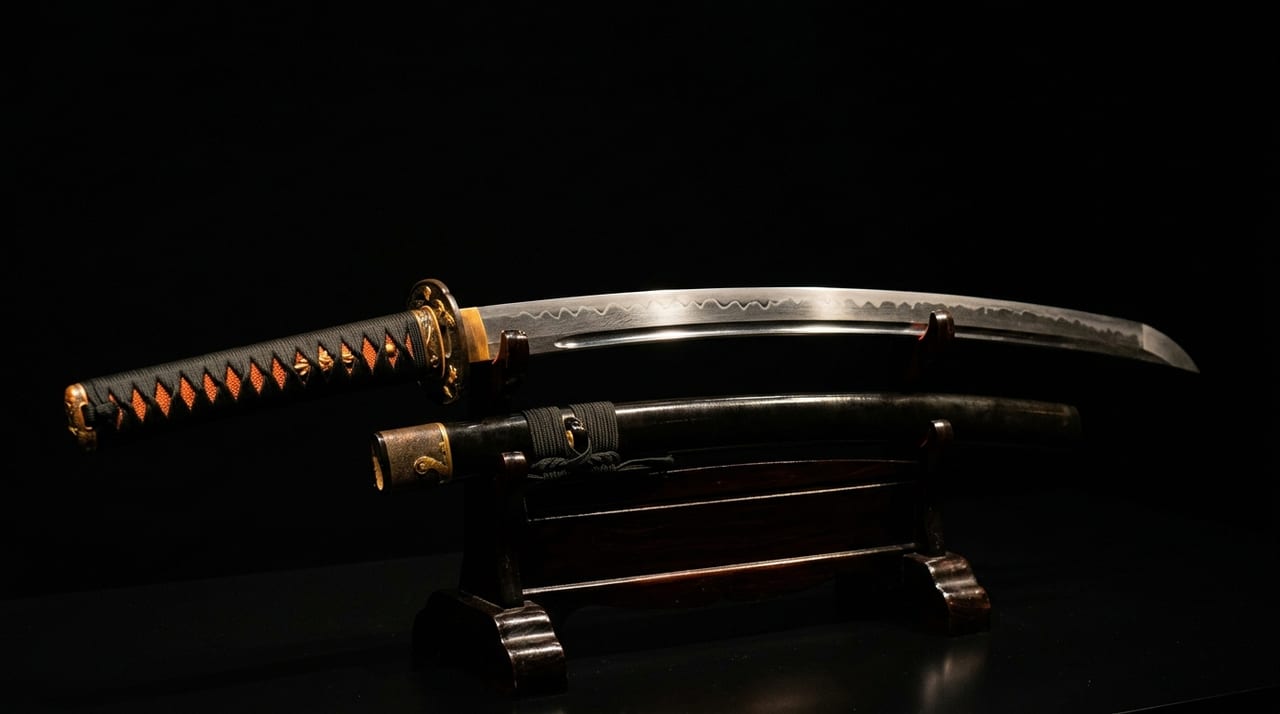 * Image is for illustrative purposes only.
Table of Contents
Can Tamahagane Be Used As-Is?
Tamahagane is steel produced by tatara smelting and intended exclusively for nihontō, but in the state it comes directly from the smelting furnace it cannot be used for sword-making. Tamahagane has three problems: uneven carbon distribution, contamination by slag (non-metallic inclusions), and coarsening of the metal structure. Only after passing through a "material refining" process — also called "oroshi-tetsu (oroshi iron)" or "tatara-naoshi" — by which the tōshō resolves these issues can work proceed to forging the blade.
Tamahagane as a Product of tatara Smelting
In tatara smelting, air is blown into the "tatara furnace" — in which iron sand and charcoal are stacked in alternating layers — using a foot bellows (tatara fuigo), and an iron mass (kera) is produced over about three days of operation. Tamahagane is the product of dividing and sorting this kera.
The carbon content of tamahagane varies across a range of approximately 0.5–1.5%, and even within a single mass the carbon distribution is not uniform. Portions with higher carbon content (closer to white iron or pig iron) are hard and brittle, while portions with lower carbon (closer to wrought iron) are soft but lack cutting sharpness. The tōkō's mission is to produce, from this heterogeneous material, a homogeneous steel with an ideal carbon content (around 0.6–1.0%).
The Oroshi-tetsu Process in Practice
The first refining process the tōshō undertakes, "oroshi-tetsu (oroshi iron)," consists of the following steps.
- Sowari: The tamahagane mass is broken apart with a hammer and the carbon content is estimated visually from the color of the cross-section. A silvery-white, lustrous surface indicates high carbon (a kawagane candidate); a dark grey surface indicates low carbon (a shingane candidate). This "discerning eye" is a skill that can only be acquired through years to over a decade of apprenticeship, and it embodies experiential knowledge that cannot be replaced by modern chemical analysis instruments.
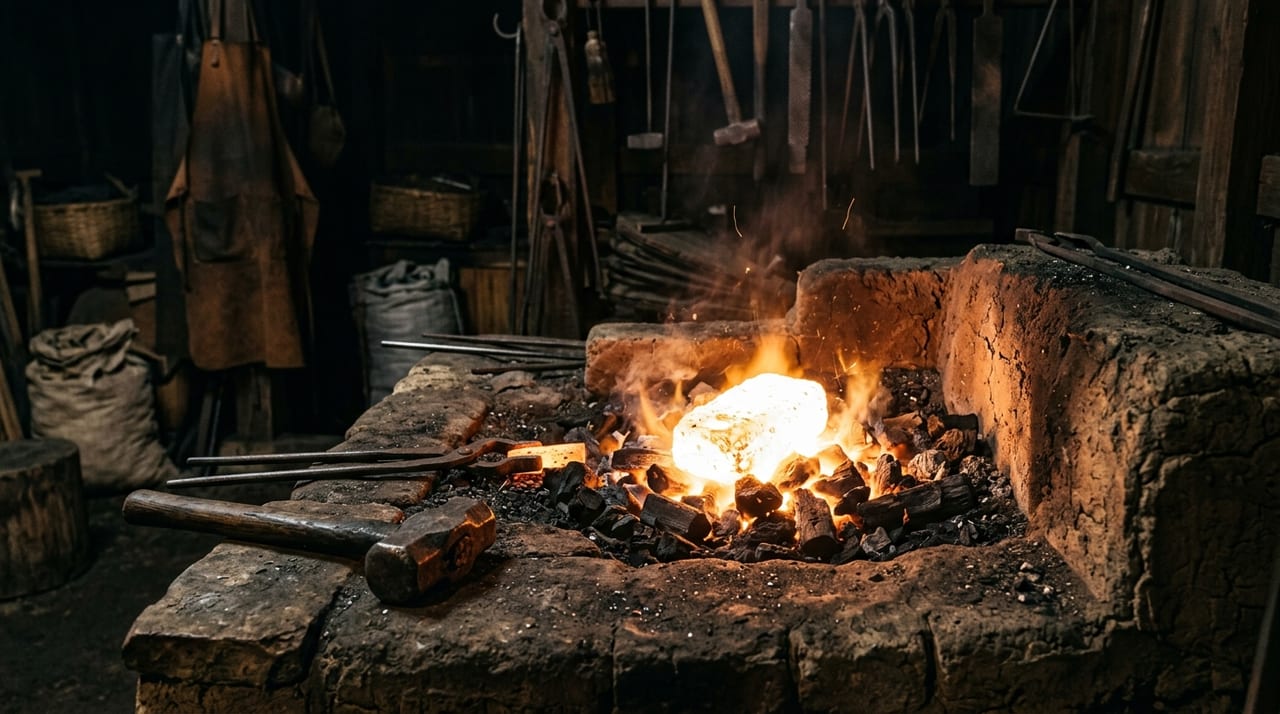
- Tsumiwakashi: The fragmented tamahagane pieces are stacked on the iron bed (material platform) over the furnace and heated to a white-hot state ("boiling") at a high temperature of around 1,200–1,300°C. At this stage, slag liquefies and begins to rise to the surface of the steel. Because overheating causes carbon to burn away, temperature control (judging the fire color) is critically important.
- Hammering and exfoliation (hakuraku): The tamahagane in its white-hot state is brought out onto the anvil and struck hard with a large hammer. Liquid slag is scattered and expelled along with yellow sparks ("hibana," sending sparks flying). The purity of the steel increases with each repetition of this process. The amount of slag expelled in a single hammering is small, but the cleanup progresses cumulatively through repetition.
- Initial stage of orikaeshi tanren: The steel that has been hammered and drawn out is folded over, and the cycle of reheating and tanren (forging) is repeated approximately 5–8 times. In this process, homogenization (diffusion) of carbon is promoted and refinement (recrystallization) of the metal structure proceeds. "Oroshi-tetsu" often refers to the entire refining process including this initial-stage orikaeshi tanren.
Sorting of Kawagane and Shingane
An important part of the refining process is the "sorting" by carbon content.
| Item | Kawagane (jacket steel) | Shingane (core steel) |
|---|---|---|
| Carbon content | Relatively high (around 0.6–1.0%) | Low (around 0.1–0.4%) |
| Role | Forms the surface (jacket) of the blade | Forms the core (heart) of the blade |
| Characteristics | Hardened by yaki-ire (quenching), it possesses the hardness and wear resistance needed to form the cutting edge | Rich in flexibility, it gives the blade tenacity and toughness. Functions as a "buffer" to realize a blade that does not break easily |
This combination of kawagane and shingane is the secret behind realizing the nihontō's seemingly incompatible characteristics of being "hard yet resistant to breaking." High carbon content makes steel hard but brittle; low carbon content gives it tenacity but leaves it soft — the core of nihontō kaji technique lies in resolving this contradiction by combining materials in layers.
The Refining Principle as Seen from Modern Metallurgy
From the perspective of modern materials science, the oroshi-tetsu process is a combination of the following phenomena.
- Deoxidation and deslagging: High-temperature heating causes oxide-type inclusions such as FeO and SiO₂ to liquefy, and they are expelled to the surface by the impact of forging (deoxidation reactions and flotation separation).
- Homogenization of carbon: Diffusion at high temperatures (the solid diffusion coefficient D is an exponential function of temperature) eliminates the boundaries between high- and low-carbon zones. The tōshō's rule of thumb to "heat sufficiently until it boils" aligns with the thermodynamic requirement of securing the time needed for diffusion.
- Recrystallization and refinement of crystal grains: The combination of repeated forging (deformation processing) and reheating refines the crystal grains, yielding more homogeneous and tough material properties.
The fact that the "boil, hammer, fold" cycle that craftsmen established empirically hundreds of years ago corresponds precisely to modern physical chemistry theory is a fine example of the intellectual depth of traditional craft.
Material Management Determines Sword Quality
The tamahagane refining process fundamentally determines the quality of the finished blade. No matter how excellent a tōshō's kaji technique and yaki-ire (quenching) technique may be, if the refining of the material is inadequate, defects such as "rough jigane," "disturbed hamon," and "quench cracking" will occur. In the appraisal of nihontō, being evaluated as having "good jigane" is one of the highest compliments, and it is something that can only be achieved through the careful accumulation of work from the material refining stage onward.