The World of Tōsu — The Craft Culture of Small Blades Continuing from the Nara and Heian Periods
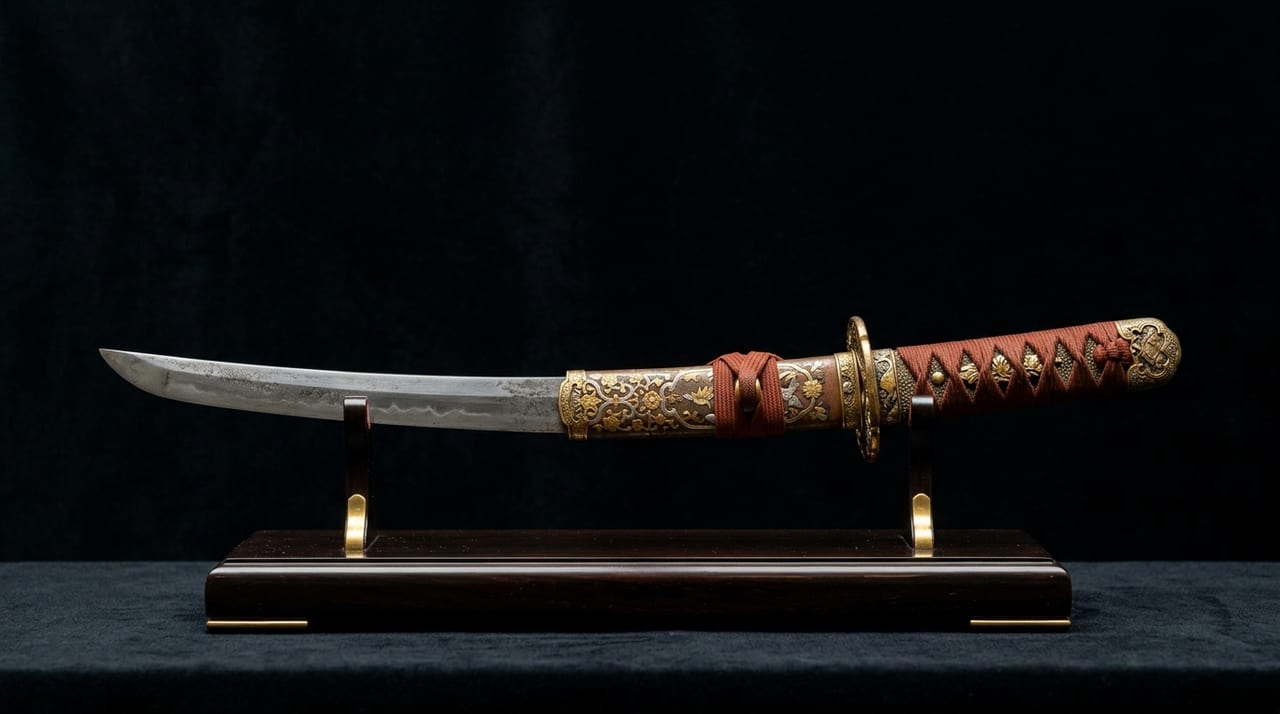 * Image is for illustrative purposes only.
Table of Contents
What Is a Tōsu — One Form of the Japanese Sword's "Ancestor"
The tōsu is a collective term for small blades with blade lengths of roughly 10 cm to 30 cm. The word derives from the Chinese dāozi, and both the concept and the physical objects, introduced from the continent before the Nara period, took root in Japan. It is thought that knowledge came first through Chinese texts, and that manufacturing techniques were later transmitted along with the import of actual objects.
Under the ritsuryo legal system of the Nara period (710–784), the tōsu was recognized as an official personal item that nobles and government officials were permitted to carry. While the tachi was a large sword for military purposes, the tōsu was regarded as a multipurpose practical tool for uses such as the following.
- Writing (scraping documents)
- Eating (cutting food)
- Medical use (surgical procedures)
The breadth of its functions is considered one of the reasons the tōsu became established in court culture over a long period.
A word often confused with tōsu is "kogatana." In present-day Japanese, "kogatana" is used as a general term for blades with short cutting edges, but some hold that tracing its origins leads back to the practical qualities of the tōsu — its portability and versatility. It is thought that even as the name changed over time, the function itself — "a small, easily portable blade" — was continuously passed down.
The Use of the Tōsu in the Heian Court — An Everyday Tool of the Literary Aristocracy
As the Heian period (794–1185) began, the tōsu became deeply embedded in court culture. In Heian literature such as The Pillow Book and The Tale of Genji, there are passages in which the tōsu appears as an everyday tool of the aristocracy. In this era when writing and books were also a foundation of power, the tōsu functioned as a cultural accessory that transcended being a mere blade.
Particularly important uses included "kezuri" — working thin slices of bamboo or wood to create kezuri-bana (decorative shavings) and other items — and cutting ryōshi (paper for writing). In the Heian court, where manuscript culture flourished, the tōsu was so familiar a tool that it was kept on hand at the desk as "a kind of writing implement." The sight of a tōsu laid out alongside a brush, inkstone, and ryōshi can be said to have symbolized the daily life of the intellectual of that time.
In court ceremonies, the carrying of the tōsu is recorded under names such as "mihakashi" and "mitono," and the materials for the tsuka (hilt) and saya (scabbard) were strictly prescribed according to rank. The fact that differences in materials themselves served to make rank visible demonstrates that the tōsu held symbolic meaning beyond its practical use.
The practical tasks the tōsu served were wide-ranging.
- In writing, it was used as a tool to scrape away letters written incorrectly in ink by thinly shaving the paper itself.
- At meals, it was used as a small knife for cutting fruit and dried foods.
- Use in medical contexts has also been recorded.
This character as an all-purpose blade is considered one of the reasons it became so widely established within the court.
The Craft Development of the Tōsu — Inheritance from the Shōsōin
In the Shōsōin of the Nara period, several tōsu decorated with gold and silver are preserved. Examples such as the urushi-saya tōsu (lacquered-saya tōsu) and the kingin hyōmon-saya tōsu (gold-and-silver hyōmon-saya tōsu) clearly demonstrate that the tōsu of the time functioned not merely as practical objects but as "craft works" and "prestige goods."
The techniques used in these Shōsōin tōsu — lacquering, gold-and-silver zōgan (inlay), and arabesque carving — were passed down into the koshirae (mounting) of swords in the Heian and Kamakura periods, becoming one of the origins of Japanese metalwork and lacquerwork. The process by which continental-derived designs merged with Japanese sensibility is clearly inscribed in the Shōsōin tōsu.
The hyōmon seen in the name "kingin hyōmon-saya tōsu" is a technique in which thin sheets of gold or silver are cut into the shapes of patterns, applied onto a lacquer ground, and finished by togi (polishing). The fact that this labor-intensive and sophisticated decorative technique was used without restraint even on small, portable tōsu speaks to the high esteem in which craft was held at the time.
The Relationship Between the Tōsu and the Japanese Sword — The Transition from Straight Blade to Curved Blade
The tōsu is also an important presence when considering the evolution of Japanese sword shapes. The tōsu and tachi of the Nara period were both "chokutō" — a straight form in which the blade had no sori (curvature) — but from the mid-Heian period (around the 10th century), sori began to appear in blades, and the "wantō" (curved sword), close in shape to the modern Japanese sword, was born.
Behind this change in shape were, it is said, the ease of handling in mounted combat and changes in Japan's terrain and methods of fighting. When one considers swift drawing and cutting strikes on horseback, it is self-evident that a blade with sori is rational. The fact that similar sori came to be seen even in small blades such as the tōsu tells us that the wave of shape evolution spread across all swords regardless of size.
Regarding the factors behind the emergence of sori in blades, multiple elements have been pointed out — including advances in forging technique and changes in purpose of use — and it is held that this cannot be reduced to a single cause. In any case, the fact that the design of sori spread even to the small tool that was the tōsu confirms that the sword makers of the time paid keen attention to the form of the blade itself.
The Place of the Tōsu in the Modern Era
Today, the tōsu is once again drawing attention among sword enthusiasts as a "precursor of the Japanese sword." At the Japanese Sword Museum and national museums, tōsu from the Shōsōin and excavated from ancient burial mounds are sometimes featured in special exhibitions, and they have become indispensable for tracing the roots of Japanese sword culture. As physical materials connecting antiquity and the present, they are also of high academic value.
Among present-day sword smiths, there are also craftsmen who undertake the making of tōsu as an attempt to research and reconstruct the techniques of the Nara and Heian periods, and valuable practice continues from the perspective of ancient sword research. By reproducing past techniques with present-day hands, manufacturing insights that cannot be clarified from documents alone are being accumulated.
How Is the Tōsu Treated in the Current Sword Market?
Most tōsu were made as practical objects that are mumei (unsigned) — bearing no mei (signature) of a tōkō (swordsmith) — and in this respect they differ in character from the framework of appreciation and appraisal of Japanese swords, which places great importance on mei and form. The majority of surviving old tōsu are preserved as holdings of art museums and museums, and opportunities for them to circulate in the antique art market where individuals can acquire them are limited. For readers who wish to deepen their appreciation of swords, first confirming the texture and design of actual objects at museum exhibitions can be said to be the most reliable entry point for understanding the craft culture that is the tōsu.