Oroshigane and Refining Techniques — The Science of Impurity Removal and Carbon Homogenization in tamahagane
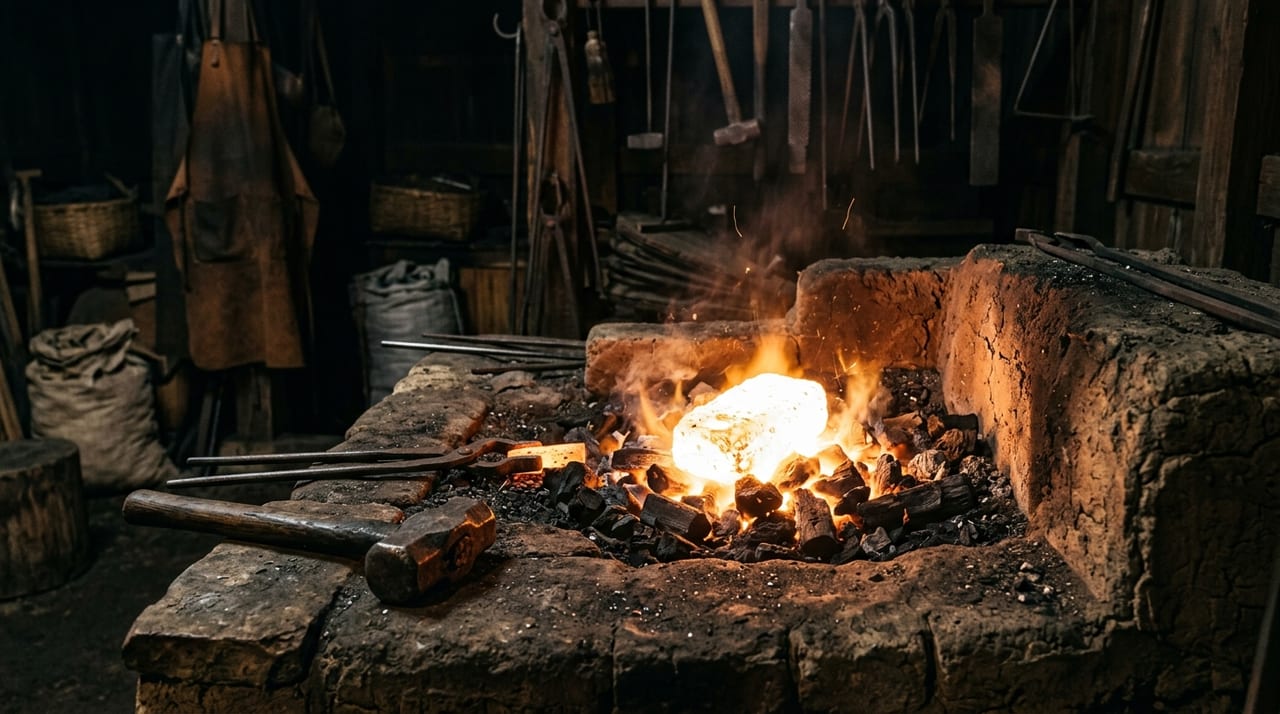 * Image is for illustrative purposes only.
Table of Contents
What Is Oroshigane?
Oroshigane refers to the process in which the tōshō reheats tamahagane — produced through tatara smelting — in a forge, performing "rough loosening and refining forging" as a preliminary step before orikaeshi tanren (folding). The word "orosu" carries the nuance of "preparing a material into a workable state," and through this process the slag (non-metallic inclusions), excess carbon, and inhomogeneous portions contained in the tamahagane are discharged and homogenized.
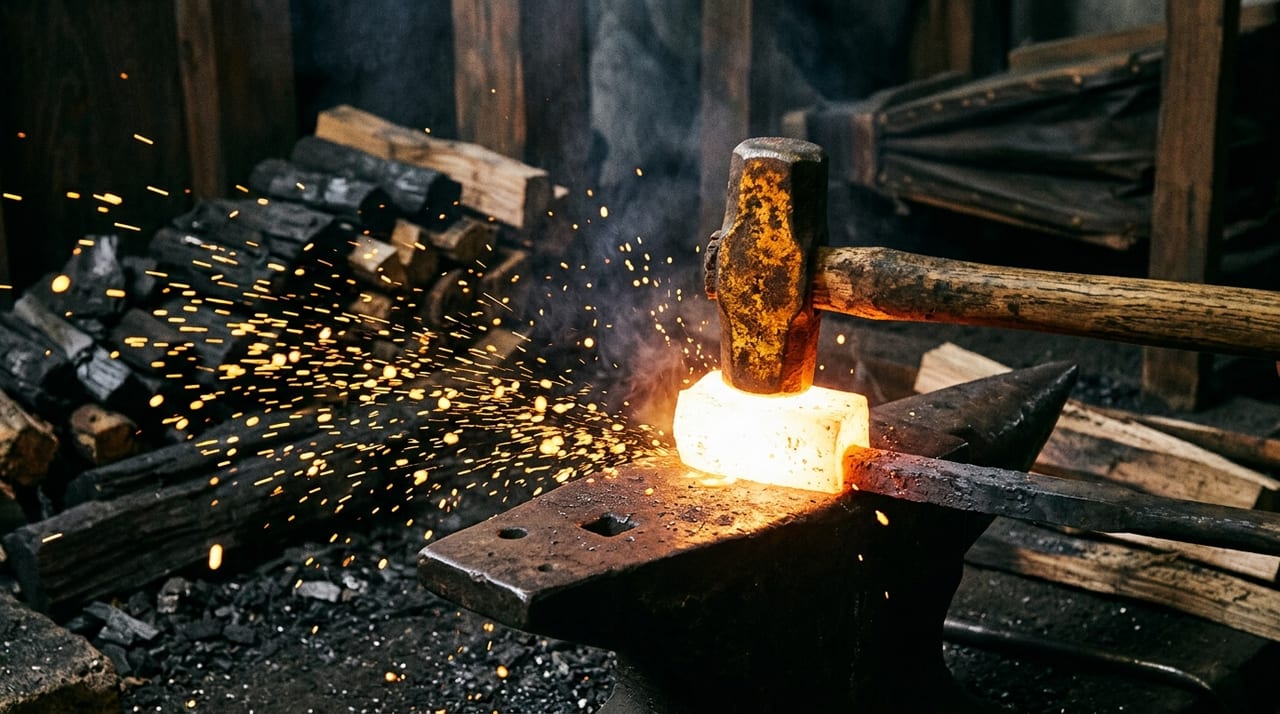
Although tamahagane is a product of tatara smelting, in its as-produced state its carbon content (which varies across a range of 0.5–1.5%), slag distribution, and structural homogeneity are not necessarily in a condition suited to sword making. The oroshigane process is a highly technical and scientific refining operation undertaken to resolve these problems.
Problems with tamahagane and the Necessity of Refining
tamahagane obtained through tatara smelting presents the following challenges.
- Slag contamination: During the smelting process, sand from the furnace walls and iron oxides are incorporated into the steel, dispersing as non-metallic inclusions (slag). If this slag remains, it causes roughness in the jigane of the finished blade and, in the worst cases, edge chipping (hagire).
- Variation in carbon content: Even within a single piece of tamahagane, carbon content differs from place to place. High-carbon areas (above 1.5%, close to pig iron) and low-carbon areas (below 0.3%, close to soft iron) coexist. Forging a blade from such inhomogeneous material results in an uneven hardness distribution after yaki-ire (quenching), raising the risk of hamon irregularities and fracture.
- Grain coarsening: After tatara smelting, the iron crystal grains in the tamahagane are in a coarsened state. Forging with coarse crystal grains cannot produce a homogeneous blade structure.
The Actual Oroshigane Process
The oroshigane process carried out by the tōshō consists of the following steps.
- Sowari (splitting): The block of tamahagane is broken into small pieces and the carbon content is assessed visually. If the fracture surface shows a lustrous "white brightness," it is judged empirically to be high-carbon (close to pig iron); if dark grey, low-carbon (close to soft iron). This expert assessment sorts the material into high-carbon stock (for kawagane) and low-carbon stock (for shingane).
- Tsumiwakashi (stacked heating): The fragmented pieces of tamahagane are stacked on top of one another in the forge and heated at high temperature (approximately 1,200–1,300°C) — heated until reaching an incandescent state. At this stage, carbon begins to redistribute within the steel and the slag liquefies from the heat and rises to the surface.
- Hammering down: The heated tamahagane is taken to the anvil and vigorously hammered flat with a large mallet. The impact causes the liquefied slag to scatter and be expelled. The yellow particles that fly along with the sparks (hibana) are the slag, and by repeating this step the purity of the steel rises.
- Orikaeshi tanren (first few cycles): The steel that has been hammered and elongated is folded over, and the cycle of reheating and tanren is repeated. These initial cycles of orikaeshi tanren are the stage that maximizes the refining effect of oroshigane, and carbon homogenization advances rapidly.
The Principles of Oroshigane from a Modern Metallurgical Perspective
Organized from the perspective of modern metallurgy, the phenomena occurring in oroshigane are as follows.
- Slag expulsion (deoxidation and inclusion removal): Heating at high temperature causes slag components (primarily oxide-based inclusions such as FeO, SiO₂, and MnO) to become low-viscosity liquids that rise readily to the surface of the steel. The impact of hammer blows (forging) acts as an additional force pushing the slag to the surface. This corresponds to the "degassing and inclusion removal treatment" of modern steelmaking.
- Carbon homogenization (homogenizing diffusion): Holding at high temperature (the heating step) promotes diffusion of carbon atoms. The boundaries between high-carbon and low-carbon areas are gradually eliminated and the carbon distribution approaches homogeneity. Both time and temperature are important for this homogenization, and the tōshō's empirical rule of "heating sufficiently" corresponds precisely to the physical requirements of diffusion.
- Grain refinement (recrystallization): Repeated forging at high temperature breaks up the coarse crystal grains and promotes "recrystallization" during the subsequent cooling process. The fine crystal grains formed by recrystallization yield more homogeneous and tougher material properties.
The Intersection of the Tōshō's Empirical Knowledge and Science
The "hiiro (fire-color) judgment" — the skill of reading the color of the steel to determine temperature — that the tōshō relies upon during the oroshigane process is grounded in the physics of blackbody radiation. The progression from dark red (approximately 600°C) through orange and yellow (900–1,100°C) to incandescence (above 1,200°C) exploits the phenomenon whereby the radiant brightness of steel changes with temperature. The fact that centuries of accumulated craftsman's empirical knowledge corresponds precisely to the theories of modern physics is an excellent example demonstrating the scientific rationality of traditional crafts.
While the oroshigane process may appear to be nothing more than vigorous hammering and scattering sparks, its essence is "a refining and purification chemical reaction that converts inhomogeneous material into homogeneous material." Only after passing through this process does tamahagane attain a state befitting the material for a blade body, enabling the subsequent processes of orikaeshi tanren, hi-zukuri, and yaki-ire (quenching) to exert their true effect. It is no exaggeration to say that the quality of the nihontō is largely determined by the precision of the oroshigane. Please check the listing of swords currently for sale.