Swordsmiths of the Sengoku Era: The Reality of Blacksmiths Living Between Mass Production and Masterpieces
 * Image is for illustrative purposes only.
Table of Contents
The Sengoku Period: A Harsh Era of "Explosive Demand"
Following the Onin War (1467–1477), which engulfed all of Japan in conflict, demand for swords reached unprecedented heights. The daimyo of various regions needed massive quantities of weapons to feed their troops and send them into battle. At the heart of this demand were two types of swords: the uchigatana and wakizashi.
The swordsmiths of this era had to meet two conflicting demands. On one hand, there was demand for mass-producing swords to be used and discarded on the battlefield, and on the other, demand from daimyo and samurai generals for "finest-quality masterwork swords" as symbols of their status.
This article explores how swordsmiths of the Sengoku period lived and worked amidst this polarized demand.
The Era of "Kazuuchimono" (Mass-Produced Swords)
What surged during the Sengoku period were swords called "kazuuchimono"—mass-produced blades. These were artisanal mass-production items; individual swordsmith names rarely appeared as maker's marks, and quality was standardized at a consistent level.
It should be noted that swords were not the star of the Sengoku battlefield. The primary weapons in warfare were spears, naginata, bows and arrows, and firearms; swords played a supporting role, primarily in close-quarters combat when grappling with enemies or in finishing strikes to behead an enemy commander. The demand for large quantities of kazuuchimono reflected their aspect as "practical cutting tools as consumables."
The Production System for Kazuuchimono
Seki in Mino Province (present-day Gifu Prefecture) became the largest sword-producing center during the Sengoku period. Seki's smiths established a division-of-labor system, creating a production system in which specialized craftsmen divided the work processes.
- Blade roughing
- Edge sharpening
- Polishing
- Handle wrapping
Through this division of labor, a single workshop could produce several swords per day.
According to modern estimates, the Seki swordsmith collective (Seki-kaji) produced over 100,000 swords per year at its peak. This equals the scale of modern industrial production, demonstrating how much of the Sengoku period's economic power was concentrated in the sword industry.
The Mass-Production System of Bizen Osafune
Osafune in Bizen Province (present-day Okayama Prefecture) was likewise a major mass-production center alongside Seki. Osafune, heir to a tradition of Bizen smithcraft that continued from the Muromachi period, expanded its workshop scale during the Sengoku era to meet large orders from daimyo (such as "orders for one hundred swords").
However, Osafune's kazuuchimono maintained higher quality standards than Seki's, and even within "mass production," the craftsmen's technical skill was preserved. Among surviving Bizen Osafune kazuuchimono, not a few are rated by authentication authorities even 200–300 years later as "preserved sword" class.
The Lineage of Master Smiths: Masterpieces Blooming in the Era of Mass Production
Even as mass production dominated the Sengoku period, there were master smiths who produced outstanding works under the patronage of particular daimyo and wealthy samurai generals.
Magoroku Kanemoto—The Pinnacle of Mino Seki
The master smith most representative of Sengoku-period Seki was "Magoroku Kanemoto" (second generation). Magoroku Kanemoto's swords were known for a distinctive hamon pattern called "sanbon-sugi" (three-tree pattern) and were among the most beloved blades of Sengoku warlords. Kanemoto was a swordsmith based in Mino Akasaka (present-day Ogaki City), and "Seki's Magonroku" became a nickname that spread in later generations.
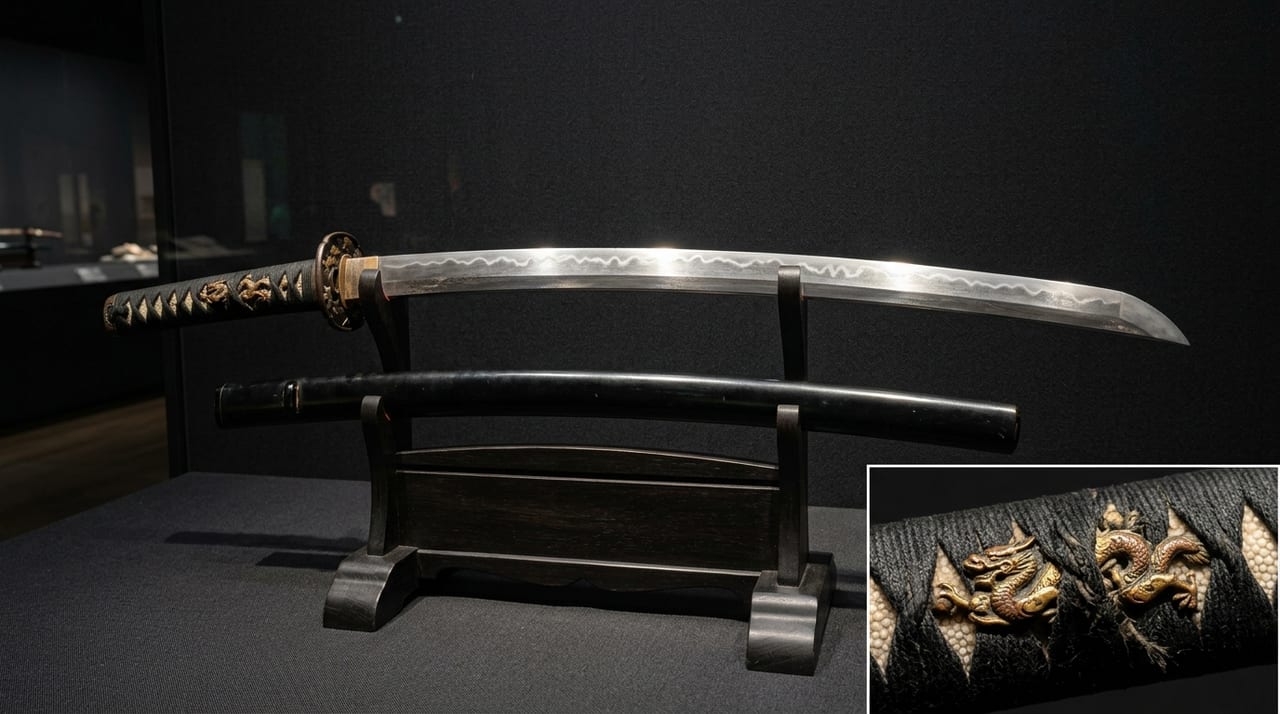
The sanbon-sugi hamon features a distinctive pattern of gunome arranged in sets of three, combining visual beauty with practical cutting sharpness. Renowned warlords such as Uesugi Kenshin, Takeda Shingen, and Oda Nobunaga reportedly favored Kanemoto's blades, and the name "Seki's Magonroku" resounded throughout the land during the Sengoku period.
Today, Kanemoto's name continues to be used as a brand for the cutlery industry in Seki, Gifu Prefecture, demonstrating the magnitude of cultural legacy left by this master smith of the Sengoku period.
Kanesada—The Master Smith Known by the Alias "Nosada"
The second-generation Kanesada was a master smith of the Mino-den tradition known by the alias "Nosada." His swords exemplified the highest standard of "Mino-mono," praised for their keen edges and elegant form.
Records show that culturally refined warlords of the Sengoku to early Edo period—such as Hosokawa Fujitaka (Yusai), Akechi Mitsuhide, and Maeda Toshiie—favored Kanesada's blades. There is a tradition that the blade Akechi Mitsuhide used in the Honnō-ji Incident was made by Kanesada, and such historical episodes abound.
Osafune Norimitsu—A Master Among Bizen's Mass Producers
Norimitsu, a swordsmith of Bizen Osafune who flourished in the late Muromachi period (late Bizen), was renowned as a master smith who maintained high individual technical standards even within a mass-production system. Extant blades bearing the date 1472 (Bunmei 4) have been confirmed, and as a representative of late Bizen, he served as a model for later generations of Bizen smiths. It should be noted that the representative smiths of "Oei Bizen" include Yasumitsu, Morimitsu, and Moromitsu, and Norimitsu belonged to a later generation.
The Special Relationship Between Daimyo and Swordsmiths: "Okakae-Touko" (Retained Smiths)
Some Sengoku daimyo retained particular skilled swordsmiths as "okakae-touko" (retained smiths) exclusively for their domain. This system guaranteed the smiths stable income and status in exchange for priority supply to the feudal lord and prevention of secret techniques from leaking outside.
Satsuma Domain and the Naminohira School
The Satsuma Domain (Shimazu house) protected Naminohira-school swordsmiths over many years. Naminohira-kaji blades bearing the Shimazu family crest became a symbol of Satsuma warriors, and combined with the Satsuma Jigen-ryu sword technique, became known throughout the land as "Satsuma swords."
The Uesugi House and Echigo Swordsmiths
The Uesugi house of Echigo (present-day Niigata Prefecture), known for Uesugi Kenshin, also possessed its own group of swordsmiths. Kenshin is said to have had deep interest in swords and cherished the masterwork blade he used in the Battle of Kawanakajima against Takeda Shingen. Echigo-kaji technique possessed a unique quality of jihada (steel grain structure) distinct from that of Seki and Bizen.
Changes in Sword Shape Demanded by Practical Warfare Use
What Sengoku-period swordsmiths faced most seriously was the functional demand for "swords capable of withstanding real combat." The shapes of swords from this era directly reflected practical warfare experience.
Changes Toward "Wide-Bladed" Uchigata
"Deeply curved, slender tachi" that were common among the masterwork blades of the Kamakura and Nanboku-cho periods were suited to attacks delivered by mounted samurai from horseback. However, in the close-quarters combat of infantry (ashigaru) that became dominant in the Sengoku period, uchigatana with "broader blades and center of gravity closer to the tip" proved more effective. Tachi and uchigatana had the following differences:
| Aspect | Tachi | Uchigata |
|---|---|---|
| Shape | Deeply curved, slender | Broad blade, center of gravity closer to tip |
| Length | 2 shaku 5 sun (approx. 75 cm) or more | 2 shaku 3 sun to 2 shaku 4 sun (approx. 70–73 cm) |
| Carrying method | Suspended from waist with edge facing down (haiyo) | Worn on sash with edge facing up (taito) |
The difference in length accommodated close-quarters combat in confined spaces (indoor combat, mountain warfare). Additionally, the difference in carrying method directly affected draw speed; the uchigatana's "iai-nuki-like" action of drawing and immediately striking simultaneously gave a decisive advantage in dense infantry combat.
The Expansion of "Yakihaba" (Hardening Width)
Swords with broad "yakihaba" (wide hardened zones) also increased during the Sengoku period. The wider the yakihaba, the larger the quenched zone at the edge, improving sharpness, but also increasing the risk of breakage. Sengoku-period swordsmiths confronted this tradeoff between strength and sharpness by mobilizing all available techniques: selection of iron sand, management of charcoal composition, and control of quenching temperature.
What Sengoku-Period Swordsmiths Left Behind
The Sengoku period was an era in which mass production and practical application of Japanese swords advanced. Among these, the works left by some master smiths continue to receive high evaluation in modern sword authentication.
Furthermore, the division-of-labor production system established in production centers like Seki and Bizen became the foundation of the Edo-period sword industry and has been passed down to the modern cutlery industry (cutlery from Seki, Gifu Prefecture).
The figure of swordsmiths who continued creating masterpieces without succumbing to mass-production pressures embodies the pride of craftsmen and the spirit of mastery. The names of Magoroku Kanemoto, Kanesada, Norimitsu, and others are still recounted among sword enthusiasts 500 years later, and the memory of the iron they forged lives on.