The Difference Between Shinken and Replica Swords: A Thorough Comparison of Materials, Manufacturing Methods, and Legal Status
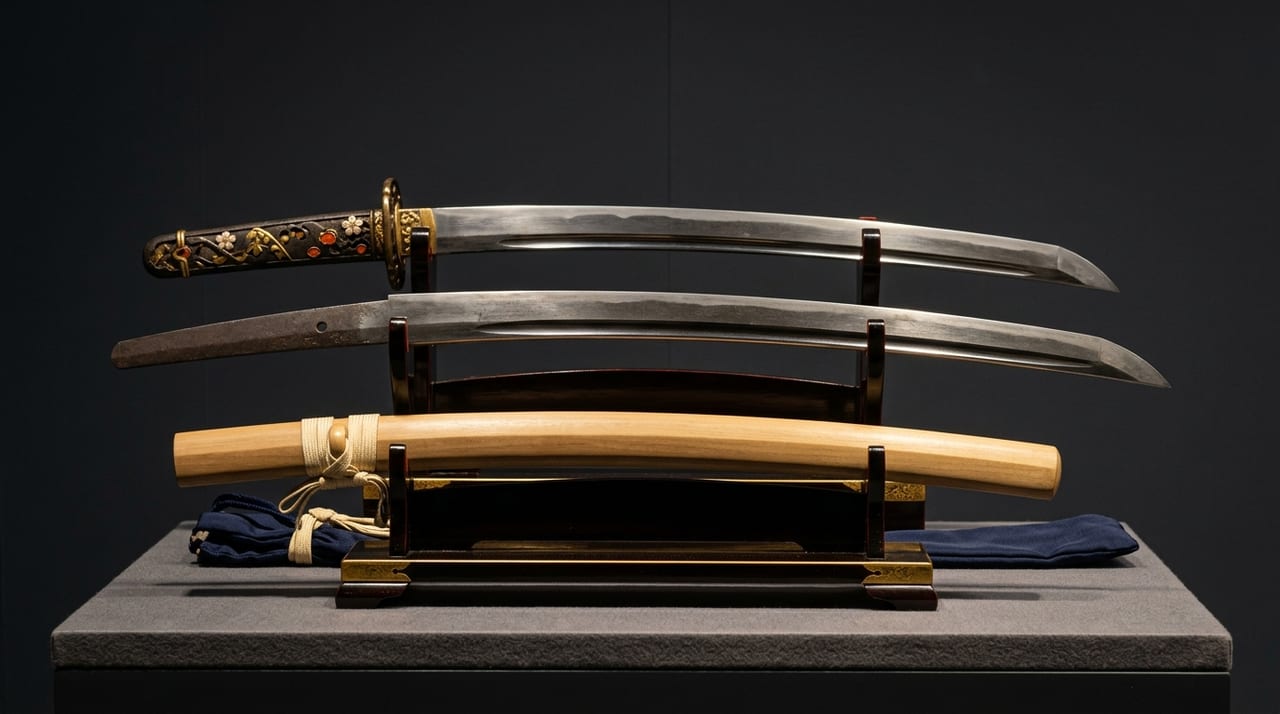 * Image is for illustrative purposes only.
Table of Contents
The Boundary Between "A Real Sword" and "Everything Else"
One of the first questions anyone who takes an interest in nihontō encounters is: "What is the difference between a shinken and a mozo-tō (replica sword)?" From the "Japanese-sword-style ornaments" sold in tourist souvenir shops, to the iaito used in martial arts practice, to "genuine nihontō with a kanteisho (appraisal certificate)" — all of these are "objects in the shape of a sword," yet their materials, manufacturing methods, legal status, and prices are entirely different.
This article systematically organizes the differences among shinken, mozo-tō, and iaito from the perspectives of materials, manufacturing, price, and law.
The Definition of Shinken
"Shinken" refers to a nihontō fitted with a real, sharp blade. More precisely, it denotes a functional sword with cutting capability, produced by forging and yaki-ire (quenching) tamahagane — or equivalent carbon steel — obtained through tatara (traditional smelting).
In modern Japanese, the phrase "shinken ni" (earnestly/seriously) exists as an idiomatic expression meaning "to approach something wholeheartedly," derived precisely from the idea of "a sword with a real blade = something to be handled as though one's life depends on it."
Characteristics of Shinken
- Blade material: tamahagane or equivalent high-carbon steel (carbon content approximately 0.6–1.5%)
- Forging: the sword passes through a series of processes — rough shaping, hot forging, orikaeshi tanren (folding), tsuchioki (applying the clay coating), and yaki-ire (quenching)
- Hamon (temper line): the boundary of the actual hardened layer formed by yaki-ire (quenching). Present only on genuine shinken.
- Cutting capability: a properly polished shinken can easily cut bamboo, tatami omote, and wood.
- Registration certificate: to possess one within Japan, a firearms and swords registration certificate (issued by the prefectural Board of Education) is required.
The Definition and Types of Mozo-tō (Replica Swords)
"Mozo-tō" broadly refers to all products that imitate swords, but in practice they are divided into finer categories.
1. Tourist and Interior Decorative Replica Swords
"Japanese-sword-style ornaments" found in souvenir shops and online stores. The materials center on non-steel materials such as zinc alloy (die-cast), stainless steel, and aluminum. The blade is either unsharpened or has a very dull edge (not sharp). Prices range from several thousand to tens of thousands of yen.
Products of this kind do not pass through a forging process, so no metal hardened layer equivalent to a hamon exists; what appears to be a hamon is merely a pattern created on the surface through polishing, painting, or etching.
2. Iaito
Replica swords made for martial arts practice (iaidō and battōdō). The materials use actual metals such as manganese steel, stainless steel, and carbon steel, and the blade is finished as a "namakura (dull edge)" — the cutting edge is deliberately blunted, though the material itself is hard.
An iaito does not have a real blade, but the weight balance, length, and sori angle of the blade are made to specifications close to a genuine shinken, making it suitable for iai kata practice and sword-drawing practice. Prices range from approximately 20,000–150,000 yen.
The tsuba (hand guard), tsuka (hilt), and saya (scabbard) share the same construction as a genuine shinken, but the blade itself is often a single-piece steel formed without a forging process.
3. Mogi-tō and Assembly Kits
Replica swords using metal blades without an edge, intended for martial arts performances, film, and drama production. They are designed with an even greater emphasis on safety than iaito, and many products are "completely blunt" with no sharpening of the blade portion whatsoever.
4. Bokutō and Shinai
Because the material is wood or bamboo, they are treated legally not as swords but as "woodcraft" or "sporting goods." They are widely used in basic practice and kata practice in kendo and iai.
Comparison of Materials and Manufacturing Methods
| Item | Shinken | Iaito (replica sword) | Tourist replica |
|---|---|---|---|
| Material | Tamahagane / high-carbon steel | Manganese steel / stainless steel | Zinc alloy / aluminum, etc. |
| Manufacturing | Forging + yaki-ire (quenching) | Machine forming or no forging | Die-casting / polishing |
| Hamon | Genuine (boundary of hardened layer) | None (paint / pattern only) | None (decorative only) |
| Cutting capability | High (varies by togi) | Low to none | None |
| Tōshō involvement | Required | Not required | Not required |
| Registration certificate | Required | Not required | Not required |
Differences in Legal Status — Relationship to the Jūtōhō
Legal Treatment of Shinken
To possess a shinken (a sword with a blade length of 15 cm or more) within Japan, a firearms and swords registration certificate is mandatory. This is "a document issued by the Board of Education that certifies lawful possession of a sword," and the possessor is required to file a notification each time ownership changes.
Possessing unregistered swords and other bladed weapons constitutes a violation of the Firearms and Swords Control Act (Jūtōhō), subject to imprisonment of up to three years or a fine of up to 500,000 yen (Article 3 and Article 31-16). Furthermore, bladed implements with a blade length exceeding 6 cm may not be carried except for business or other legitimate reasons (Article 22, Act for Controlling the Possession of Firearms or Swords and Other Such Weapons (Jūtōhō) (e-Gov Law Search)). A registration certificate is required even simply "to display at home."
Legal Treatment of Iaito and Mozo-tō
Blunt-edged iaito are in principle not classified as "swords" under the Jūtōhō (because they have no sharpened blade). However, mozo-tō made of metal that closely resemble swords are prohibited from being carried without business or other legitimate justification (Article 22-4).
While cases such as traveling to and from an iai dojo are widely recognized as "carrying for legitimate reasons," one should avoid carrying an iaito in public without purpose.
In the Case of Overseas Export
To export a shinken overseas, one must obtain an "export inspection certificate for antique art objects" from the Agency for Cultural Affairs, and return the registration certificate to the Board of Education of the prefecture where it was registered (Tokyo Metropolitan Board of Education, "When Exporting Firearms and Swords"). Mozo-tō and iaito, on the other hand, generally require no such procedures, but must comply with the laws and regulations of the destination country (the EU, Australia, and Canada in particular have strict regulations).
Comparison of Price Ranges
The price difference between shinken and mozo-tō is very large, depending on materials, craftsmanship, and rarity.
- Tourist replica swords: approximately 3,000–30,000 yen
- Iaito (mid-price range): approximately 20,000–150,000 yen
- Gendaitō (newly made shinken): 500,000 yen to several million yen or more
- Kotō and shintō (period shinken): depending on condition, mei (signature), and kanteisho (appraisal certificate), from several hundred thousand to tens of millions of yen
The reason gendaitō are expensive is that they reflect the time a tōkō invests (several months per sword), the cost of materials (tamahagane), tool costs, and workshop maintenance costs, in addition to the fact that the number that can be produced is practically limited. The Rules for the Approval of the Manufacture of Art Swords contain no provision for an annual cap on the number of swords (Rules for the Approval of the Manufacture of Art Swords (e-Gov Law Search)). However, the assessment criteria of each prefecture stipulate the minimum number of tanren (forging) days per sword (15 days or more for tachi, katana, and naginata; 10 days or more for wakizashi, tantō, and similar), which practically limits the number that can be produced (Aomori Prefecture, "Approval for the Manufacture of Art Swords" Assessment Criteria).
Selection Guide for Collectors and Beginners
If the Goal Is Martial Arts Practice
For practice in iaidō or battōdō, a quality iaito is sufficient. There is no need to purchase an expensive shinken from the outset. When transitioning to a shinken, however, follow the guidance of the dojo instructor and begin with obtaining a registration certificate.
If the Goal Is Interior Display or Collecting
If the purpose is purely decorative, a mozo-tō is sufficient; but if one wishes to possess and appreciate a genuine nihontō, purchasing a shinken with a registration certificate from a reputable sword dealer is strongly recommended.
If the Goal Is Investment or Asset Holding
Only shinken are relevant here. Works accompanied by an NBTHK kanteisho (appraisal certificate) (Hozon through Jūyō Tōken) in particular function as proof of asset value. Tourist replica swords and iaito have virtually no resale value.
Conclusion — The Meaning of Being "Genuine"
The difference between a shinken and a mozo-tō can sometimes be difficult to judge by appearance alone. However, the essential distinction lies in "whether it is a historical craft object born from human hands, fire, and steel."
A shinken carries within it the tōkō's skill, philosophy, and the spirit of its era, and its value holds a cultural and spiritual significance that transcends the weight and shape of the metal. For those who have developed an interest in nihontō, we recommend first visiting a reputable sword dealer or museum, and experiencing a genuine shinken firsthand — picking it up (where permitted) to feel it in one's hands.