Natural Whetstone Origins and Quarrying — Types of Whetstone, Quarry Sites in Kyoto and Across Japan, and How Togishi Choose Them
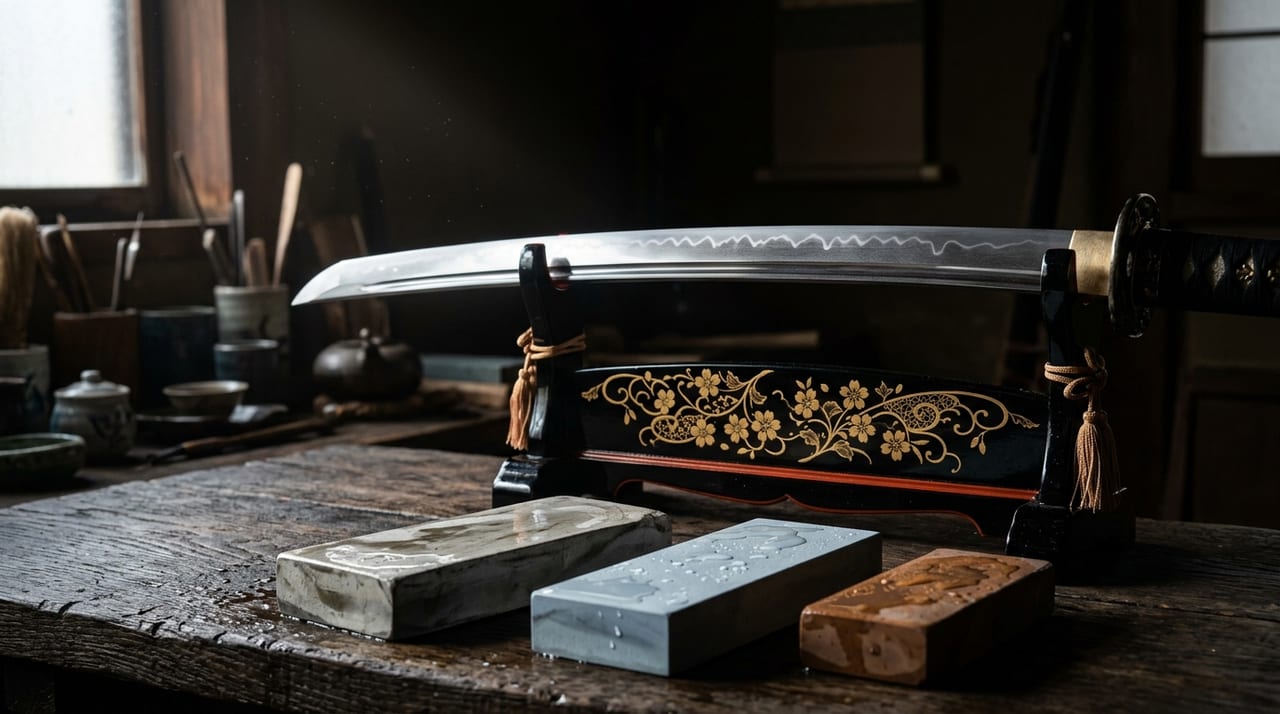 * Image is for illustrative purposes only.
Table of Contents
The Whetstone: Another Essential Material of the Nihontō
When discussing the nihontō, the manufacturing processes of tamahagane, forging, and yaki-ire tend to attract attention; yet it is the togishi who brings out the full appearance of the finished blade. And what supports the togishi's skill is the whetstone — the natural whetstone in particular.
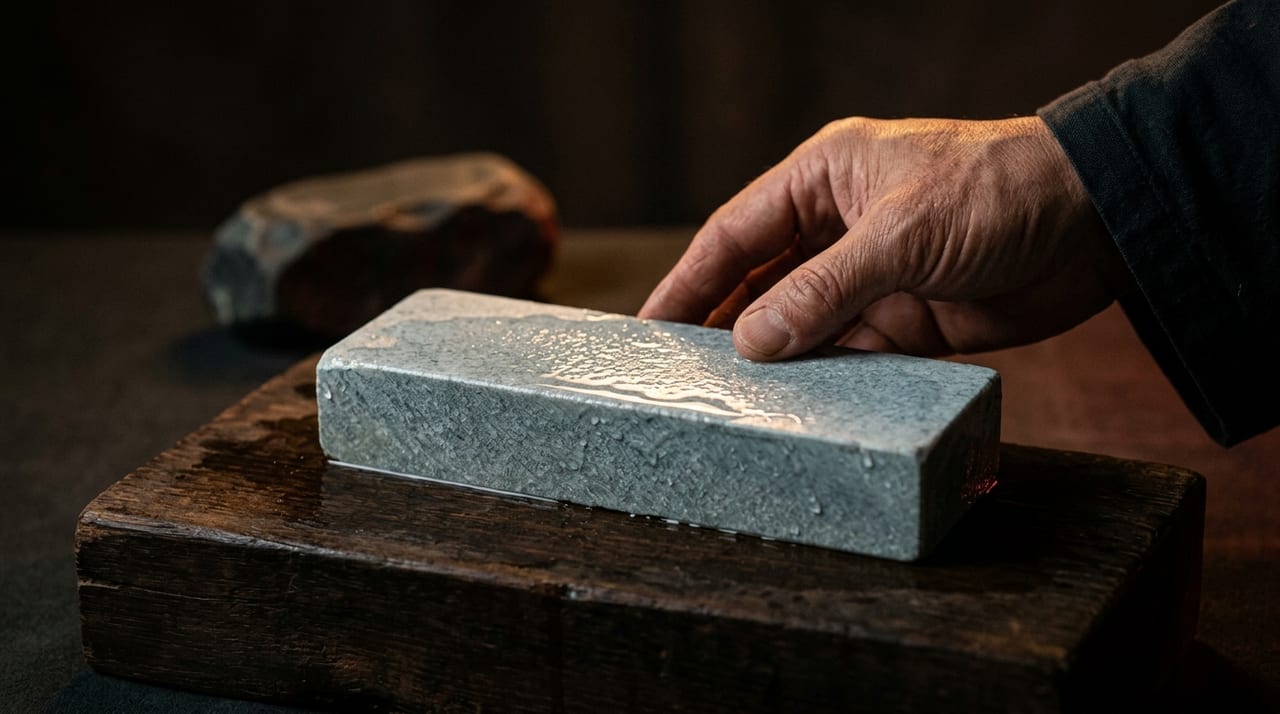
Natural whetstones are quarried rock cut to appropriate sizes, and their abrasive properties vary greatly depending on their origin, stratum, and grit number (coarseness). Natural whetstone sources are distributed throughout Japan, but Kameoka City, Kyoto Prefecture (the former province of Tanba) is known worldwide as the source of the finest-quality stones.
A togishi uses several different types of whetstone to finish a single blade, working through stages from rough togi to finishing togi. Because the quality of the whetstone determines the quality of the finished togi, selecting the right stone is as important to a togishi as the technical skill itself.
Origins and Types of Natural Whetstones
The following table summarizes the names, origins, characteristics, and uses of the major natural whetstones.
| Name | Origin | Characteristics and Use |
|---|---|---|
| Uchigumori-do | Kameoka City, Kyoto Prefecture (Chiyokawa district) | Hard crystalline schist (mica schist) or metamorphic quartz diorite. Used for finishing togi (shiagetogi), it draws out the working of the hamon — nie, nioi, kinsuji, and other features — better than any other stone |
| Nakayama-do | Umegatata, Kyoto, and Kameoka | Hard metamorphic rock. Ranked as the pinnacle of aito (finishing-grade stones); used for finishing togi rather than intermediate togi, it is suited to the final stage of the process |
| Nagura-do | Aichi Prefecture (Mikawa, Hourai district of Shinshiro City, and others) | During polishing, fine particles (nagura-doro) dissolve from the surface; rubbed onto other whetstones to produce a slurry (todoro) and used as a supplementary stone (jotogi) |
| Tanba-do | Nantan City, Kyoto Prefecture (adjacent to Kameoka) | A medium-grit stone with a good balance of hardness and fineness of abrasive grain. Used for intermediate togi to shape the blade after rough togi is complete |
| Amakusa-do | Amakusa region, Kumamoto Prefecture | A pottery-stone type, relatively coarse (equivalent to rough to medium grit). Widely used for rough grinding of bladed tools in general (kitchen knives, woodworking tools) rather than nihontō |
Uchigumori-do and Nakayama-do from Kyoto and Kameoka
The stones regarded as the finest in nihontō polishing are the uchigumori-do and nakayama-do produced in Kameoka City, Kyoto Prefecture (the former province of Tanba). These are hard crystalline schist (mica schist) or metamorphic quartz diorite whose abrasive particles are extremely uniform and fine, giving them ideal polishing properties for steel.
Uchigumori-do is the finishing whetstone used for the "shiagetogi" (finishing togi) of the nihontō, and togishi prize it as the stone that best draws out the working of the hamon — nie, nioi, kinsuji, and other features of the blade. Its source is concentrated in the Chiyokawa district of Kameoka City; quarrying continues today by a small number of operators, but high-quality stone becomes scarcer every year.
Nakayama-do, an aito (finishing-grade stone) from Umegatata, Kyoto, and Kameoka, is ranked as the pinnacle of finishing whetstones; it is used not for intermediate togi but for finishing togi, being suited to the final stage of the process.
Nagura-do (Nara, Nagura)
The nagura-do quarried in Aichi Prefecture (Mikawa, Hourai district of Shinshiro City, and others) has the property of releasing fine particles (nagura-doro) from its surface during polishing. These nagura-doro particles enter between the whetstone and the blade, enabling the stone to function as a supplementary stone (jotogi) that creates a uniform polishing surface.
Nagura-do is not used on its own; its primary use is to be rubbed with water onto another whetstone to produce a slurry called todoro, which assists in the polishing. A high-quality nagura-do becomes indispensable to the togishi as a "regulator of the whetstone."
Tanba-do (Nantan City, Kyoto Prefecture)
Tanba-do is a medium-grit whetstone suited to intermediate togi, quarried in the vicinity of Nantan City adjacent to Kameoka. Its good balance of hardness and fineness of abrasive grain makes it widely used in the intermediate stage of shaping the blade after rough togi is complete.
Because it is more affordable than uchigumori-do, it is also used for practice by togishi in training. However, since the finished result varies greatly depending on how it is combined with the higher-grade uchigumori-do, mastery is required to use it effectively.
Amakusa-do (Kumamoto, Amakusa)
Amakusa-do is a pottery-stone type whetstone produced in the Amakusa region of Kumamoto Prefecture, suited to relatively coarse grinding (equivalent to rough to medium grit). It is used more widely for the rough grinding of bladed tools in general (kitchen knives, woodworking tools) than for togi of the nihontō. Because it shares constituent materials with ceramics raw materials, it is known as a "dual-purpose source of ceramics and whetstones."
Comparison with Synthetic Whetstones
In recent years, synthetic whetstones made from compacted aluminum oxide (alundum) and silicon carbide (carborundum) have become widely available. Synthetic whetstones have uniform grit and stable abrasive power, making them highly efficient for rough and intermediate togi. However, for the final finishing of the nihontō, it is held that the natural variation among the fine abrasive particles in natural whetstones draws out the "scenery of the hamon," and natural whetstones are therefore considered indispensable for serious sword polishing.
Current State of Quarrying and the Problem of Increasing Scarcity
Quarrying of natural whetstones depends largely on manual labor by small-scale operators. The uchigumori-do quarrying regions of Kyoto reached their peak in the postwar period, but production has declined sharply due to the aging of quarry operators, lack of successors, and soaring extraction costs.
A single high-quality uchigumori-do stone (isseki) can reach anywhere from tens of thousands to hundreds of thousands of yen, and it is not uncommon for togishi to collect and store whetstones as "assets." Whetstones owned by retired togishi or sword enthusiasts sometimes come up at auction, creating an established market for whetstones.
As quarrying grows more difficult, sharing the skill of "appraising stone" between quarry operators and togishi has become an important challenge. Even within the same source area, polishing properties differ by stratum, orientation, and moisture content, so the judgments made at the quarry site determine the quality of the finished stone.
How Togishi Select and Store Whetstones
Appraising Stone
Togishi apply several criteria when selecting a whetstone.
- Color — for uchigumori-do, a uniform gray-white to pale blue is considered high quality; stones with striped patterns or black spots (kurouchi) may produce uneven polishing
- Hardness — a stone so hard that it does not crack may have low abrasive power and may not wear evenly
- Uniformity of the grinding surface — the cut face is wetted with water and examined visually to confirm the uniformity of the particles
Storing Whetstones
Natural whetstones risk cracking if they dry out too much. Togishi store their whetstones submerged in water (or in an environment kept at consistently appropriate humidity). Expensive uchigumori-do stones are kept in dedicated paulownia-wood or wooden boxes and protected from direct sunlight and sudden temperature changes.
"Breaking in" (narashi) a whetstone is also an important step. Because the surface of a new whetstone is uneven, the stone is first broken in through light work to condition the grinding surface before being used for serious polishing.
Conclusion: The Whetstone as the Unsung Support of Sword Culture
The world of natural whetstone origins, quarrying, and selection is one that sword appreciators seldom think about. Yet the brilliance of the hamon the togishi draws out, the scenery of the jigane, the shape of the bōshi — all of these are ultimately "shown" by the power of the whetstone.
A single uchigumori-do stone taken from a quarry in Kameoka may pass into the hands of a togishi a hundred years from now and be used to polish the next masterpiece blade. The whetstone is stone, and at the same time a quiet sustainer of the continuity of nihontō culture.