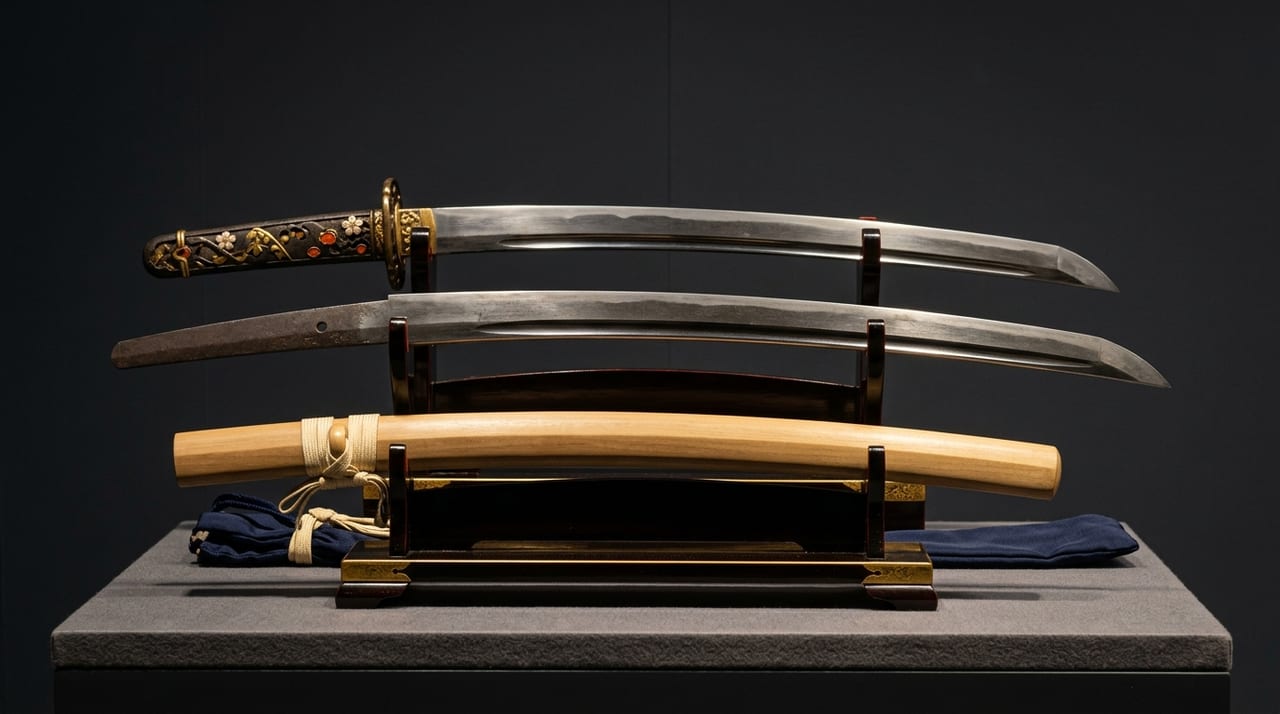
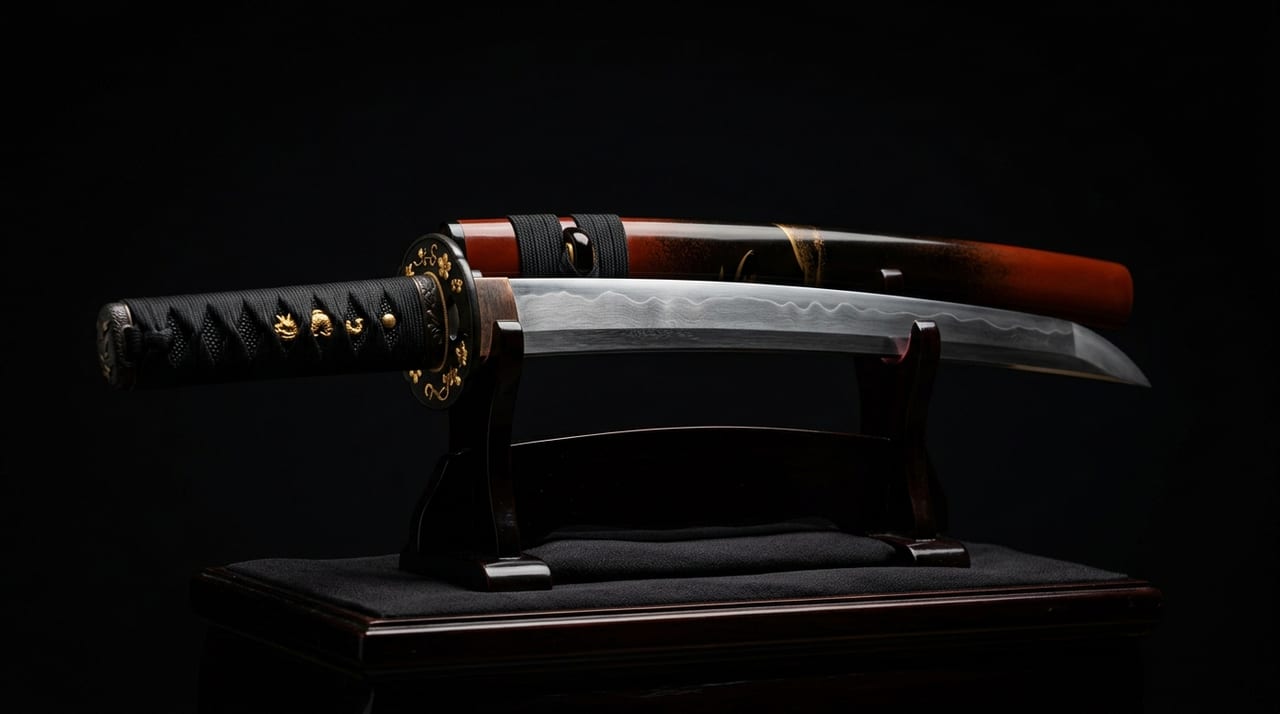
Tachi and Katana: A Comprehensive Comparison of Two Major Styles and Key Points of Appraisal
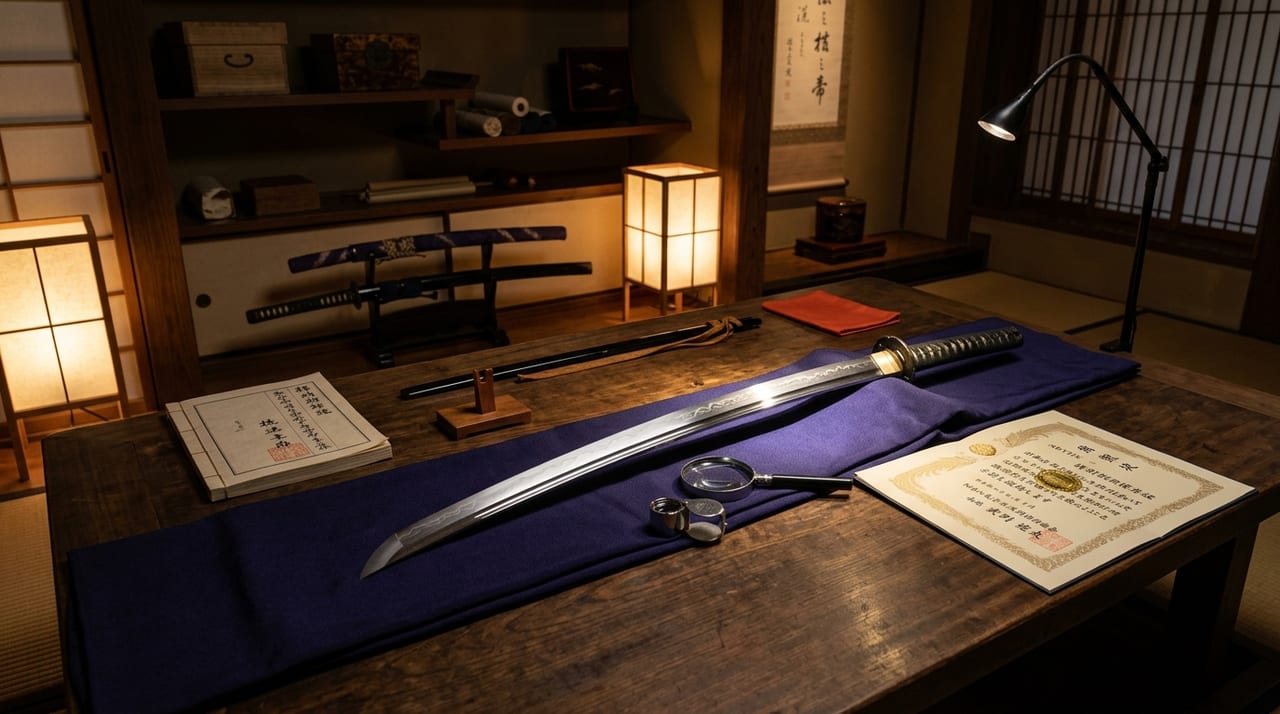 * Image is for illustrative purposes only.
Table of Contents
Fundamental Differences in Wearing Methods
Japanese swords can be broadly divided into two forms: tachi and uchigatana. The most fundamental difference between them lies in the "wearing method."
The tachi is worn at the waist "with the blade facing downward." It is suspended from the waist belt using a suspension cord made of leather or braided cord, and this style is called "haitou" (worn sword). In contrast, the uchigatana is "inserted into the belt with the blade facing upward." This is called "taitou" or "sashitou."
This difference is not merely a convention but arose from the rationality of the usage environment and the drawing motion. The tachi, suspended on horseback where the body sways, achieves stability of the blade and follows the movements of the mounted warrior. The uchigatana, fixed to the belt, enables swift drawing of the blade while keeping the edge facing upward—the prototype of later iaijutsu.
Technical Differences in Dimensions, Curvature, and Center of Gravity
The tachi and uchigatana differ clearly in their physical characteristics, and these differences are directly connected to their purposes.
| Item | Tachi | Uchigatana |
|---|---|---|
| Blade length (nagasa) | 70 centimeters or longer (ootachi exceeds 90 centimeters) | 60–73 centimeters |
| Curvature (sori) | Deep "waist curvature" (koshizori) near the handle (close to the nakago), with significant curvature throughout the blade | Shallow "tip curvature" (sakizori) or uniform "mid-curvature" (chuuzori) are common, with a tendency toward extremely shallow curves in the Edo period |
| Center of gravity | Near the handle, prioritizing stability in single-handed operation on horseback | Near the kissaki, suited to powerful two-handed downward striking motions |
| Weight | It is not uncommon for examples to exceed one kilogram | Approximately 800 grams is typical |
Note that blades under 60 centimeters are classified as wakizashi, and those under 30 centimeters as tanto. The koshizori of the tachi smooths the sweeping arc of the slash on horseback, while the sakizori and chuuzori of the uchigatana enable powerful strikes.
Mounted and Foot Combat: Design Philosophy Rooted in Purpose
The differences between tachi and uchigatana directly reflect the combat styles to which they correspond.
Battles from the late Heian period through the Kamakura and Nanboku-Cho periods, when the tachi was the primary weapon, were based on "mounted striking combat," in which warriors on horseback shot arrows at each other and engaged in sword combat from horseback when they drew close. In the slashing attacks executed by mounted warriors as they passed each other, the long blade and deep koshizori proved effective. The motion of the blade reaching the opponent in an arc, combined with the downward stroke from the high position of the horseback, made the tachi the optimal weapon in mounted combat.
After the Onin War (1467–1477), the main force in battle shifted from mounted warriors to large infantry units (ashigaru). In close hand-to-hand combat between densely packed ashigaru, the uchigatana, which could be quickly drawn from the belt, was overwhelmingly more practical than the long, suspended tachi. In foot combat fought with feet planted on the ground, the shallow curvature and tip-weighted center of gravity of the uchigatana produced direct, powerful strikes. Moreover, because the uchigatana was fixed to the waist belt together with its scabbard, the drawing motion was considerably faster. This became the foundation for the iaijutsu that would later be systematized.
Historical Transitions: From the Heian Period to the Edo Period
In the history of Japanese swords, the transition from tachi to uchigatana was not linear but followed a complex evolution in response to the demands of each era.
The Heian to Kamakura periods (10th–14th centuries) were the golden age of the tachi. Smiths from the five provinces of Yamato, Yamashiro, Bizen, Soushu, and Mino competed with each other, and many masterpieces designated as National Treasures or Important Cultural Properties were created during this period, which remains true as of 2026. After the Mongol invasions (1274, 1281), the Nanboku-Cho period saw the appearance of tachi with thick blades and broad widths in a magnificent form.
Among these, Dōjigiri Yasutsuna, Mikazuki Munechika, and Shishiō are known as three masterpieces representing the Heian–Kamakura periods, and Shishiō is said to have been used by Minamoto no Yorimasa in the Battle of the Uji River.
The Muromachi period (14th–16th centuries) was a period of transition. Although tachi continued to be produced for ceremonial and votive purposes, uchigatana spread rapidly in actual combat. The practice of "suriage" (shortening the blade to reuse existing tachi as uchigatana) also became widespread.
In the Azuchi-Momoyama to Edo periods (16th–19th centuries), the uchigatana became firmly established as the formal style of sword wearing for samurai. Samurai of the Edo period constantly carried the daishou (a pair of swords: the larger uchigatana and the smaller wakizashi). As the peaceful era continued, the sword transformed in significance from a tool of combat to a symbol of authority and status, and the worlds of shintō and shinshintō flourished, with smiths competing in the artistry of hamon and jihada.
Methods for Distinguishing Tachi from Uchigatana in Authentication
This section explains the principal methods for distinguishing tachi from uchigatana in actual sword authentication.
① Direction of the Signature (mei) on the Nakago
The most fundamental method of identification is the direction of the signature carved into the nakago. Swordsmiths followed the convention of carving the signature on the side (omote) that would face outward when the sword was worn correctly. Since the tachi is worn with the blade facing downward, the omote is the side visible from the outside when mounted on horseback. Since the uchigatana is worn with the blade facing upward, the omote is the side that faces outward when worn at the waist.
When holding the sword in the standard viewing position with the blade facing upward, if the signature appears on the far side (ura), it is a tachi; if it appears on the near side (omote), it is an uchigatana. This principle is widely used as an initial clue in authentication.
② Verification of Suriage (Shortening)
The process of shortening the nakago to reuse a tachi as an uchigatana is called "suriage," and one that is shortened substantially is called "oosuriage." From the Sengoku period through the early Edo period, many tachi were shortened and converted to uchigatana size. Suriage'd tachi often lose their original signatures (suriage-mumei), and authenticators discern suriage through changes in file marks, uneven rust coloration, and an unnaturally short nakago. Once suriage is verified, it is confirmed that the sword was originally forged as a tachi.
When only a portion of the signature remains during suriage, it is called "kirimei" (cut signature); when the nakago is folded back to preserve the signature, it is called "orikaeshi-mei" (folded signature). These traces serve as important physical evidence proving suriage.
③ Judgment from Sugata (Form) and Dimensions
One comprehensively observes the overall length of the blade, the depth and position of the curvature (koshizori or sakizori), the difference between the base width and tip width, and the shape of the kissaki (ko-kissaki or ō-kissaki). A neat form with deep koshizori and a large difference between base and tip widths, described as "fukura kareta," is typical of older tachi. Conversely, a blade with uniform width, shallow curvature, and a large kissaki represents the typical form of an uchigatana.
④ Period Identification through Hamon and Jihada
Identifying hamon and jihada peculiar to the tachi also provides indirect evidence. The choujimidare (clove blossom pattern) of Bizen swords is a characteristic feature of Kamakura-period tachi, while the broad straight edges and hamon with strong nie of Soushu swords are common in Nanboku-Cho period tachi. These characteristics help identify the period and provide supporting evidence for classifying the sword as a tachi.
⑤ Position of the Mekugi Hole
The position of the mekugi hole also serves as supplementary identifying evidence. In the tachi, due to its downward-blade wearing position, mekugi holes tend to be located on the spine (upper) side, while in the uchigatana, due to its upward-blade wearing position, they are often placed toward the blade (lower) side. The presence of multiple mekugi holes suggests the possibility of modification through suriage.
Conclusion
The tachi and uchigatana are not mere swords differing only in length and form. They are embodiments in which the combat styles, social structures, and aesthetic sensibilities of their respective eras are concentrated. The elegant curvature of the tachi embodies the age of mounted warriors, while the practical form of the uchigatana symbolizes the Sengoku period when ashigaru became the main force.
The reason this distinction is emphasized in modern authentication is not merely for accurate assessment of artistic value, but also to correctly interpret the historical context of a sword's journey. To discern in a suriage'd, unsigned blade the choices made by samurai of old and the demands of their era—this is one of the great rewards of sword authentication.