The World of Tsuba: Iron as Art in Japanese Sword Fittings
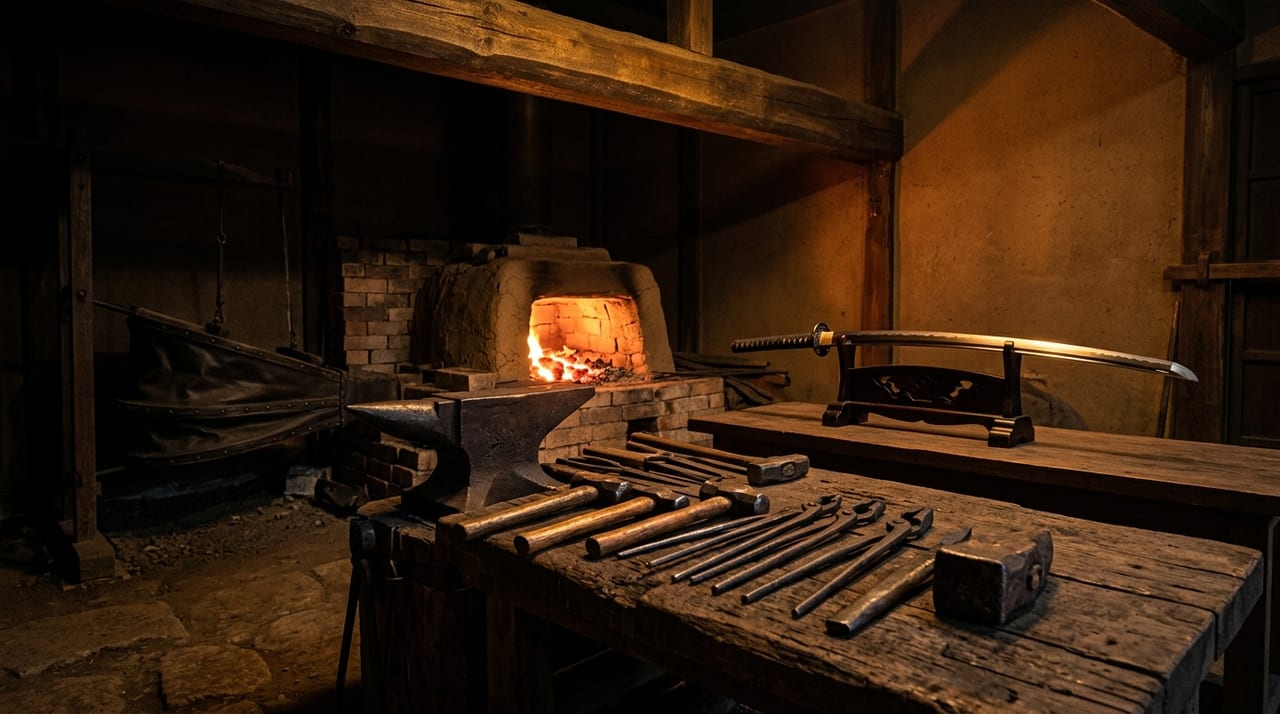 * Image is for illustrative purposes only.
Table of Contents
What is a Tsuba? — The Flower of Sword Fittings
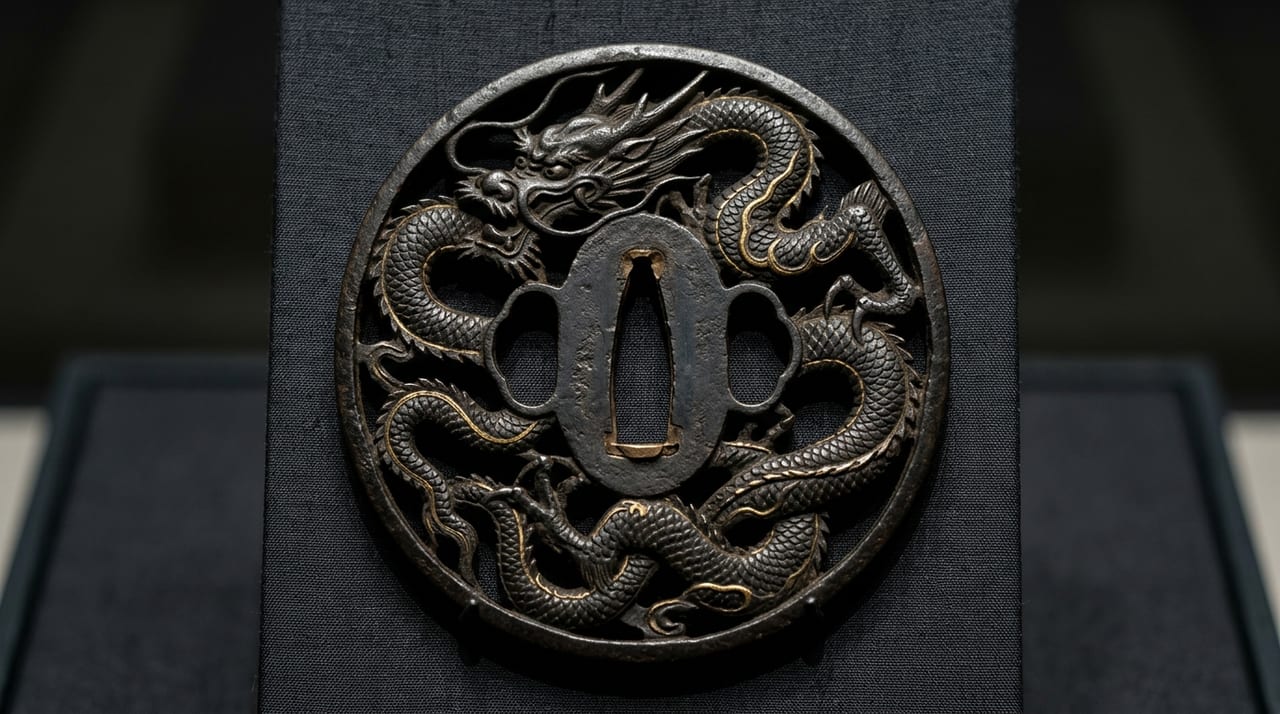
Among the components that make up a Japanese sword, the tsuba (tsuba) is a circular or elliptical metal fitting inserted between the blade and the hilt (tsuka). Its original purpose was to serve as a hand guard (gote) to prevent the hand from slipping onto the blade during combat, but over time its value as both a functional weapon and a work of art increasingly grew.
Materials vary widely, including iron, copper, brass, shakudo (copper-gold alloy), and shibuichi, but iron tsubas are the most fundamental form, continuously produced unchanged since the ancient sword period. The designs carved into the black patina of iron possess a deep and profound beauty not found in other materials, and today they are housed in museums around the world, including the Tokyo National Museum, Kyoto National Museum, and the Japanese Sword Museum (Tokyo, Sumida Ward).
Iron Tsubas of the Ancient Sword Period — Beauty in Simplicity
Tsubas made during the Kamakura and Muromachi periods (ancient sword period) continue to receive the highest praise for their simple elegance. Representative forms include the ko-tōshō tsuba (made by sword smiths themselves) and the kokatchu-shi tsuba (made by armor craftsmen).
The ko-tōshō tsuba was worked by the sword smith himself, with minimal decoration and emphasis on the beauty of the iron's forging surface itself. The concise form—with only slight openwork (sukashi) or linear carving added to round or mokko-shaped outlines—exemplifies the ideal of "beauty of utility."
The kokatchu-shi tsuba was made by armor craftsmen and is characterized by its flat form and thick iron. The hammer marks (tsuchime) stamped on the surface and rough iron finish create a rugged beauty. Few fine examples survive, and they remain a rare area that attracts attention in the antique market.
From the late Muromachi period into the Momoyama period, tsuba makers called Koshoami emerged and established techniques of fine openwork carving. This tradition was later inherited by the Shoami school.
Characteristics of Representative Schools
Higo Metalwork
This school was established in the early Edo period by metalworkers serving the Hosokawa family in Higo Province (present-day Kumamoto Prefecture). Representative metalworkers include Hayashi Matashichi (various accounts place his birth during the Keicho era and death during the Genroku era), Nishigaki Kanshiro, and Shimizu Jingobei.
The characteristic of Higo metalwork lies in the beauty of the tetsu-migakiji (polished iron ground), which deliberately preserves the iron's natural surface. The technique of eliminating unnecessary decoration and using bold silhouettes for openwork carving of bamboo, plants, and family crests reflects the spirit of the warrior class and Zen aesthetic sensibility. Many works featuring Hosokawa family crests such as the "flag, fan, and sasa-rindō (bamboo-leaf gentian)" continue to exist. Even today, Higo tsubas remain popular in the market, and high-quality works by Hayashi Matashichi are sometimes traded for hundreds of thousands to over a million yen.
The Shoami School
This was Japan's largest group of tsuba makers, active for over three hundred years from the late Muromachi period through the late Edo period. Based in Kyoto, it developed branch schools throughout the country in places like Edo, Kaga, and Satsuma, each developing their own distinctive styles.
The greatest characteristic of the Shoami school is their openwork carving technique. They skillfully combined "positive openwork," where the ground plate is pierced to reveal the design, with "negative openwork," where the ground plate is preserved and the design's outline is pierced, creating delicate natural motifs such as pine, plum, paulownia, and sparrows. Styles varied by region, with Kaga Shoami establishing their distinctive style through elaborate colored metal inlay, while Satsuma Shoami developed theirs through bold linear carving and powerful composition. Due to the large number of works produced, examples at prices accessible to beginning collectors circulate in the market.
The Umetada School
This school was founded by Umetada Myōju (1558–1631), who was active from the Momoyama period through the early Edo period. Myoju was a master craftsman of exceptional talent in both sword making and metalwork, and is said to have crafted a sword for Emperor Go-Yozei.
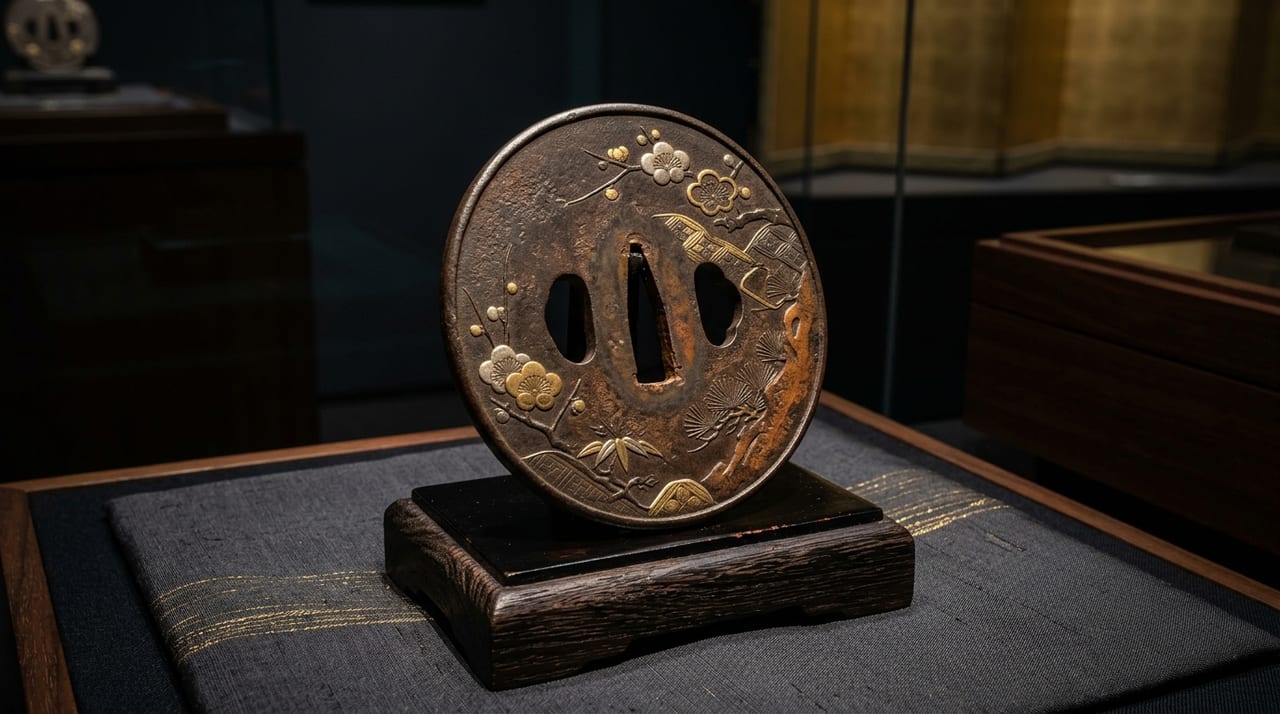
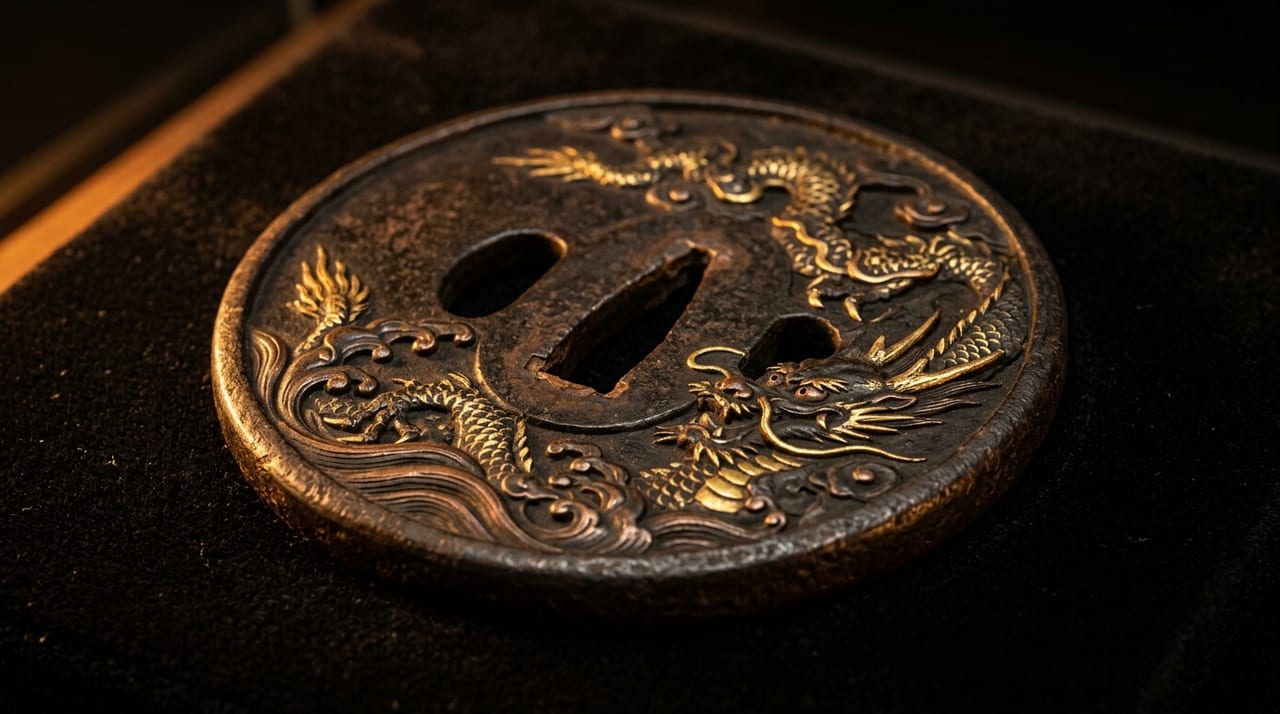
The essence of Umetada Myōju's artistic style lies in pictorial expression achieved through flat inlay using colored metals. This technique involved inlaying gold, silver, and shakudo into an iron ground through flat inlay to create pictures of plants and figures, with nunome inlay being one variation. The style is also rich in high-relief designs of figures, dragons, and flowers and birds, exemplifying the elegance of Momoyama culture.
Points for Appreciating Tsubas
When appreciating tsubas, paying attention to the following points deepens one's understanding.
- Surface patina and iron color: The condition of rust, tone, and surface finish are important indicators of the work's period and maker. Ancient-period tsubas are uniformly covered with deep black rust (ferroferric oxide) and display a lustrous depth.
- Precision of carving technique: The sharpness of openwork outlines, the delicacy of hair-line carving (kebori), and the tightness of inlay work reveal the craftsman's technical skill. Detailed evaluation becomes possible with magnification.
- Dignity of design: The compositional beauty, spatial distribution, and choice of motifs in the depicted designs reflect the aesthetic sensibilities of the school and era. The use of negative space is particularly crucial; the more masterful works that embody "the aesthetics of subtraction" have the most vital spatial presence.
- Box inscriptions and certificates of authenticity: When accompanying box inscriptions or certificates of authenticity from renowned scholars are present, credibility and market value increase. However, many excellent works lack such documentation, so excessive reliance should be avoided.
The Joy of Collecting
Tsubas are sword fittings that can be collected at relatively affordable prices compared to complete Japanese swords. Beginner-level examples are available for thousands to tens of thousands of yen and can be found at antique markets, sword markets, and auctions.
- Set a theme: Focusing your collection—such as collecting only Higo tsubas, specializing in openwork designs, or collecting iron tsubas from the Edo period—creates coherence in your collection and advances your specialized knowledge.
- View many actual examples: The Tokyo National Museum, Kyoto National Museum, and Japanese Sword Museum house excellent collections and can be viewed at reasonable admission fees. Accumulated experience viewing actual works hones your ability to judge authenticity in the market.
- Build relationships with trusted specialists: Sword dealers specializing in tsubas and long-established antique dealers provide accurate advice about provenance, authenticity, and condition. Utilizing enthusiast communities and social media also serves as valuable information sources. As of 2026, Japanese sword-related communities both domestically and internationally remain active online, providing an environment where even beginners can easily deepen their knowledge.
The beauty of black acquired by iron over time, the precise designs carved stroke by stroke by craftsmen — the world of tsubas offers a gentle and rich collecting journey that condenses the profound depths of Japanese craft art.