Fuigo and Forge Temperature Control — The Science of Forging in Which the Tōshō Controls Steel Composition with Charcoal Fire and Airflow
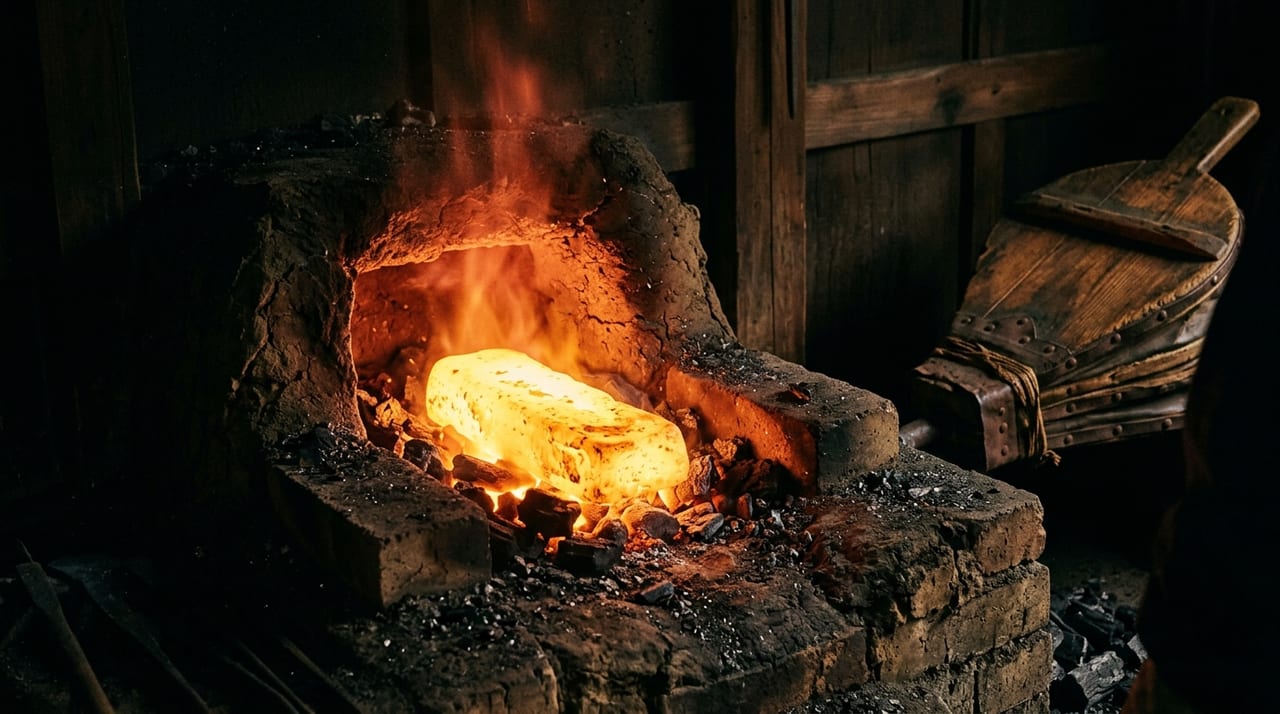 * Image is for illustrative purposes only.
Table of Contents
The Forge and Fuigo: the Heart of Forging
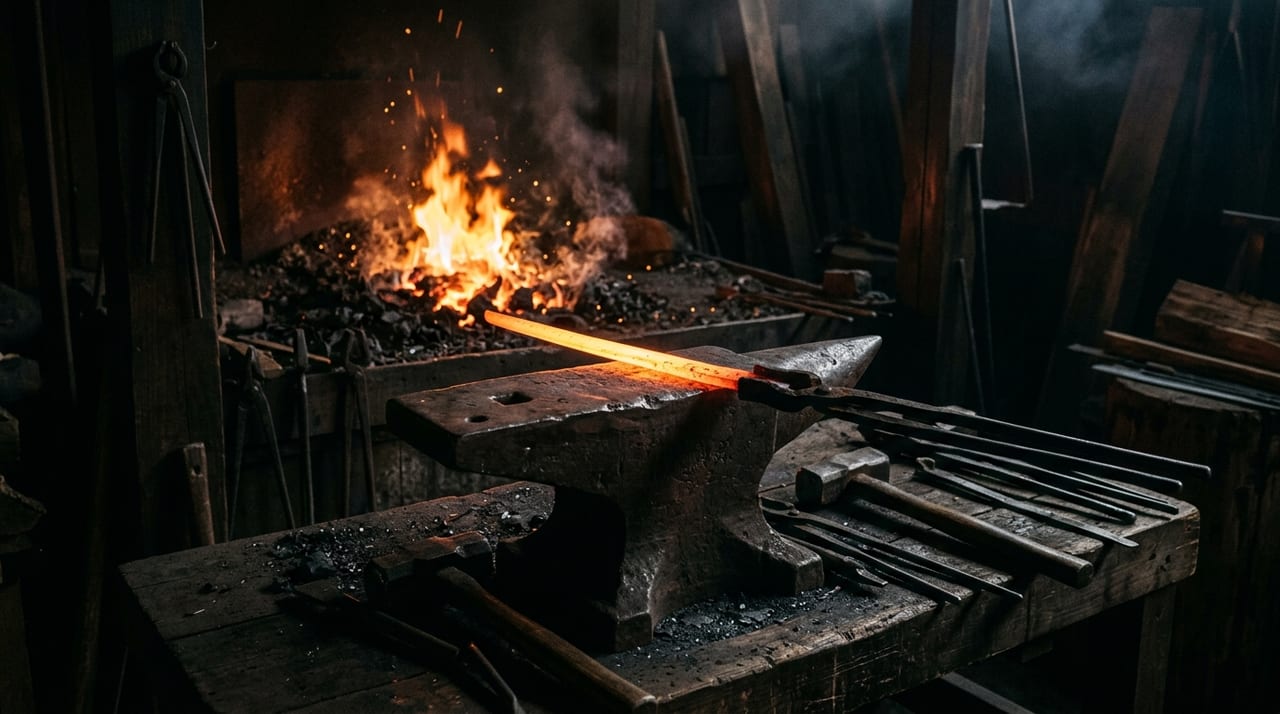
In the forging of nihontō, one of the moments that most intensively tests the tōshō's knowledge and intuition is forge temperature control. Heating tamahagane to the right condition and maintaining a forging temperature at which it can be struck with a hammer may appear simple on the surface, but in practice it is a complex skill requiring simultaneous control of charcoal type, fuigo operation, and heating time.
The forge (kamado) is commonly called a kaji furnace and is a small combustion chamber built of clay and firebrick. In front of the forge sits a fuigo (bellows), which drives air in by foot-pedal or electric power. Many modern forging studios use electric blowers, but some studios that maintain traditional training practices still use foot-operated fuigo.
It is said that apprentices training to become tōshō are often not allowed to hold a hammer at first, and begin instead with tasks such as cutting charcoal and tending the forge fire. This is because each individual action — the amount of charcoal loaded into the forge, how the ash is knocked away, how the air is blown in — determines the success or failure of the subsequent tanren process. Through repeated performance of these unglamorous tasks, apprentices develop a physical sense for the overall state of the forge.
Charcoal Type Changes the Properties of the Steel
The type of charcoal used in forging directly affects furnace temperature and its impact on the steel. Nihontō forging primarily uses shirozumi (white charcoal) and kurozumi (black charcoal), whose properties differ greatly.
| Charcoal type | Combustion characteristics | Suitable process |
|---|---|---|
| Shirozumi (binchotan) | Capable of high-temperature, long-duration combustion. Takes longer to reach maximum temperature, but once hot it maintains stable high heat. CO (carbon monoxide) gas produced by shirozumi acts as a "reducing flame," suppressing oxidation of the steel (the formation of iron oxide on the surface). | Heating in the latter half of forging, after the steel has been sufficiently homogenized |
| Kurozumi (mokutan) | Ignites quickly and is easy to control. However, it burns at a lower temperature than shirozumi and is not suited to long-duration stable combustion. | The early stage of warming tamahagane, or when heating small pieces of iron quickly |
Tōshō select between shirozumi and kurozumi depending on the stage of forging, or blend them before loading the forge. Much of this choice is learned orally from a master, and it is the core of empirical knowledge that resists quantification.
Before use, charcoal must be split to an appropriate size in a preparatory step called sumikiri. Charcoal that is too large tends to burn unevenly in the firebox, while charcoal that is too small cannot sustain high heat. Selecting the right charcoal size to match the stage of work and the size of the steel being handled is one of the skills that tōshō and apprentices refine through daily practice. In addition, as combustion progresses and ash accumulates inside the forge, heat transfer changes, so the ongoing task of knocking away ash and maintaining the firebox is equally indispensable.
Fuigo Airflow and Carbon Behavior in the Steel
The volume of air (oxygen) driven in by the fuigo affects both the forge temperature and the carbon content of the steel.
Increasing airflow raises the forge temperature, softening the steel and making it easier to hammer. At the same time, however, excess oxygen oxidizes the steel surface (forming fire scale), raising the risk that oxides will remain inside the steel during orikaeshi tanren. Conversely, reducing airflow lowers the temperature, hardens the steel, and increases the effort required to hammer it.
From a carbon content perspective, prolonged high-temperature heating promotes decarburization, in which carbon escapes from the steel surface. Conversely, carburization — the addition of carbon from the (wood) charcoal into the steel — also occurs. To control the balance between decarburization and carburization, tōshō empirically adjust heating time, temperature, and charcoal placement.
The rhythm of pumping or pulling the fuigo is also an important element of temperature control. Abrupt changes in airflow cause wild swings in forge temperature, causing part of the steel to soften ahead of the rest or, conversely, to remain hard. Tōshō attempt to keep forge temperature fluctuations smooth by maintaining as steady a rhythm as possible when blowing air. It should also be noted that the carbon monoxide produced by the reducing flame is colorless, odorless, and harmful to the human body, so ventilation in the forging studio receives careful attention.
Temperature Judgment — the Intuitive Knowledge Called Hi-iro
Modern forging studios have no thermometers. The tōshō judges the temperature of the steel by its hi-iro — the color of the light it radiates.
| Temperature | Hi-iro |
|---|---|
| Approx. 700–800°C | Red (dark red to bright red) |
| Approx. 900°C | Orange |
| Approx. 1,000–1,100°C | Yellowish white, close to white |
| 1,200°C and above | Incandescent white |
The optimal forging temperature — the temperature at which the steel becomes soft enough to hammer — is roughly 900–1,100°C, but within this band of orange to yellowish white, the tōshō intuitively judges the optimal temperature based on the type of steel being worked (kawagane or shingane) and the stage of the process (the stacking-and-soaking stage or the folding stage).
This hi-iro judgment is difficult in a bright daytime workspace, and traditional forging studios deliberately maintain a dim working environment with restricted natural light. When a tōshō uses the expression "sharpening one's senses," the precision of this hi-iro judgment lies at the heart of what that means. The meanings of such technical terms can also be confirmed in the glossary.
Reading hi-iro is not simply a matter of memorizing colors, since the same steel responds differently depending on whether it is kawagane or shingane. Over years of experience, tōshō develop the ability to make comprehensive judgments that encompass the type of steel, its position within the forge, and even the way the flame flickers. Cultivating this sensitivity is said to require years of patient practice and cannot be acquired overnight.
Integration with Modern Technology — The Potential of Thermometers and AI
In recent years, some forging studios have begun supplementary use of non-contact infrared thermometers (pyrometers). The aim is to improve the efficiency of apprentice training by confirming in numerical form fine temperature differences that are difficult for the human eye to distinguish.
Research into "forging support systems" combining AI and sensor technology is also partially underway in collaboration with institutions such as the National Institute of Advanced Industrial Science and Technology and universities. If a system were built that records forge temperature, airflow, and heating-time data in real time and compares it analytically against past masterworks, objective evaluation of the craft might become possible.
However, many tōshō believe that thermometers and AI are ultimately supplementary tools, and that final judgment should remain in the domain of human intuition. Such measurement technologies are often used to assist in training apprentices who have not yet mastered hi-iro judgment, and they do not replace the tōshō's own forging process. Numerical data is at most a form of "checking one's answers," and judgment in the actual forging environment still rests with the tōshō's senses. Feeling the breath of the steel, listening to the sound of the forge, reading the hi-iro — this comprehensive sensory awareness is the essence of nihontō forging and the soul of the craftsperson that no number can replace. The figure of the tōshō standing before the forge and fuigo continues to embody the heart of nihontō-making, unchanged from hundreds of years ago.
The Precision of Temperature Control Determines the Finished Quality of the Blade
The results of forge temperature control ultimately manifest in the appearance of the jigane and hamon of the finished blade. Unevenness in the heating and tanren processes can lead to defects such as irregularities in the kitae-hada, so the precision of temperature control is one of the foundations that underpins the quality of the sword itself. When handling an authenticated work accompanied by an NBTHK (Society for the Preservation of Japanese Art Swords) kanteisho, many enthusiasts focus on the beauty of the jigane and the clarity of the hamon; yet behind those qualities lies the accumulated skill of the tōshō in temperature control before the forge and fuigo. It is worth knowing, too, that the beauty of a blade is supported not only by the spectacular finishing processes but also by the accumulation of this unglamorous, patient dialogue with flame.