Types and Quality Control of Kaji Charcoal — Forging Characteristics of Shiro-zumi, Kuro-zumi, and Binchōtan, and the Tōshō's Art of Charcoal Selection
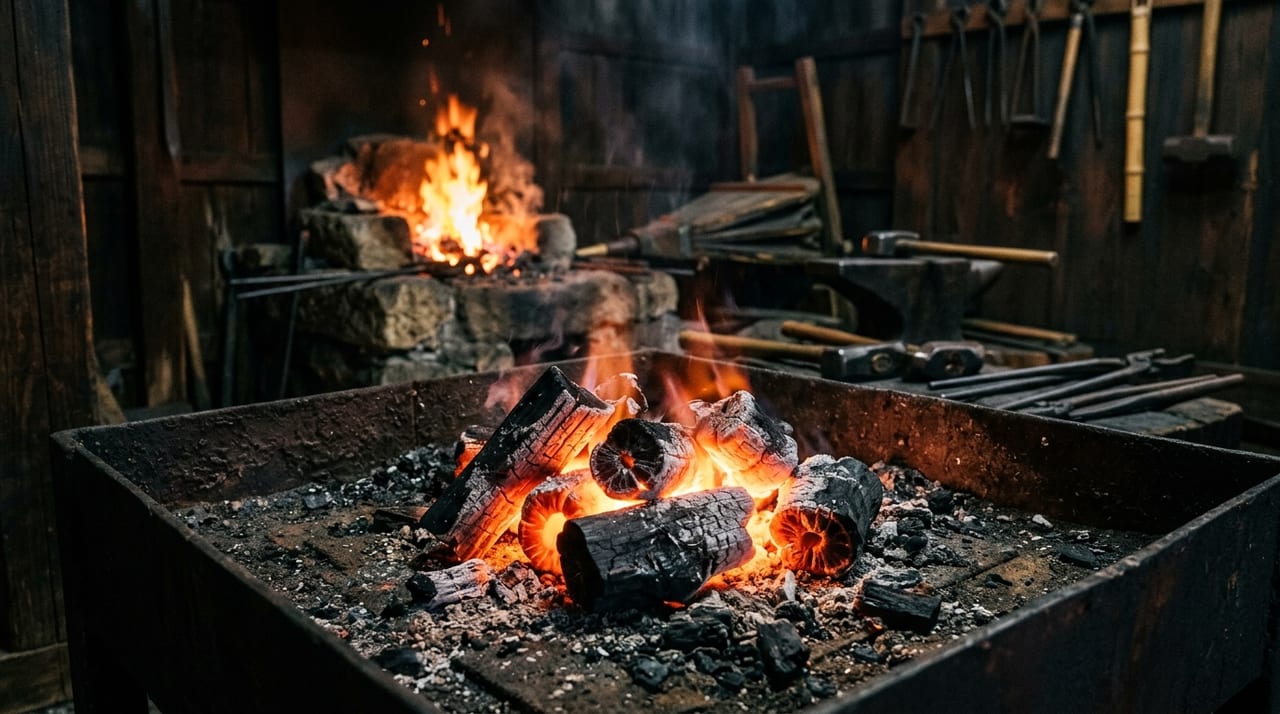 * Image is for illustrative purposes only.
Table of Contents
Charcoal Is a Material of the Sword — The Overlooked Lead Player in Forging
In the production of Japanese swords, tamahagane tends to attract attention as the raw material; yet among tōshō, it is an unshakeable article of faith that the quality of charcoal governs the quality of the sword. Charcoal is not merely a fuel — at high temperatures, the carbon in the charcoal dissolves back into the steel, playing a role in finely adjusting the steel's carbon content.
If the type, quality, or provenance of the charcoal is wrong, temperature control becomes erratic, the steel's composition goes awry, and the quality of the hamon is affected as well. The choice of charcoal is one of the most critical junctures in the technical judgment of a tōshō.
The Three Major Categories of Kaji Charcoal
Japanese kaji charcoal falls broadly into three types.
Shiro-zumi: Produced by carbonizing at high temperatures (over 1,000–1,200°C) and then rapidly cooling. It has the characteristic of bearing a whitish ash on its surface, is dense, and burns at a high temperature. The prime example is binchōtan, the highest-quality shiro-zumi made from ubame oak grown in Wakayama Prefecture. Shiro-zumi contains few impurities and can sustain a stable high temperature for a long time.
Kuro-zumi: Made by carbonizing slowly at a relatively low temperature (400–700°C), sealing the kiln, and allowing natural cooling inside. Its surface is black, and it is softer and more prone to crumbling than shiro-zumi. Its combustion temperature is lower than shiro-zumi, but it ignites quickly and is easy to adjust for heat output.
Momi-zumi and bamboo charcoal: Used by some tōshō for specialized purposes. They are sometimes employed for removing the kuro-kawa (black scale) from a finished blade or for surface preparation work, and their application differs from charcoal used in main forging.
Comparison of Shiro-zumi and Kuro-zumi
Organizing the differences between the representative shiro-zumi and kuro-zumi from the three major categories yields the following.
| Item | Shiro-zumi | Kuro-zumi |
|---|---|---|
| Carbonization temperature range | High (over 1,000–1,200°C) | Relatively low (400–700°C) |
| Cooling method | Rapid cooling | Natural cooling inside the kiln |
| Surface appearance | Bears a whitish ash | Black |
| Hardness / tendency to crumble | Dense and hard | Softer and more prone to crumbling than shiro-zumi |
| Combustion temperature | High | Lower than shiro-zumi |
Knowing how to use these two types according to purpose is itself part of the tōshō's skill.
Why Binchōtan Is Regarded as the King of Kaji Charcoal
There are several reasons why binchōtan is respected as the "king of kaji charcoal" in the world of tōkō.
First is the high combustion temperature and its stability. Binchōtan can stably produce high temperatures exceeding 1,300°C, making it well suited to keeping tamahagane at the optimal forging temperature (white-hot state, approximately 1,000–1,200°C). It produces little temperature unevenness, making temperature management inside the furnace easier.
Next is the character of the ash. Binchōtan ash has fine particles that spread evenly inside the furnace. This produces a secondary effect of stabilizing the thermal environment within the furnace. With inferior charcoal that produces coarse ash, the heat distribution inside the furnace is disrupted.
And then there is control over carbon absorption. As noted above, the carbon monoxide (CO) generated during the combustion of charcoal finely adjusts the carbon content of the steel. Because binchōtan contains few impurities, this carbon supply is stable, making it unlikely for unintended carbon gain (carburization) or carbon loss (decarburization) to occur during forging.
Regional Charcoal Characteristics and Tōshō Preferences
The main production areas for binchōtan are Wakayama (Kishū), Mie, Kōchi, and Miyazaki, but the quality of the charcoal differs subtly by region. Kishū binchōtan is the most trusted by tōshō for its consistently high quality of ubame oak.
At the same time, binchōtan is expensive, and the amount of charcoal used in a single forging session (for one sword) can run to several dozen kilograms. For this reason, some tōshō use binchōtan in combination with high-quality kuro-zumi. The practice of using "kuro-zumi for the ara-gitae (rough-forging) stage and binchōtan for the finishing stage of sei-gitae (fine forging)" is considered rational.
Charcoal Quality Management — The Tōshō's Eye for Quality
When selecting high-quality kaji charcoal, the main points a tōshō checks are as follows.
Color and appearance: Uniformly black (or grayish-white in the case of shiro-zumi), with no cracks or chips and no visible knots or rot. Charcoal with a large proportion of shirata (sapwood portions) where carbonization is uneven is considered inferior.
Sound when struck: High-quality binchōtan produces a dry, high-pitched "kan-kan" sound close to a metallic ring. If the charcoal contains moisture or has internal voids, it produces a dull "kotsu-kotsu" sound instead.
Weight and density: High-quality shiro-zumi is dense and heavy for its size. Charcoal that is too light has a coarse interior and burns for a shorter time.
Checking the certificate of origin: In recent years, charcoal with falsified regional labeling has circulated on the market. It is important to purchase from a trustworthy charcoal wholesaler and to verify the certificate of origin.
Points to Verify When Purchasing and Procuring
Organizing the verification items listed above for easy use at the point of procurement yields the following.
- Are there any irregularities or dullness in color and appearance?
- Is the sound when struck high-pitched and dry?
- Is the weight and density sufficient when held in the hand?
- Is the certificate of origin clear, and is the purchase being made from a trustworthy supplier?
These are not standalone criteria; they are assessed holistically by combining multiple perspectives.
Contemporary Charcoal Supply Problems and the Search for Alternative Fuels
The decline in charcoal-burning craftsmen and the drop in domestic charcoal production are also affecting how tōshō procure kaji charcoal. The price of high-quality binchōtan has been rising year by year, and has become a factor squeezing the fixed costs of running a tōshō's workshop.
Some tōshō have attempted partial introduction of gas furnaces and electric furnaces, but it is currently considered difficult to fully replicate the charcoal fire's characteristic "carbon supply and temperature properties." The reason charcoal fire is indispensable in traditional Japanese sword forging is not mere custom but derives from this carbon control and temperature characteristic.
"Support for training charcoal-burning craftsmen" and "promotion of the use of domestically sourced timber" for a sustainable charcoal supply have emerged as challenges for the sword industry as a whole, and efforts to forge partnerships with the Forestry Agency and local governments are at the stage of being explored. Protecting charcoal is directly linked to protecting the future of the Japanese sword.
How Knowledge of Charcoal Connects to a Discerning Eye for Swords
For today's sword enthusiasts and buyers, knowledge of kaji charcoal is not merely background information. It is said that the more carefully charcoal is managed during forging, the more stable the steel's grain structure tends to be, and that care is more likely to show in the appearance of the jigane and the hamon. Conversely, it is said that in forging where temperature control through charcoal breaks down, unevenness tends to arise in the steel's composition.
That said, for existing swords — especially those made in earlier ages — it is difficult to accurately identify after the fact what charcoal was actually used. In the context of purchasing or appreciating a sword, making a judgment based on the compactness of the jigane visible on the blade, the condition of the hamon, and the content of an appraisal by a specialist institution is, practically speaking, the most reliable method — rather than trying to infer the type of charcoal used.