Sword Culture of the Insei Period (1086–1185): The Blades Beloved by the Cloistered Emperors Shirakawa, Toba, and Go-Shirakawa, and the Age of the Warrior's Rise
 * Image is for illustrative purposes only.
Table of Contents
What Kind of Era Was the Insei Period?
"Insei" refers to a political system in which an emperor, after abdicating and becoming a "Retired Emperor (Cloistered Emperor)," continued to hold actual political power. It began in 1086 (Ōtoku 3) when Emperor Shirakawa abdicated in favor of Emperor Horikawa yet refused to relinquish political power, and lasted approximately one hundred years until the establishment of the Kamakura shogunate (1185). This era was a period of turbulence in which three simultaneous upheavals—internal strife within the court aristocracy, the rise of the warrior class, and the growing complexity of the shōen system—unfolded in parallel, making it an important turning point in sword culture as well.
This system, in which the Retired Emperor himself led government affairs by setting aside sekkan politics, is characterized by the suppression of the influence of the Fujiwara clan—the maternal relatives of the reigning emperor—while the Retired Emperor made decisions through his own private administrative organ, the In-no-chō. During the insei period, the dedication of shōen to the Retired Emperor became concentrated, and the need to administer and defend the resulting portfolio of estates drove the systematic mobilization of warriors. In this process, swords came to play an important role not merely as weapons but also as gifts symbolizing loyalty to the Retired Emperor and powerful aristocrats.
Cloistered Emperor Shirakawa and the Collection of Swords
Cloistered Emperor Shirakawa (insei 1086–1129), the founder of insei rule, was the first cloistered emperor to seek to stand at the apex of the court aristocracy through private possession of military force. He established the "Hokumen no Bushi" as the armed force of the In-no-chō, directly taking powerful warriors under his command.
Records indicate that Cloistered Emperor Shirakawa had a keen interest in swords and demanded that tōkō across the provinces dedicate fine tachi to him. The swords of this era display a transitional form, moving slightly away from the slender, koshi-zori shape of the early Heian period, with the nagasa somewhat longer and the sori beginning to shift toward the middle. Many tachi produced during the Shirakawa insei period are among the finest of the "old tachi," and some surviving examples are confirmed to have been preserved as dedicated swords at shrines.
The Hokumen no Bushi are said to have taken their name from maintaining their station on the northern side of the retired imperial palace; the institution offered even low-ranking warriors the chance to serve in close attendance on the Cloistered Emperor. As a result, warriors who had previously been kept on the periphery of aristocratic society began to gain experience in places close to the center of politics, laying the groundwork for the later rise of the warrior class. The majority of tachi dedicated under Cloistered Emperor Shirakawa are thought to have been made with presentation to the gods and Buddhas or use in ritual settings in mind rather than for actual combat; such swords are said to be largely of careful, painstaking craftsmanship, with considerable effort lavished on the hamon and the finish of the jigane.
Cloistered Emperor Toba and the Reorganization of Warrior Groups
The era of Cloistered Emperor Toba (insei 1129–1156) saw the process of integrating warrior groups into the core of insei authority advance still further. Cloistered Emperor Toba deployed warriors as sword guards of the inner palace (katanaban), institutionalizing armed protection within the court.
From the perspective of sword history, noteworthy in this period is the growing demand among warriors of the eastern provinces (Kantō and Tōhoku) for refined tachi. The Osafune area of Bizen Province (present-day Okayama Prefecture) was already laying the foundations for its community of tōkō during this insei period, ahead of its flourishing in the Kamakura era. Bizen swords of the Toba insei period are technically still at a developing stage compared to the celebrated Kamakura blades that would follow, but the seeds of an organized production system are visible in this era.
During the era of Cloistered Emperor Toba, warriors who administered shōen began to accumulate independent military strength in the provinces, and in parallel the tōkō communities across the country honed their skills in response to orders from local warriors. In regions like Bizen Province, blessed with high-quality iron sand and fuel, tōkō began to pass down their craft within family lineages, with entire settlements adopting a division of labor. This expansion of productive organization represented a transition from a stage in which individual master swordsmiths forged tachi on their own to a stage in which production centers capable of supplying consistent quality were established.
The Genpei Conflicts and the Changing Demand for Swords
In the final stage of the insei period, three large-scale civil conflicts erupted in succession: the Hōgen Disturbance (1156), the Heiji Disturbance (1159), and the Jishō-Juei War (1180–1185). These conflicts brought dramatic changes to the demand for swords.
- Hōgen Disturbance (1156): This incident, in which the confrontation between Retired Emperor Sutoku and Emperor Go-Shirakawa escalated into armed clash, announced the arrival of an era in which the military power of warriors decided the political struggles of the imperial family and court nobles. Warriors of the Minamoto and Taira clans who participated in the battles placed orders for combat-ready tachi with tōkō in the eastern and western provinces, and demand surged.
- Jishō-Juei War (Genpei War, 1180–1185): This nationwide civil war, lasting five years, brought about the mass consumption of swords. At the same time, among the warriors who went to the front, a strong attachment to carrying fine swords arose, and this also became an opportunity for the reputations of outstanding tōkō to spread throughout the country.
Through this series of civil conflicts, swords shifted their center of gravity from ceremonial implements of the aristocracy to practical tools of the warrior class. As conditions in which the outcome of battle was directly linked to the practicality of a sword continued, warriors came to place greater emphasis on sharpness and durability, and tōkō were increasingly required to produce blades better suited to actual combat. With the conclusion of the Jishō-Juei War and the establishment of a warrior government in Kamakura, the center of sword demand gradually shifted to the eastern provinces, and the techniques and networks cultivated during the insei period were carried on into the sword culture of the Kamakura period.
Cloistered Emperor Go-Shirakawa and the Awakening of Aesthetic Value in Swords
Cloistered Emperor Go-Shirakawa (1127–1192), the last cloistered emperor of the insei period, navigated the complex political situation from the late Heian through the early Kamakura period. He is known for his deep interest in cultures such as imayō and kemari, and was also active in the collection and dedication of swords.
What draws attention in the era of Cloistered Emperor Go-Shirakawa is the fact that swords began to be perceived not merely as pure weapons but as "sacred objects possessing aesthetic value." As represented by the large-scale dedication of swords to Itsukushima Shrine (the dedications by Taira no Kiyomori and others are particularly well known), the offering of outstanding tachi to the gods and Buddhas became established as an act demonstrating the virtue of cloistered emperors and military commanders. This became the foundation for the later "culture of dedicating famous swords."
Cloistered Emperor Go-Shirakawa was a rare individual who experienced all three great conflicts—the Hōgen Disturbance, the Heiji Disturbance, and the Jishō-Juei War—and his reign was colored by complex political maneuvering. Even amid such turbulence, the Cloistered Emperor continued his deep devotion to temples and shrines and their dedication ceremonies, and sought to make his own authority and virtue visible through the dedication of treasures, including swords. The fact that the culture of treating swords as offerings to the gods and Buddhas was maintained even in an era when the power of warriors swayed politics has important implications for the subsequent development of Japanese swords as objects that combined the dual character of weapon and work of art.
Morphological Characteristics of Insei-Period Swords
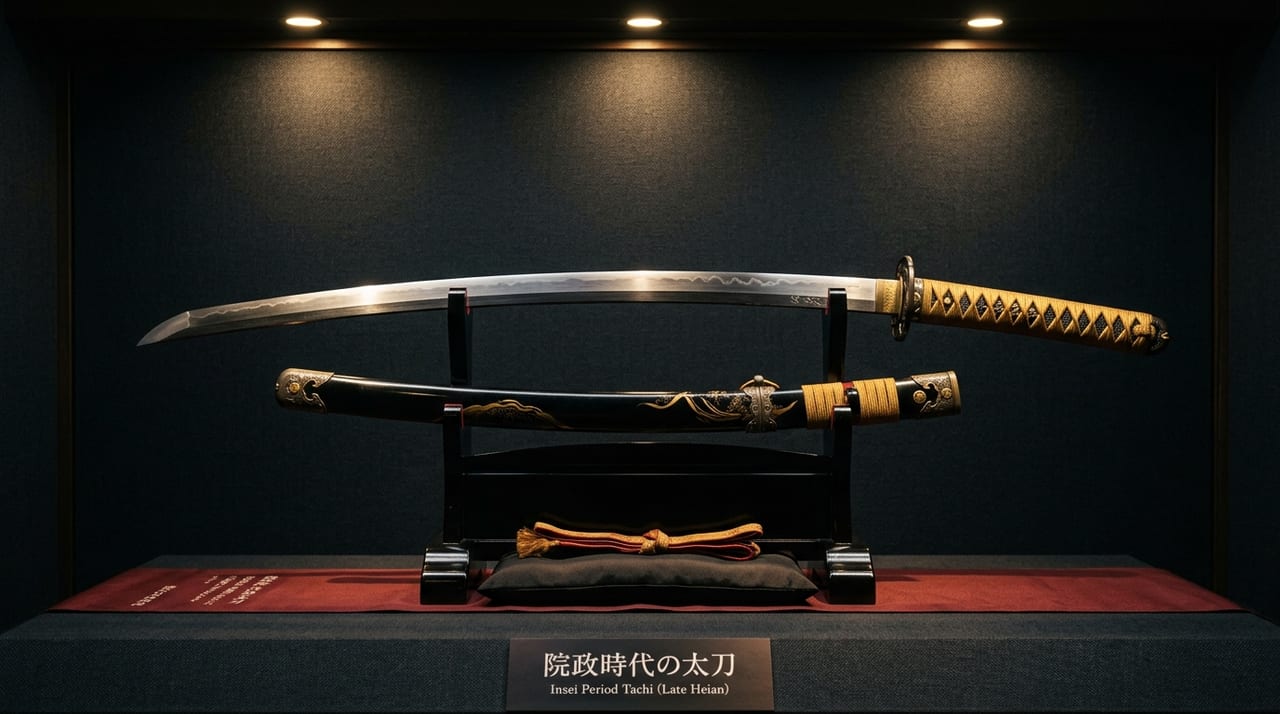
Tachi of the insei period (the latter half of the 11th–12th centuries) display the following morphological characteristics.
- Changes in sori (curvature): During the insei period, many blades display a transitional form in which the position of the sori is gradually shifting toward the center, away from the "koshi-zori" of the early Heian period—in which the highest point of the sori lies near the lower third of the nagasa.
- Trends in nagasa: Swords of the insei period are mostly in the range of 2 shaku 4 sun to 2 shaku 8 sun (73–85 cm) in nagasa, representing a preparatory stage for the transition to the grand long tachi of the Kamakura period.
- Jigane and hamon: The jigane of insei-period blades is predominantly itame or small itame, and the hamon is mostly suguha or small midare. The flamboyant hamon of chōji-midare is a development from the mid-Kamakura period onward; the insei period is still dominated by simple, unpretentious forms.
Furthermore, the tachi of this era have a relatively long nakago, and it is thought that the tsuka was made long to allow mounted warriors to wield the sword one-handed from horseback. The number of tōkō who cut a mei was limited, and most surviving insei-period tachi have been transmitted as mumei; dating is determined by a comprehensive assessment of the characteristics of the jigane, hamon, and overall shape.
Perspectives for Appreciating Insei-Period Tachi
Surviving insei-period tachi are limited in number, and are mainly pieces transmitted as dedications to shrines and temples, or those carefully preserved by later generations. Because dating is carried out not by mei alone but from a comprehensive set of elements including shape, jigane, and hamon, careful comparison of these features helps deepen one's understanding when viewing such pieces. It should also be kept in mind that many examples have undergone togi and suriage in the course of their long transmission, so it cannot be assumed that the original form at the time of production has been preserved intact. For determining the age and authenticity of a sword, it is most reliable to verify through a kanteisho from a specialist institution, and it is desirable to evaluate the piece together with documented provenance materials.
The Legacy of Insei-Period Swords in the History of Japanese Swords
The insei period was the first turning point at which Japanese swords transformed from "practical implements of the battlefield" into "spiritual symbols of the warrior class and works of art." The accumulated developments of this era—in which insei authority institutionalized the dedication and collection of swords and warriors came to regard the sword as "the soul of the warrior house"—became the foundation for the golden age of Japanese swords in the subsequent Kamakura period. It is no exaggeration to say that one cannot speak of the celebrated Kamakura blades without first understanding the insei period.