The Forge-Welding Technique of Wari-komi-zukuri — The "Hi-iro" and "Uchi-goro" That Craftsmen Judge During the Furnace Joining of Shingane and Kawagane
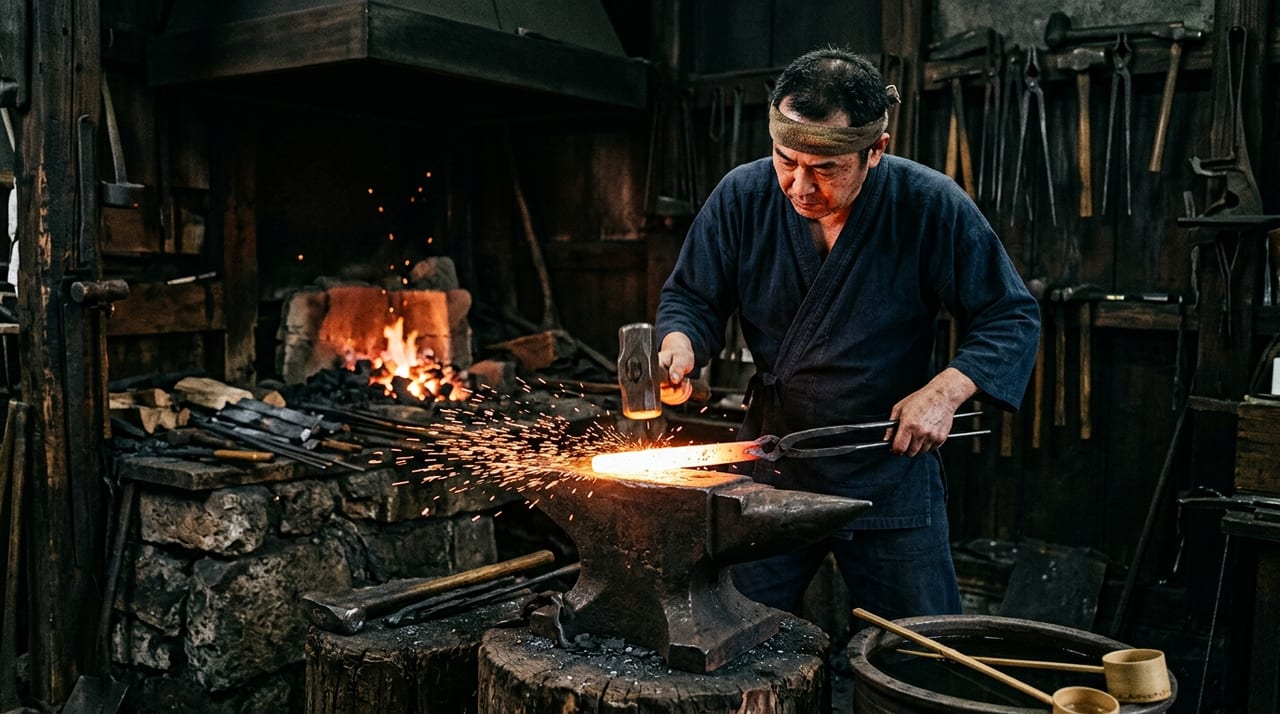 * Image is for illustrative purposes only.
Table of Contents
What Is Wari-komi-zukuri? — The Core of Nihontō "Structural Design"
Since ancient times, to simultaneously achieve both the strength and cutting ability of nihontō, smiths arrived at the concept of "differentiated use of steel." The representative example is the structural design known as wari-komi-zukuri.
In wari-komi-zukuri, kawagane — which has a high carbon content and readily achieves hardness — is used for the cutting edge, while shingane — a low-carbon steel with high flexibility — is placed at the core of the blade. The name comes from the form in which the kawagane "wedges into" and wraps around the shingane from front and back.
The hard outer layer handles the function of "cutting and crushing," while the tough inner layer supports the resilience of "not breaking or bending." In theory this is simple, but the process of tansetsu (forge welding) that unifies these two types of steel is precisely the moment that tests a tōshō's skill most severely.
What Happens in the Furnace — The Chemical Mechanism of Forge Welding
Forge welding is a technique in which two or more pieces of metal are heated to high temperature and unified by pressure (hammering) while remaining in the solid phase. Rather than melting and joining as in welding, the bond is created at the molecular level purely by "striking."
For this reason, the precision of the heating temperature is extremely important. If the temperature is too low, gaps remain at the joining surface and become a defect called kuchi-aki (literally "open mouth") in the subsequent polishing stage. Conversely, if it is too high, oxidation of the steel advances and an "oxide scale" becomes sandwiched in the joining surface, reducing strength. Carbon combustion loss also occurs, causing the carbon needed for hamon formation to become unevenly distributed.
The appropriate forge-welding temperature is generally said to be 1,250–1,350°C, but tōshō never use a thermometer. What they rely on is hi-iro — the color of the light emitted by the steel as it changes moment by moment in the charcoal fire.
Reading the Hi-iro — The "1,300°C" That Craftsmen Measure with Their Eyes
When a tōshō looks at the furnace, what they are judging is not the color of the charcoal itself, but the electromagnetic spectrum emitted by the heated steel.
As temperature rises, steel changes color as follows.
- 600–700°C: dark red (dull red)
- 800–900°C: orange-red (bright orange)
- 1,000–1,100°C: yellow-orange (orange tinged with yellow)
- Around 1,200°C: bright yellow (vivid yellow)
- 1,300°C or above: white-yellow to white (the light becomes markedly stronger)
The uchi-goro suited to forge welding is said to be the moment just before the steel begins to glow white-yellow and sparkling points like fireworks (waki) appear on the surface. At this stage the steel surface is in a semi-liquid state, and when struck with the hammer the joining surface bonds as if "melting together."
However, once the waki has already appeared, oxidation has already advanced too far and it is too late. "Strike just before the waki appears" — mastering this delicate timing requires years of hands-on training under a master.
The Actual Forge-Welding Work — A 0.5-Second Judgment from Furnace to Anvil
In the actual forge-welding process, the heated shingane and kawagane are removed from the furnace nearly simultaneously, isago is sprinkled to remove the scale, and striking begins immediately after they are placed on the kanatoko (anvil).
The time available for this entire sequence is within a few seconds. The steel begins to cool the moment it is removed from the furnace, and the time it can be held at the optimal forge-welding temperature is extremely short.
If striking is too late, "incomplete bonding" occurs; if too early, "misalignment" occurs. The force applied from above also matters — too strong and the steel deforms, causing the shingane to shift position; too weak and the bonding is incomplete.
The role of the teko — the apprentice — is to match their striking timing to the master. The teko must continuously read both the master's movements and the state of the furnace simultaneously, so as to bring the hammer down without a moment's hesitation before the master signals "now."
Types of Failure and How to Deal with Them — Identifying Defects That Experience Teaches
Failures in forge welding can be broadly classified into the following three types.
Ware (cracking): Cracks running along the joining surface. Insufficient heating is the main cause, and they are often discovered during polishing in a later process. When found, the relevant section is ground away and re-forge-welded, or the blade itself is shortened.
Kuchi-aki (open seam): A state in which part of the forge-welded surface is not bonded, leaving a void. When the jigane is polished after yaki-ire, it appears as a linear defect on the surface. Mild cases can sometimes be corrected through togi, but deep ones greatly diminish the commercial value of the blade.
Uneven carbon distribution: Carbon diffusion occurs near the boundary between kawagane and shingane, causing unintended coloring when the hamon forms. This problem often does not surface until the final polishing stage, and it is said that even skilled tōshō find complete control difficult.
Some gendaitō smiths partially employ ultrasonic testing (UT) before the forge-welding stage, but it has not yet reached the point of fully replacing traditional visual and acoustic judgment.
The Contemporary Significance of Wari-komi-zukuri — Why It Is Still Chosen Today
Wari-komi-zukuri is actively adopted by gendaitō smiths alongside other structural styles such as "hon-san-mai-zukuri" and "shihō-zume-zukuri." The reason is clear — it makes maximum use of the material properties while the degree of difficulty in the forge-welding process is more controllable compared to other structural styles.
In shihō-zume-zukuri, because the kawagane wraps the shingane from four directions, the number of joining surfaces increases, and with it the risk of forge-welding failure. Wari-komi-zukuri involves only two-directional joining from front and back, making precision management easier for the tōshō.
That said, "easier" is a relative term, and the fact that the forge welding of wari-komi-zukuri cannot be mastered overnight remains unchanged. Reading the hi-iro, learning the uchi-goro with one's body, and synchronizing breath with the teko — only when these three elements are integrated at a high level does the quality of a blade as a sword come into being.
In gendaitō education today, the forge welding of wari-komi-zukuri is considered one of the core evaluation criteria of training. Deepening scientific understanding while inheriting techniques of the past — that is the way of forging swords in the present age.