The Composite Structure of Kawagane and Shingane—The Material Science Behind Why Japanese Swords Don't Break or Dull
 * Image is for illustrative purposes only.
Table of Contents
Why Japanese Swords Don't Break, Don't Bend, and Cut Superbly
"Does not break, does not bend, cuts exceptionally well"—these have been the three qualities historically demanded of an ideal Japanese sword. Yet from the perspective of materials science, these three properties cannot be easily combined in a single object.
In general, steel exhibits:
- High carbon content (high-carbon steel) → hard and sharp, but brittle and prone to breaking
- Low carbon content (low-carbon steel) → resists breaking, but soft with poor edge retention
Japanese swordmakers solved this by applying a strategy of "dividing labor by location within the blade"—combining properties that would otherwise conflict. The core technology behind this is the composite structure of kawagane (outer steel) and shingane (core steel).
Kawagane (Outer Steel)—The Blade's Outer Layer
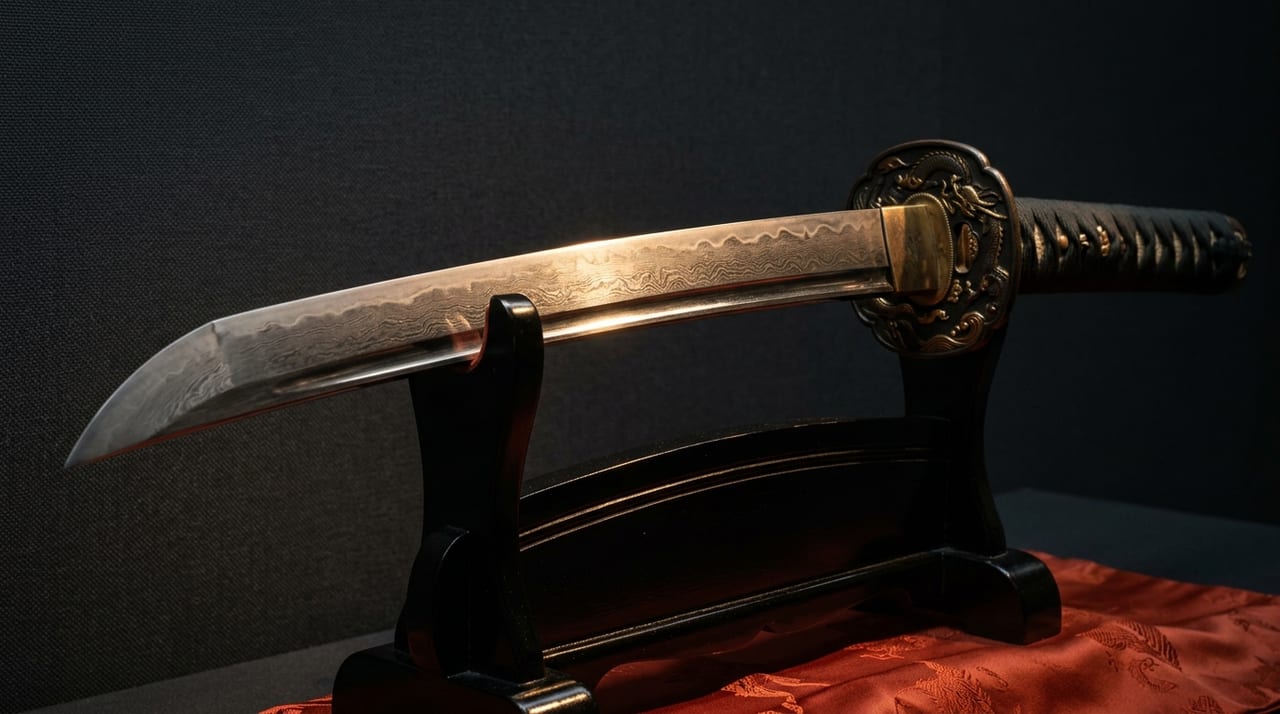
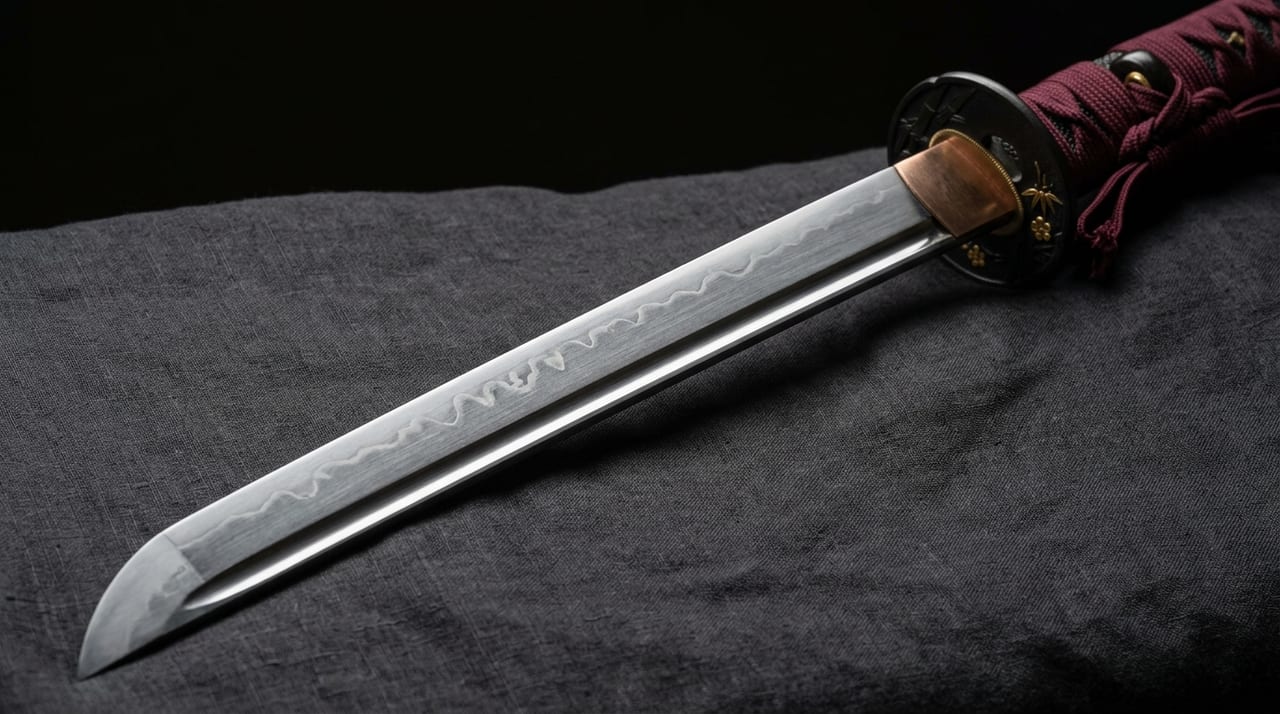
Kawagane literally means "the outer steel" of the sword. It forms the surface of the blade (the flat side, the ridge line, the spine) and is the section where the blade pattern (hamon) is formed.
Characteristics of Outer Steel
- Carbon content: relatively high (approximately 0.6–1.5%). Responsible for sharpness and hardness.
- Type of tamahagane: typically high-quality tamahagane from "akame satetsu" (red-grain iron sand) sources produced by tatara smelting.
- Number of folds: outer steel undergoes many folds (typically around 15), creating a fine, homogeneous steel structure.
The Role of Outer Steel
- Ensures sharpness: high-carbon outer steel hardens through quenching, maintaining a keen edge.
- Wear resistance: the hard surface layer prevents chipping and wear.
- Forms the blade pattern: the hamon is primarily formed in the outer steel during quenching.
Shingane (Core Steel)—The Sword's Core
Shingane is the soft, low-carbon steel occupying the interior (core) of the blade.
Characteristics of Core Steel
- Carbon content: relatively low (approximately 0.1–0.4%). Provides toughness and flexibility.
- Type of tamahagane: typically from "masagane" (fine iron sand) sources produced by tatara smelting.
- Number of folds: sometimes fewer than outer steel (to preserve softness).
The Role of Core Steel
- Prevents breaking (provides toughness): when struck, the soft core absorbs impact through deformation, preventing the blade from fracturing.
- Resists bending failure: under excessive bending stress, the core steel bends to prevent catastrophic failure.
- Overall strength balance: the combination of hard outer layer and soft core creates overall "break resistance" as a unified structure.
How Composite Structures Are Arranged—Types of "Tsukurikomi" (Construction)
There are several patterns for combining outer and core steel:
Kabuse (Covering)
The simplest structure: core steel is "covered" by outer steel. The outer steel wraps around the blade's exterior, with core steel inside. Relatively simple and widely used.
Hon Sanmai (True Three-Layer)
When viewed in cross-section, the core steel (center) is sandwiched between three layers of outer steel (left, right, and top). Also called "three-layer construction." Selected by highly skilled swordmakers for greater precision.
Shihou Tsume (Four-Way Enclosure)
The core steel is surrounded by outer steel on all four sides (top, bottom, left, right). The most precise and technically demanding. Found in some of the highest-quality swords.
Structures Using Munegane (Back Steel)
Some designs employ a separate material called "munegane" (back steel) along the spine to further enhance the back's toughness. This reflects the philosophy of specially reinforcing the spine—which receives the most impact—with a particularly soft material.
Folding and Forge Welding—Refining Outer and Core Steel
Before creating outer and core steel, a preparatory process called "orikaeshi tanren" (folding and forge welding) is performed.
The Principle of Folding and Forge Welding
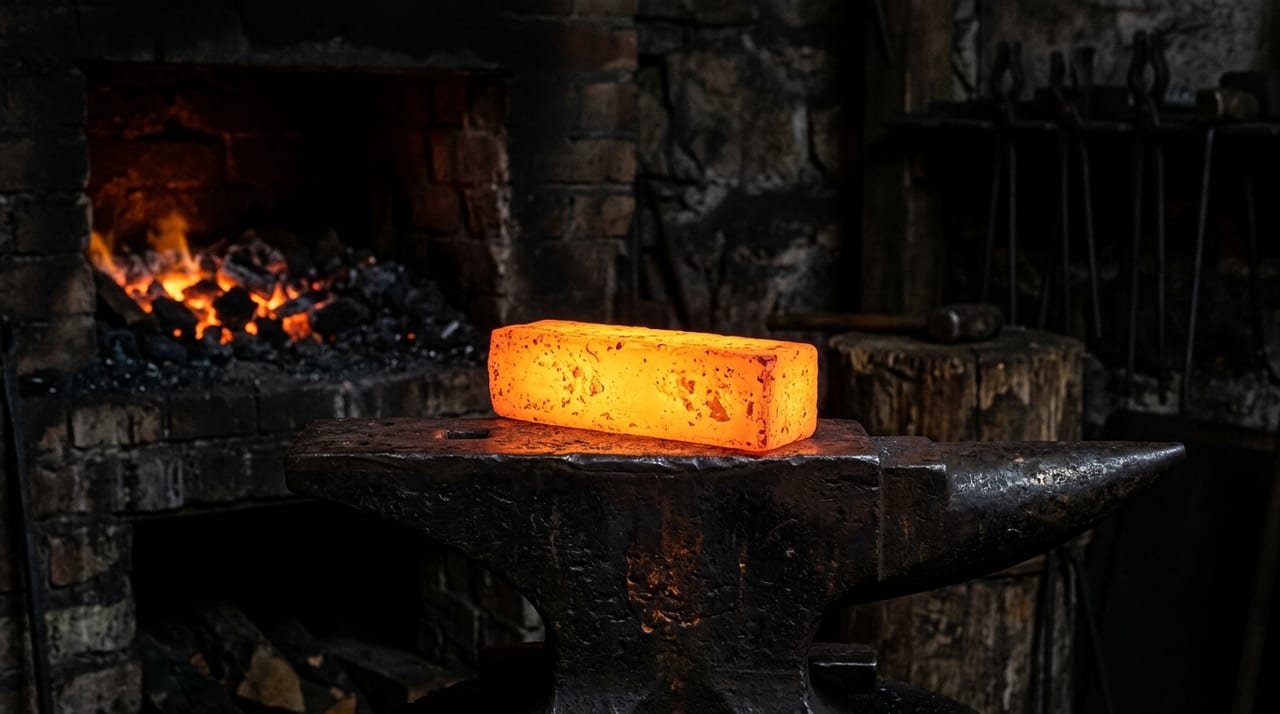
A lump of tamahagane is heated to high temperature (1000–1200°C), then beaten flat with a large hammer (machine or hand hammer) → folded in half → reheated and beaten again. This cycle repeats.
With each fold, the steel's layers double. Through repetition:
- 15 folds: 2¹⁵ = 32,768 layers
- The steel structure becomes fine and homogeneous
- Impurities (slag) are expelled
- Carbon distributes evenly
The Problem of Over-Folding
More folds are not always better. Excessive folding causes carbon depletion (decarburization), preventing the intended carbon content from being maintained. The swordmaker's experience determines the optimal number of folds.
Modern Metallurgical Interpretation—Scientific Understanding of Sword Structure
Viewed through the lens of contemporary materials science and metallurgy, the techniques empirically discovered by swordmakers align remarkably with principles of advanced materials design.
Martensitic Transformation and the "Blade Pattern"
During quenching (water cooling), the high-carbon outer steel undergoes martensitic transformation, forming the blade pattern (the boundary line of the edge). Martensite is an extremely hard structure that provides the blade's cutting ability.
The Principle of Binary Alloys
The combination of outer steel (high-carbon) and core steel (low-carbon) corresponds to modern concepts like "bimetal" or "clad materials." By combining materials with different properties, each property is optimally utilized—a principle still employed in cutting-edge modern materials engineering.
Control of Residual Stress
The blade's curve (sori) that emerges during quenching results from residual stress caused by differences in thermal expansion and contraction between outer and core steel. Swordmakers account for this curvature in their calculations, enabling them to achieve their intended blade shape.
Contemporary Swordmakers Carrying Forward Kawagane and Shingane Technology
Japan's current living national treasures and swordmakers designated as important intangible cultural property faithfully continue these ancient kawagane and shingane techniques.
One challenge contemporary swordmakers face is "year-to-year variation in tamahagane quality." The carbon content of tamahagane produced through tatara smelting varies; even identical processes yield different results annually. Swordmakers must adjust their material selection and folding frequency accordingly. This adaptability is part of what defines a "master craftsman's skill."
Conclusion—A Composite Material Masterpiece Born from 1000 Years of Wisdom
The composite structure of outer and core steel was essentially perfected through trial, error, and accumulated experience by the Kamakura and Nanboku-Chō periods. This technology represents the "optimal solution" Japanese swordmakers empirically arrived at centuries before modern materials science would independently develop similar principles.
Does not break, does not bend, cuts superbly—the design of kawagane and shingane that overcomes this trilemma is the paramount technological foundation for Japanese swords' unique and unparalleled position among blades worldwide.