Forging the Kissaki — Point-Control Techniques of Master Bladesmiths
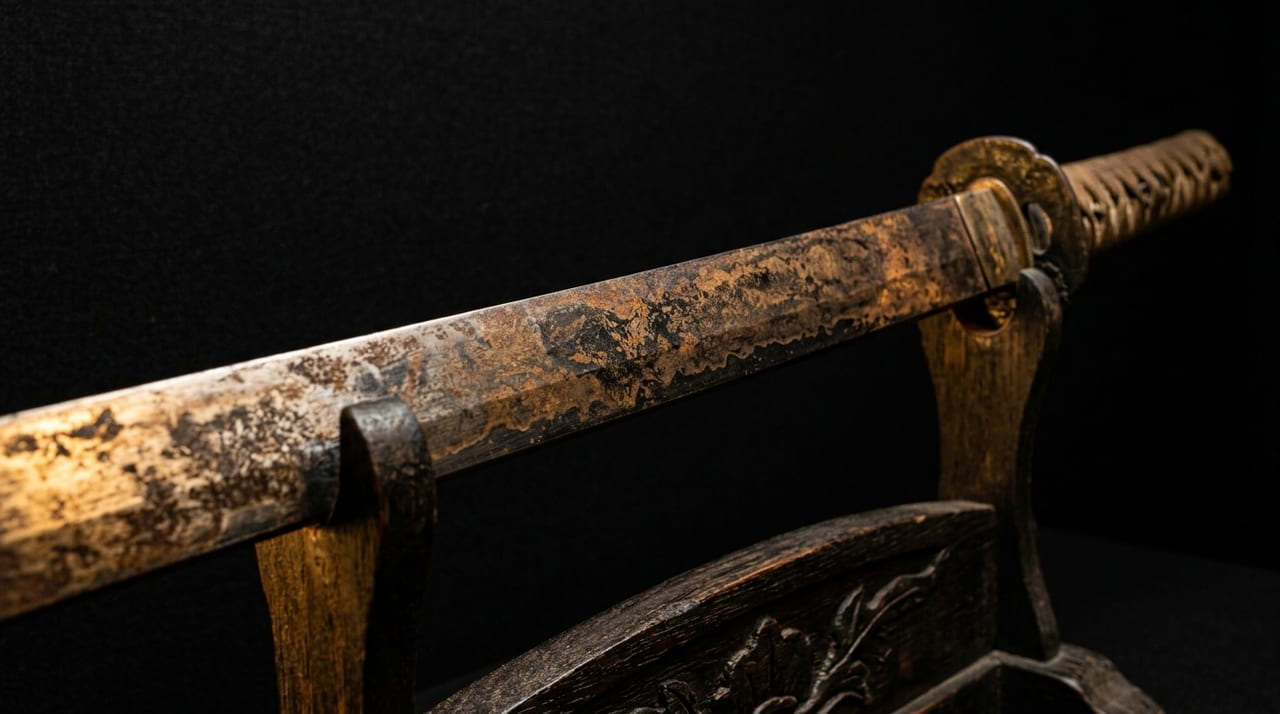 * Image is for illustrative purposes only.
Table of Contents
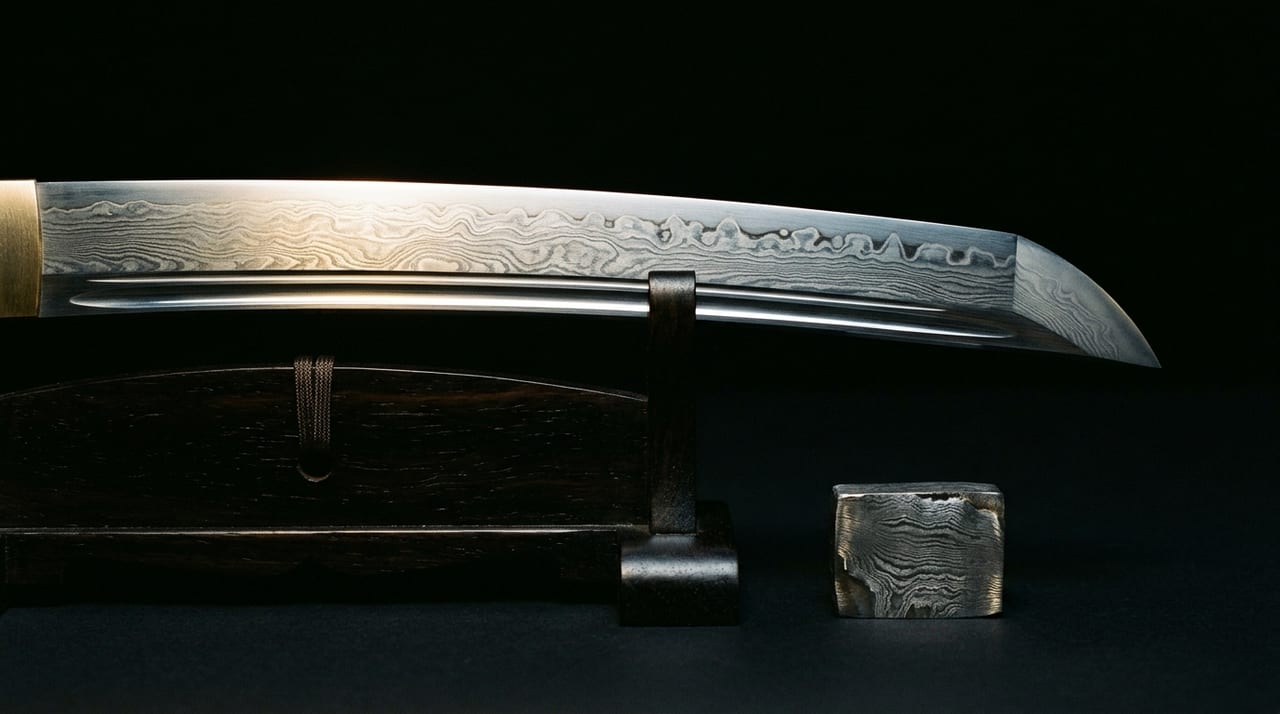
The Kissaki (Tip)—The Apex that Determines a Blade's "Face"
The term "kissaki" (sword tip) refers to the pointed end of a Japanese blade—specifically, the section where the edge pattern and blade body converge at the apex. In sword appraisal, the kissaki is one of the first features that draws the eye, and it serves as a crucial indicator of the blade's creation period, origin, and the smith's technical level.
The kissaki's shape is primarily defined by the following elements:
- Saki-haba (tip width): The width of the edge at the kissaki section. The difference between this and the base width (moto-haba) indicates how "compressed" the tip is
- Boushi (cap): The edge pattern at the kissaki section
- Kaeri (return): The length at which the cap's edge pattern folds back toward the spine
Primary Kissaki Types
Inokubi-kissaki (Boar's Neck Tip)
The inokubi-kissaki is a "short, compressed" tip resembling a boar's neck, and it is the most ancient typical form, commonly found on tachi (long swords) from the mid-Kamakura period.
Morphological Characteristics:
- The tip width is very broad relative to the blade length (minimal difference between base and tip width)
- The tip appears "compressed" or densely packed
- The boushi is small and orderly
- The fukurami (roundness at the tip) is minimal, tapering linearly toward the apex
Functional Characteristics:
- High durability (a thick, short tip is resistant to breakage)
- Better suited for cutting strikes than thrusting attacks
- Designed for mounted warfare, where a rider would strike downward from horseback
Representative Period and Smiths: Typified by the tachi of Osafune Mitsutsugu and Hiromitsu from the Kamakura period. Frequently seen in blades from the "Ichimonji" school.
Naka-kissaki (Standard Tip)
The naka-kissaki can be called the "standard tip"—the most common form. It became standardized from the Muromachi period onward and remains the most frequently produced today.
Morphological Characteristics:
- The tip width tapers appropriately from the base width
- The boushi ranges from small-round to medium-round
- The fukurami is natural and graceful
- Overall balance creates a "universal" aesthetic beauty
Functional Characteristics:
- Excellent balance between cutting and thrusting
- Ideal for the katana (the dominant blade form from the Muromachi period onward)
- Considered the "standard" form in martial arts training
Ko-kissaki (Small Tip)
Interpreted as either an evolution or variation of the inokubi-kissaki, the ko-kissaki presents a finer, more pointed appearance.
Morphological Characteristics:
- The tip width tapers significantly from the base width
- The tip is slender with an "elegant" appearance
- The boushi is small and refined
- Found on ancient blades from the Heian period and in some Shinshintoish (new-new sword) reproductions
Reasons for Development:
- Restoration of the elegant aesthetic forms of the Heian period (reproductions from the Shinshintoish period)
- Designed for specialized use emphasizing fine thrusting capabilities
Ō-kissaki (Large Tip)
The ō-kissaki is a large, extended "grand" tip that was popular during the Nanboku-chō period and the early Edo period (Shinto era).
Morphological Characteristics:
- The tip width is broad, with the kissaki extending far
- The boushi is large, sometimes with an intricate pattern
- Typical of the Nanboku-chō style, also called "Enbun-Jōji" style (after those eras)
- Overall impression is grand and imposing
Functional Characteristics:
- The extended kissaki provides superior thrusting capability
- Designed to meet the demands of the fierce battles of the Nanboku-chō period (large-scale combat)
Representative Period and Smiths: Large tachi by Osafune Kanemistu from the Nanboku-chō period, and early Edo period Shinto blades (such as Genroku-uchi style).
Controlling the Kissaki During Forging—The Craftsman's Technical Challenge
The kissaki's shape is not accidental; it is deliberately controlled at each stage of the forging process.
Controlling Tip Width
The "sogi" (tapering) before forging: During the initial shaping of the blade's apex, the smith controls the tip width by adjusting the angle of the "sogi" (taper) toward the point.
- Steeper taper → narrower tip width (ko-kissaki, naka-kissaki)
- Gentler taper → wider tip width retained (inokubi-kissaki, ō-kissaki)
The "saki-tsume" (tip compression) technique: A technique where the blade's apex is struck intensely at high temperature to extend it in the forward direction. This creates an ō-kissaki-like "extended tip."
Shaping the Boushi
The edge pattern (boushi) at the kissaki is fundamentally determined at the clay-application (tsuchoki) stage, before quenching.
Clay application for the boushi: The amount and shape of the clay applied to the kissaki section determines the boushi's edge pattern.
- Thick, wide clay application → narrow hardened edge, small boushi
- Thin, narrow clay application → broad hardened edge, large intricate boushi
Shaping the Fukurami
The "fukurami" (roundness) at the tip is finally shaped during polishing. The polisher's skill determines the kissaki's final aesthetic quality.
Summary of Kissaki Evolution Across Periods
| Period | Primary Kissaki Form | Reason |
|---|---|---|
| Heian–Early Kamakura | Ko-kissaki, Inokubi-kissaki | Mounted warfare; durability of tachi prioritized |
| Mid-Kamakura | Inokubi-kissaki | Osafune school perfected the form |
| Nanboku-chō | Ō-kissaki | Large tachi; thrusting power for ground combat |
| Muromachi–Sengoku | Naka-kissaki | Standardization of the katana |
| Early Edo (Shinto) | Ō-kissaki | Revival of Nanboku-chō aesthetics |
| Late Edo (Shinshintoish) | Naka-kissaki, Ko-kissaki | Reproductions of Kamakura and Yamashiro ancient blades |
| Modern Blades | Naka-kissaki and others | Ancient blade reproductions; contemporary sensibility |
Appreciation in Practice—Key Points for Observing the Kissaki Closely
Observing the Boushi
The boushi at the kissaki is a crucial point in edge pattern appreciation:
- Types of boushi: Small-round (komaru), medium-round (nakamaru), large-round (ōmaru), intricate (midare-gomi)
- Length of the kaeri (return): Deep returns suggest Sōshū influence; long boushi suggests Nanboku-chō origin
- Pattern intricacy: A "deep boushi" with intricate patterns extending into the core steel is a sign of high technical skill
Balance Between Tip Width and Base Width
The ratio between base width and tip width determines a blade's "profile" (sugata). When the difference is large (a fine tip), the blade conveys a "flowing elegance"; when the difference is small (uniform), it suggests "powerful martial authority."
Conclusion—The Kissaki as a "Seal" Inscribed by Time
The kissaki's shape is a "seal" inscribed with the era, origin, and aesthetic vision of the smith who made it. Seeing an inokubi-kissaki conjures images of Kamakura's mounted warriors; a ō-kissaki evokes the fierce battles of the Nanboku-chō period.
Understanding the kissaki's shape in relation to its historical period is both the gateway to reading a Japanese blade's "form" and one of the foundational principles of sword appraisal.