The Kaji's "Tameshiuchi" — The Process and Criteria for Assessing Blade Quality through Trial Forging Before Completion
 * Image is for illustrative purposes only.
Table of Contents
What Is Tameshiuchi — Quality Verification Before Completion
The word "tameshiuchi" is most commonly used to mean tameshigiri — testing the cutting ability of a completed blade. In the context of kaji technique, however, the term also refers to "test strikes" or "sample forging" carried out during the manufacturing process to check the condition of the blade material. This article explains tameshiuchi in the latter sense — that is, as an intermediate check within the sword-making process.
The intermediate checks a tōshō performs at each stage of forging can be broadly divided into three types.
- Visual inspection
- Verification by the feel of the hammer
- Test cutting (checking for peeling and cracking)
The concept that encompasses all of these is tameshiuchi, and since defects discovered after completion are difficult to repair, this process is an extremely important step that determines the success or failure of a blade.
Looking at each stage of the process, the points to be checked can be organized as follows.
| Process stage | Main points to verify at this stage |
|---|---|
| After orikaeshi tanren | Presence or absence of hadaware (surface cracking) |
| Sunobe stage | Uniformity of thickness and unevenness of carbon distribution |
| After hizukuri completion | Shape check assuming provisional yaki-ire (checking sori) |
Verification After Orikaeshi Tanren — Early Detection of Hadaware and Cracking
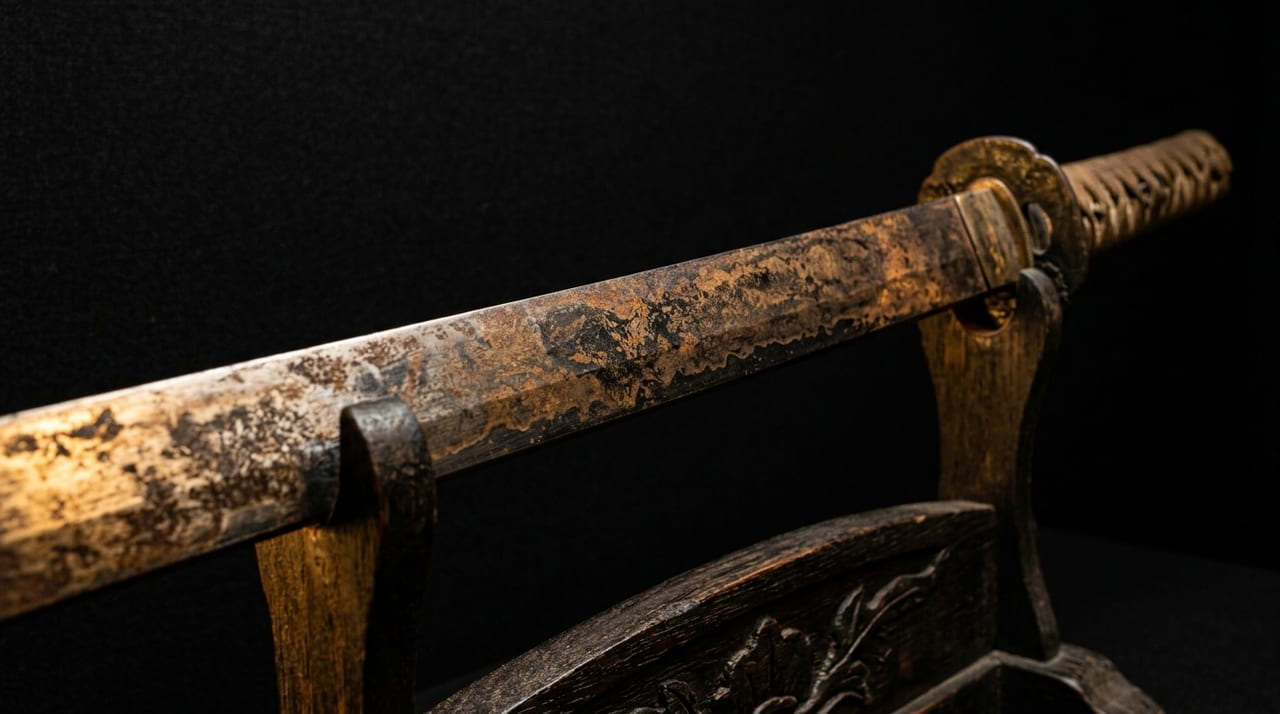
After orikaeshi tanren has been performed several times, the tōshō carefully observes the surface of the steel. The main point to check at this stage is the presence or absence of hadaware (surface cracking).
Hadaware are fine cracks that occur during orikaeshi tanren in the following types of areas.
- Areas where the temperature was too low
- Areas where the steel contained many impurities
- Areas where the adhesion at the fold was incomplete
Small hadaware may disappear as tanren continues, but deep cracks are not resolved even with repeated tanren and ultimately remain as defects in the blade. Such defects are sometimes discovered only after polishing, bringing great disappointment to the tōkō.
One method of verification at this stage is to "apply light strikes and observe the spread of cracks." The steel is reheated to an appropriate temperature, and the tōshō observes any surface changes or peeling when it is lightly struck with a hammer. If cracks spread, this is taken as an indication that the material has a problem, and the decision may be made to start over from the material. This involves great cost, but it is a far more rational choice than discovering defects after completion, and is a moment that tests the tōshō's integrity and judgment.
Testing at the Sunobe Stage — Checking Uniformity of Shape
Once the folding in forging is complete and the process moves into "sunobe" — the step of forming the basic shape of the blade — a different kind of verification becomes necessary. The purpose of tameshiuchi at this stage is to verify "uniformity of thickness" and "unevenness of carbon distribution."
Uniformity of thickness is verified by actually bending the blade slightly. If there are areas that have become too thin, those areas deform first and can be confirmed visually. The unevenness of carbon distribution may also be judged from changes in the feel of the hammer — the difference between areas that feel soft and those that feel hard. High-carbon areas are relatively hard, while low-carbon areas feel soft to the touch. Eliminating this difference in feel and making the whole uniform is the main goal of the sunobe stage, and a skilled tōshō continues a dialogue with the steel with every strike of the hammer.
Verification After Hizukuri Completion — Overall Judgment of Sori and Shape
At the stage when "hizukuri" — the step of shaping the external form of the blade — is complete, a final shape check is performed before yaki-ire. The tameshiuchi at this point can be described as a "shape check assuming provisional yaki-ire."
The tōshō simulates in advance how the blade will curve (how sori will appear) as a result of yaki-ire, and intentionally makes the sori at the point of hizukuri completion shallow (or in the opposite direction). In order to verify whether this shape design — which anticipates the deformation after yaki-ire — is correct, the tōshō may apply provisional yaki-ire to a material of similar shape and measure the degree of deformation. This is sometimes called "tameshiyaki."
The deformation data obtained from this tameshiyaki becomes the basis for fine-tuning the hizukuri shape before the actual yaki-ire. An experienced tōshō knows this degree of deformation in their body from a vast wealth of past forging experience, but when using new material (such as tamahagane from a different lot), tameshiyaki is indispensable. This carefulness is precisely what makes the difference between a masterwork blade and an ordinary one.
The Difference from the Ancient "Tameshimono"
Tameshiuchi during sword-making and "tameshimono" — the verification of a completed blade's cutting ability — are fundamentally different. Tameshimono was an institutionalized custom of the Edo period in which cutting ability was quantified using the corpses of executed criminals, bundles of grass, water-filled bamboo, and the like, with the purpose of "grading" cutting performance. The skill of the "execution officials" carried out by figures such as Yamano Kōtō and Yamada Asaemon is recorded in history as a specialized vocation devoted to tameshimono.
In contrast, tameshiuchi during sword-making has the purpose of early detection of defects and ensuring quality; it is not an evaluation after completion but a quality-control activity built into the manufacturing process. This concept corresponds in thought to "in-process inspection" in modern manufacturing, and it is a good example of the seeds of modern quality control being found within Japanese craftsmanship.
The Reality of Tameshiuchi Among Contemporary Tōshō
For a contemporary tōshō to make a nihontō, they must obtain approval for manufacture for each blade. The Regulation on Approval for the Manufacture of Art Swords sets no annual limit on the number of blades (Regulation on Approval for the Manufacture of Art Swords (e-Gov Law Search)). However, prefectural examination criteria specify the number of tanren days per blade (tachi, katana, and naginata: 15 days or more; wakizashi, tantō, and similar: 10 days or more), and the number that can be produced is effectively limited (Aomori Prefecture "Approval for the Manufacture of Art Swords" Examination Criteria). For this reason the weight of a single failure is great, and even in the modern era the importance of intermediate checks remains unchanged.
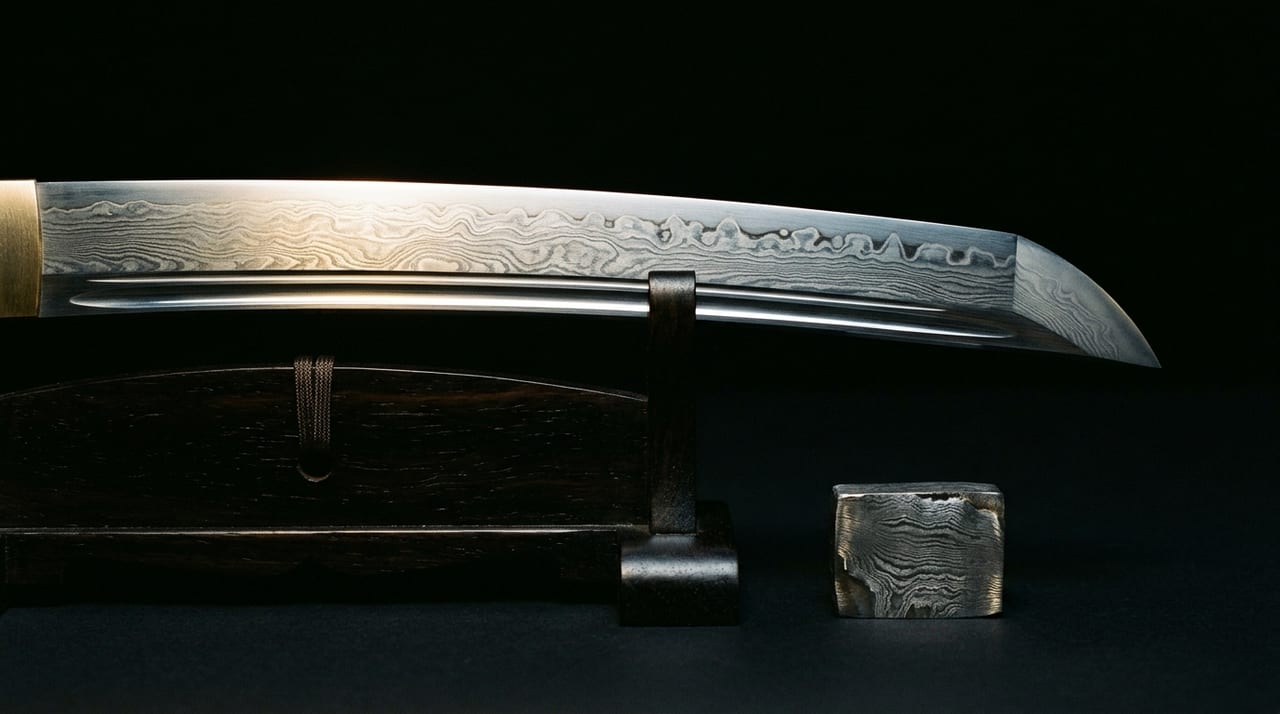
Many contemporary tōshō adopt a method of removing a sample piece (a scrap of steel) at each stage of orikaeshi tanren, polishing it, and visually confirming the jigane structure. By confirming the uniformity of the grain patterns (mokume, itame, masame) that appear when the steel is polished, the quality of the tanren can be assessed. This is a quality-control method that reinterprets traditional tameshiuchi in a modern way, and it is also evidence that contemporary tōshō practice while inheriting ancient wisdom.
Conclusion — Tameshiuchi as the Craftsman's Self-Dialogue
Tameshiuchi is an act in which the craftsman questions their own work. "Is this steel uniform?" "Can yaki-ire be performed in this shape?" "Is there any defect in this material?" — the process of answering these questions oneself is tameshiuchi, and it is also a moment that tests the tōshō's integrity and skill. Behind the beauty of the finished blade, careful verification work in these invisible stages accumulates layer upon layer. When appreciating a nihontō, try to picture the culture of rigorous self-examination that lies behind its creation.