Sorting and Grading Tamahagane — Criteria for Classifying Steel Produced by Tatara Smelting into Kawagane and Shingane, and the Discerning Eye of the Tōshō
 * Image is for illustrative purposes only.
Table of Contents
What is Tamahagane — The Special Nature of the Raw Material for Nihontō
"Tamahagane" refers to steel selected from among the non-uniform steel blocks produced by tatara smelting that meet the quality standards suitable for nihontō production. The name means "jewel-like steel," reflecting the appreciation for the beauty and luster of its fractured surface.
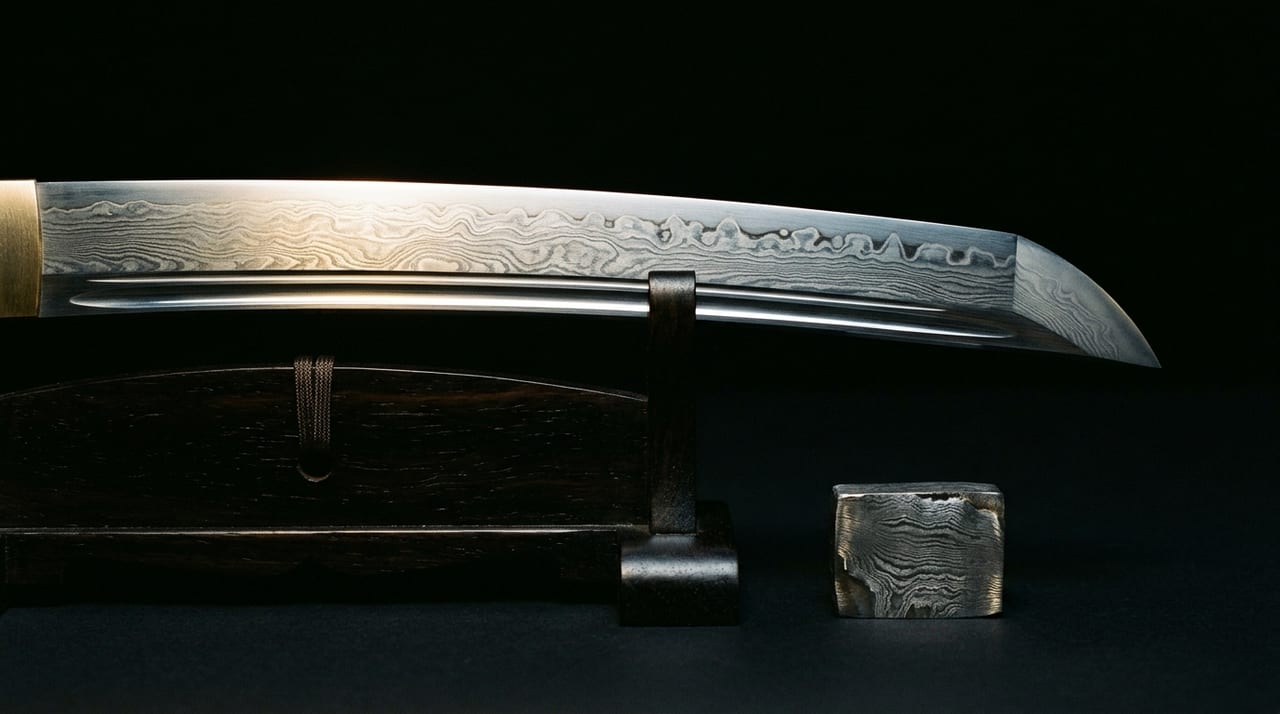
In industrial modern steelmaking, steel of uniform quality with precisely controlled carbon content can be mass-produced. In contrast, tamahagane is a non-uniform material in which the carbon content varies widely across different parts, ranging from 0.5 to 1.5%. It is precisely this non-uniformity that makes possible the sorting into "kawagane (jacket steel)" and "shingane (core steel)" in sword forging, and that contributes to the formation of the jigane and hamon unique to nihontō.
While it is technically possible to forge a blade using uniform steel produced by modern steelmaking, the natural non-uniformity of tamahagane and the distribution of fine slag produced during the tanren process give rise to the expression of kitae-hada known as "jihada (grain pattern of the steel)" that is characteristic of nihontō. Uniform industrial steel lacks this variation in jihada, and this is one of the reasons tōshō continue to choose tamahagane.
Kera-dashi and Initial Classification of Tamahagane
When the tatara smelting operation ends, the work of "kera-dashi" — dismantling the furnace (takadono) and extracting the steel block "kera" — begins. The kera is a steel block weighing several tons that has settled at the bottom of the furnace, and its cross-section is composed of multiple layers.
| Part | Carbon Content | Characteristics / Classification |
|---|---|---|
| Upper part (near the center of the furnace) | High (approximately 1–1.5%) | Tends to become the hardest steel; classified as the highest-quality tamahagane |
| Middle layer | Moderate | Often used as shingane |
| Bottom / near furnace walls | Low (0.1–0.5%) | Used as soft wrought iron (bugera) for agricultural and industrial tools |
This initial classification is carried out by an experienced murage (the overall supervisor of tatara smelting) during the process of dismantling and extracting the furnace. That said, this rough classification performed immediately after kera-dashi is merely the first stage in determining whether the material is usable as tamahagane and its approximate grade. The final judgment as to which parts are to be assigned to which blade in which manner is left to the discerning eye of the tōshō who receives the tamahagane.
The Tōshō's Technique of Tamahagane Sorting
Tamahagane distributed by the Nittoho tatara undergoes further precise sorting by the tōshō themselves when it arrives at their workshop. The tōshō's discerning eye — that is, the ability to assess the quality of tamahagane through visual, tactile, and experiential judgment — is a crucial skill that forms the very foundation of a tōkō's craft.
Observation of the Fractured Surface
One of the most important criteria in sorting tamahagane is the observation of the "wareguchi" (fractured surface). By examining the color, luster, grain size, and structure of the cross-section exposed when tamahagane is split with a hammer, one can estimate the carbon content and the state of the iron's crystal structure.
The wareguchi of high-carbon tamahagane (intended for kawagane) shows a fine granular crystal structure that glows silver-white. This reflects the fine microstructure of martensite and pearlite characteristic of high-carbon steel. Low-carbon tamahagane (intended for shingane) tends to show a grayish, coarser granular cross-section. Pig iron (zuku) with a carbon content exceeding 2% shows a whitish and brittle wareguchi, and as it is difficult to handle in orikaeshi tanren (folding), it requires separate processing.
Judgment by Color and Luster
The color of the wareguchi (ranging from silver-white to gray and black) and the degree of luster serve as indicators of carbon content and the amount of impurities (slag) mixed in. Tamahagane with a high slag content shows black streaks or voids (su) in the wareguchi, which must be expelled through repeated tanren. High-quality tamahagane is characterized by uniform luster and low slag content.
Classification into Kawagane and Shingane
The sorted tamahagane is classified into material for "kawagane (jacket steel)" and material for "shingane (core steel)" based on its carbon content and quality.
- Kawagane (jacket steel): High-carbon steel used for the outer layer of the blade (the outer jacket including the cutting edge); it is involved in hardness and hamon formation
- Shingane (core steel): Low-carbon, soft steel used for the core of the blade; it provides toughness (jinsei: resilience)
This composite structure of "high carbon on the outside, low carbon at the core" is the heart of the design that simultaneously achieves the three qualities that characterize nihontō: not breaking, not bending, and cutting well.
Training to Develop the Eye for Sorting
The tōshō's eye for sorting is not something that can be developed overnight. An apprentice spends many years under a master repeatedly splitting tamahagane, observing the cross-sections, actually forging them, and then checking the state of the resulting jigane — gradually refining the accuracy of their judgment. Because the finished result varies depending on how the same tamahagane is forged, the accumulated experience itself becomes the measure by which sorting judgments are made.
In addition to observing the wareguchi, color, and luster, it is said that for an experienced tōshō, the sound when pieces of tamahagane are struck together and the sensation of weight when held in the hand also serve as elements of judgment. Tamahagane with a dense slag content is said to feel heavier than a piece of the same size and tends not to produce a clear sound. However, such sensory judgments are difficult to quantify, and in the end they are evaluated comprehensively together with observation of the wareguchi and the behavior during actual forging.
For tamahagane about which there is uncertainty, it is not uncommon to refrain from forcing it into either kawagane or shingane, and instead to continue assessing the state of the carbon during the early stages of tanren before deciding how to treat it. This kind of flexible judgment that allows for holding off is itself one of the techniques supported by the tōshō's experience.
Connection with Orikaeshi Tanren
The sorted and classified tamahagane goes through the processes of "tsumiwakashi" (stack-heating) and orikaeshi tanren (folding) to homogenize the carbon and expel the slag. By adjusting the number of folding passes, the tōshō brings the final carbon content of the kawagane close to the target value (approximately 0.7–1.2%).
If the carbon in the kawagane is too high, the sword becomes brittle and prone to chipping; if too low, it becomes soft and loses its cutting edge. Tōshō achieve this "adjustment to the appropriate carbon level" — an invisible process — by empirically controlling three variables: the number of folding passes, the heating temperature, and the intensity of the forging. The more accurately tamahagane has been sorted, the easier this adjustment becomes, and the more stable the quality of the final jigane and hamon.
If there is an error in the assessment of carbon content at the sorting stage, it may be impossible to reach the target carbon level no matter how many times orikaeshi tanren is repeated, or conversely the steel may become lean from over-forging. Tamahagane sorting and orikaeshi tanren are not independent processes; they must be understood as a continuous set of techniques in which the assessment made at the sorting stage directly determines the design of the forging process.
Tamahagane Sorting and the Value of Swords
In appraisals conducted by the NBTHK (Society for the Preservation of Japanese Art Swords) and others after the blade is completed, the character of the jigane and the brilliance of the hamon are important evaluation criteria. Both of these are factors that are heavily influenced not only by the forging technique but also by the skill of tamahagane sorting that precedes it. Even tōshō with the same orikaeshi tanren technique will produce blades with different jigane expression depending on the quality of the tamahagane they select and the accuracy with which they assign it to kawagane or shingane.
Because tamahagane sorting is not a process that appears directly on the blade, it is difficult to read its quality directly just by looking at the finished sword. However, the accuracy of the sorting is certainly reflected in the results in the form of the uniformity of the jigane and the brilliance of the hamon. An understanding of this invisible process is an indispensable perspective for assessing the value of nihontō.
The quality of a nihontō is already decisively influenced at the stage of "tamahagane sorting" before the blade is made. The discerning eye of a skilled tōshō — the unity of the eye that sees the material and the backing of technical skill — can truly be called the comprehensive knowledge of the sword forger.