Tools and Workshop Layout of a Swordsmith: From Forging Hammers and Whetstones to the Modern Kaji-ba
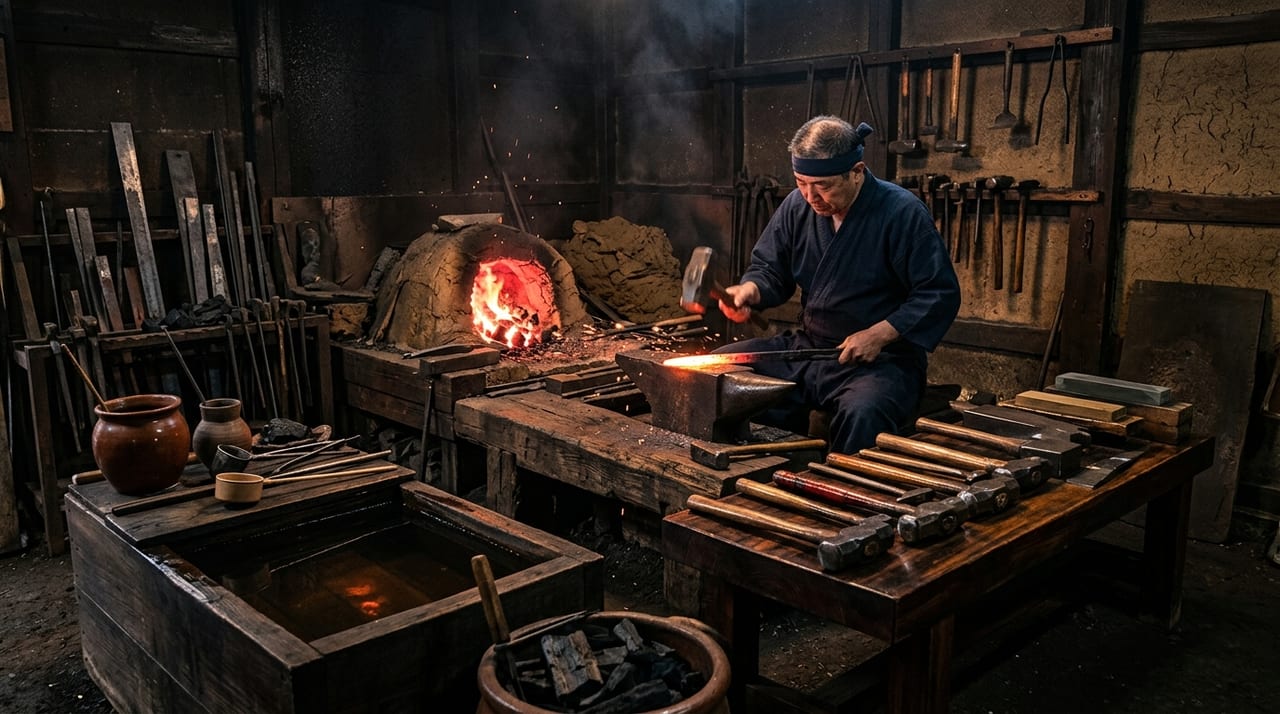 * Image is for illustrative purposes only.
Table of Contents
Basic Structure of the Forging Workshop (tantojo)
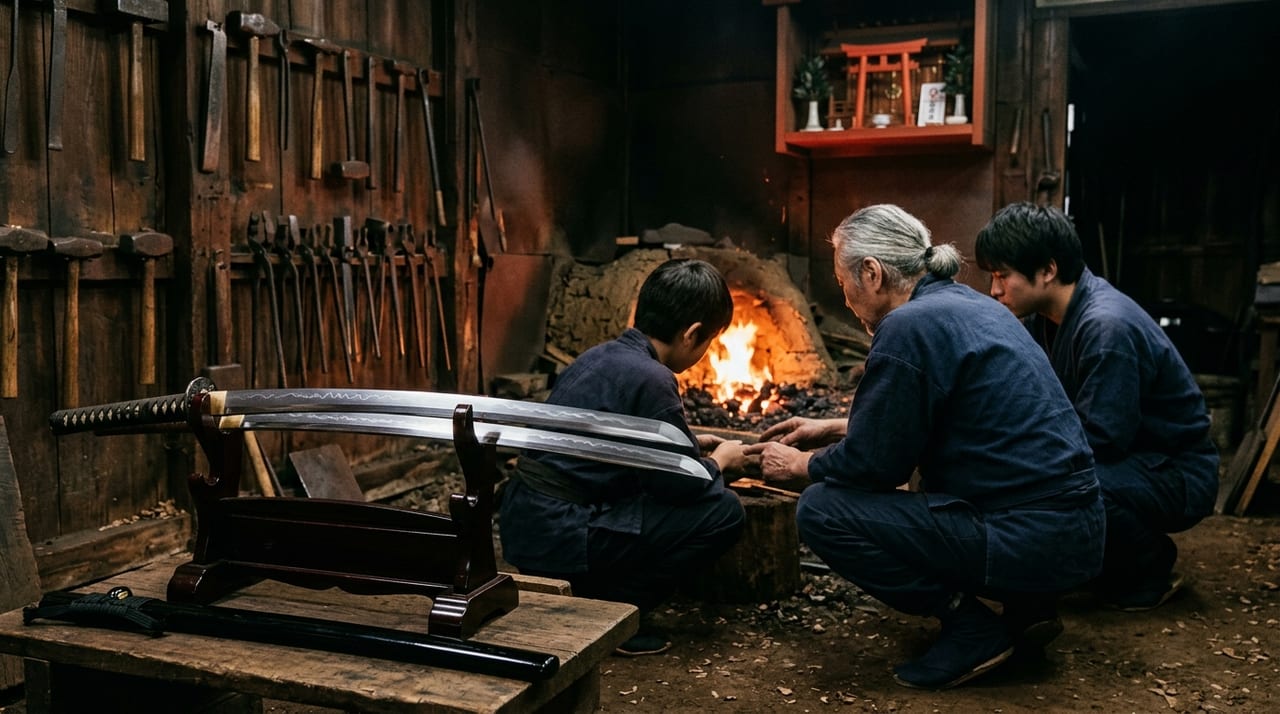
The "forging workshop" (tantojo) where contemporary sword makers work is a dedicated facility that inherits the tradition of the ancient "blacksmith shop" (kajiba) while meeting modern standards for architecture, fire prevention, and labor safety. A typical forging workshop spans approximately 30-60 square meters and is equipped with a furnace (bellows furnace or electric furnace), anvil stand (kinutadai), water tank, tool shelf, and ventilation equipment. The roof is either tile or metal sheet covered, and above the furnace is a smoke duct for exhaust purposes.
The heart of the forging workshop is the fire bed (hidoko). The traditional fire bed is a sunken depression furnace that uses coke or charcoal as fuel. Most contemporary sword makers use coke, though some are particular about charcoal. The furnace uses "bellows" (fuigo) for air supply. The traditional box bellows had a structure where stepping on both sides of the boards pumped air, but in modern times, many workshops combine this with an electric blower. Temperature management of the furnace is a master craft of the sword maker, who visually judges the color of the steel (red heat, yellow heat, white heat) to adjust the heating condition.
Types and Uses of Forging Hammers (kajitsuchi)
There are multiple types of hammers that sword makers use, each applied differently according to the forging stage. The main types are listed below.
| Type | Weight | Main Use | Characteristics |
|---|---|---|---|
| Large hammer (ootsuchi) | Approximately 1-3kg | Coarse striking to hammer and spread steel in the early stages of forging | Operated by a disciple called the "striking hand" (utte). The handle is approximately 1 meter long, allowing powerful strikes with full body weight |
| Hand hammer (tetsuchi) | Approximately 600g-1kg | Finishing stage of forging and fine adjustments to shape | A medium-sized hammer held with one hand by the sword maker. The head is made of steel, and different striking methods such as "flat striking" and "curved striking" are used depending on the curvature of the striking surface |
| Small hammer (kotsuchi) | Approximately 200-400g | Detailing and finishing of the ridge (mune) and ridge-line (shinogi) | Hammer handling is where the sword maker's individuality shows most distinctly, and the way the hammer marks (tsuchiame) are left affects the expression of the blade |
The anvil (kinuta) is a steel stand that serves as the base during forging. There are two types: the flat anvil (hirachinuta) and the grooved pattern anvil (katachinuta). The pattern anvil has grooves for forming the cross-sectional shape of the blade and is used in the "shaping" (tsukurikomi) process.
Hardening Equipment—Water Tank, Clay, and Blade (hera)
The quenching (yakiire) process requires specialized equipment. The quenching tank, called the "quenching tub" (yakibune), was traditionally made of wood or ceramic, but in modern times is most often stainless steel. Since water temperature management directly affects the success or failure of quenching, many sword makers keep a thermometer on hand and adjust the water volume and temperature seasonally. The tank shape matches the blade length (sword length), with a standard size of 80-100cm for typical long swords (65-75cm) that require accommodation.
Preparation and storage of clay coating (tsuchitori)—the refractory clay applied to the blade surface before quenching—is another essential part of the forging workshop. Clay for coating is made by mixing clay, charcoal powder, whetstone powder, and other materials, and is applied using a "blade" (spatula) (hera) or brush. The material and shape of the blade varies by sword maker, and many make their own. The thickness of the clay coating and how the boundary line is drawn determine the design of the hamon, so the precision of tools used in this process is extremely important.
Grinding and Finishing Equipment—Files, Whetstones, and Rough Polishing
In the "finishing forging" stage after forging, the file (yasuori) becomes an indispensable tool for shaping the blade. Iron files come in coarse, medium, and fine grades, and are used to adjust the angles of the ridge-line area (shinogiji), flat area (hiraji), and ridge. Contemporary sword makers sometimes use electric grinders as auxiliary tools, but all final surface finishing is done by hand.
"Rough polishing" (meaarashi) is the preliminary rough polishing done by the sword maker before passing the blade to the polisher (togishi), using a coarse whetstone. At this stage, blade distortion is corrected and the straightness of the ridge-line and blade tip angle are brought within the proper range. Rough polishing sometimes involves difficult judgments and is a process that tests the sword maker's experience and intuition. The "anvil stand" (zaganedai) found in the forging workshop is a wooden or metal stand for holding the blade during polishing, and is used when the sword maker performs the final finishing polish.
The Contemporary Sword Maker's Atelier—Auxiliary Equipment and Safety Management
In addition to traditional tools, contemporary forging workshops have introduced various auxiliary equipment. Standard equipment includes the following:
- Electric blower
- Thermometer (furnace temperature and water temperature)
- Exhaust fan
- Sound insulation material
Additionally, when applying for sword-making permission from the Agency for Cultural Affairs, installation of fire prevention equipment (fire extinguishers, fire shutters, etc.) is required, and thorough safety management is mandated.
The lighting of the forge also requires careful consideration, basically using natural light during the day and fluorescent lights at night, though many sword makers intentionally keep the space near-dark during quenching to more accurately perceive the color of the steel (color temperature). Most contemporary swordsmiths operate as sole proprietors managing one to two apprentices in a small-scale setup, and the forging workshop transcends being merely a workspace to become a dojo-like space where master and disciple transmit technique and spirit to one another. Even in matters such as tool maintenance, placement, and storage, the sword maker's dedication and philosophy are reflected, and the workspace itself can be said to be a "self-portrait of the sword maker."