Muromachi Period vs Modern Swordsmith Training
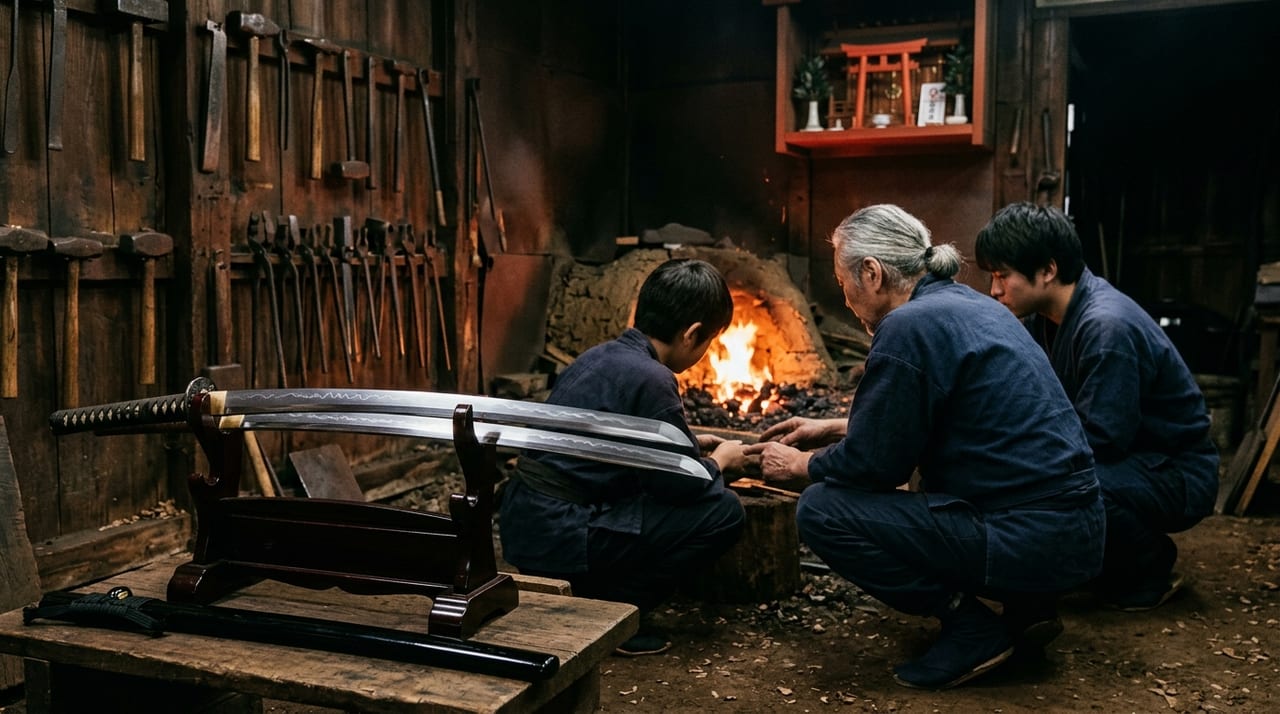 * Image is for illustrative purposes only.
Table of Contents
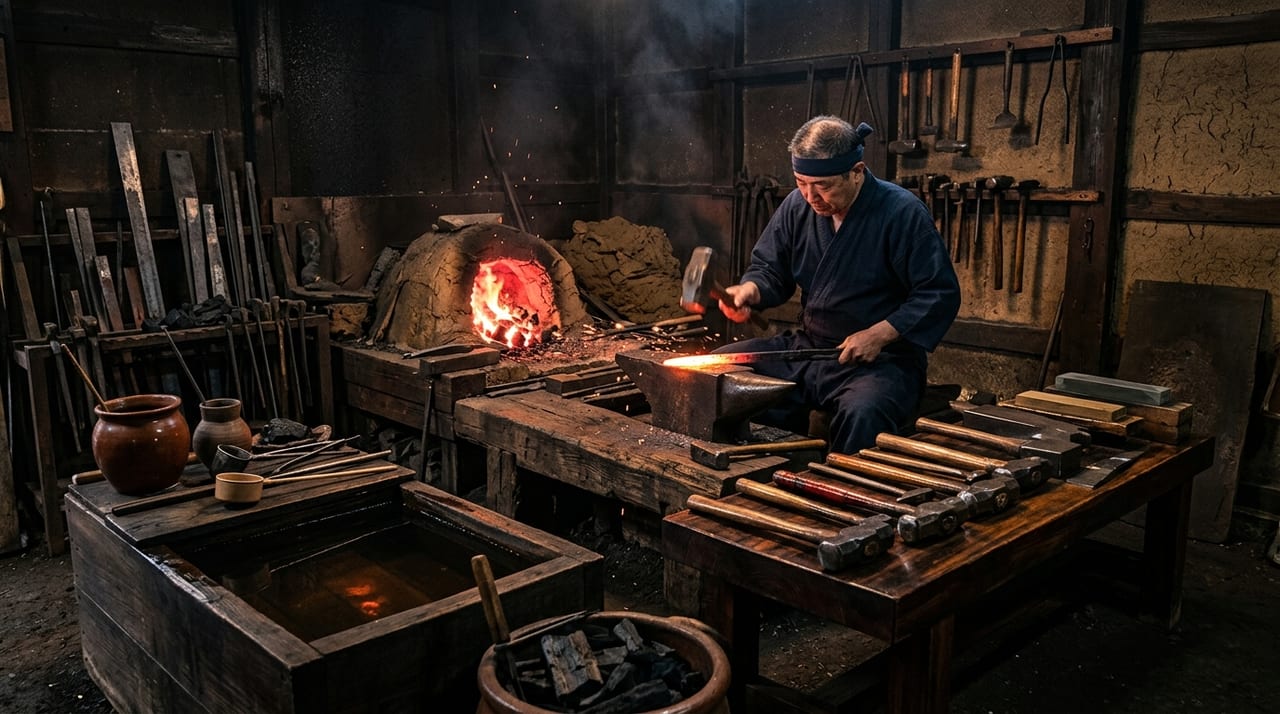
Sword smiths during the Muromachi period were part of a traditional craftsman training system where they acquired skills through apprenticeship under a master. Generally, the apprenticeship period was standardized at around seven to ten years, and during this time, they were expected to master all the following processes.
- Selection of tamahagane
- Fire forging
- Quenching
- Polishing
In particular, the quenching process, which is the most critical step, depended heavily on experience and intuition, making years of accumulated daily practice essential. During the Muromachi period, apprentices followed their master's movements with their eyes and acquired techniques through trial and error—essentially, learning by observation was the central method. Through this process, not only the master's technical skills but also the aesthetics and values unique to each school were simultaneously transmitted.
Modern sword smith training has evolved to maintain these traditional elements while moving toward a more systematic and efficient curriculum. At official training institutions such as the Japanese Sword Forging Technique Preservation Society, intensive courses lasting three years form the foundation, allowing practitioners to acquire basic techniques in a shorter timeframe than in the Muromachi era. Modern apprentices can learn theoretical understanding of historical background and materials science from the start, and can undertake practice with scientific comprehension of why such techniques are necessary. Furthermore, by using measurement instruments such as thermometers, the conditions of quenching can be controlled more precisely, significantly reducing the time spent on trial and error.
Changes in Training Content and Forms of Succession
Training during the Muromachi period dealt with all the processes from the procurement of tamahagane onward. Apprentices first learned furnace management and the handling of tamahagane, then gradually progressed to fire forging through staged education. The master demonstrated the entire process of making one sword, and through the apprentice's imitation, the techniques were passed to the next generation. The advantage of this method was that it allowed not merely technical transmission but also the simultaneous acquisition of philosophy and aesthetic sense as a sword smith. Moreover, many of the secret techniques and innovations of each school could only be transmitted through such close master-disciple relationships.
In modern training, a curriculum for systematically learning fundamental techniques has been established, and it is now possible to receive instruction from multiple instructors from different perspectives. Moreover, career paths after training have diversified, and there is an option to study under a specific master craftsman after completing official training institutions to learn more advanced techniques. In this way, in modern times, "basic education" and "practical training" have been separated, and a system for more efficiently nurturing the next generation of sword smiths has been set up.
Differences in Quality of Technical Transmission and Duration of Practical Training
Long-term training during the Muromachi period was not merely a time for acquiring techniques but also a period for forming identity as a sword smith. Over seven to ten years, apprentices experienced the changing of seasons many times, and by repeating the same processes hundreds or thousands of times, their bodies naturally came to remember the optimal movements. Acquiring this "embodied knowledge" required a time span that could not be substituted in the short term. Additionally, the length of the training period was also evidence of social status and trust, and there was a shared understanding that craftsmen who trained for longer were superior.
Even for modern sword smiths, the importance of accumulating practical experience after completing basic training has not changed. However, in modern times, it has become possible to accumulate experience efficiently through theoretical understanding and the use of measurement instruments. Generally, after three years of basic training, after an additional five to ten years of practical experience, practitioners are recognized as independent sword smiths for the first time. In other words, while the total training period often remains unchanged from the Muromachi era, its content and methods have changed significantly.
School Succession and the Path to Individualization
In sword smith society of the Muromachi period, belonging to the master's school was the foundation of identity as a sword smith. The relationship in which apprentices learned directly from their master functioned as a mechanism for purely inheriting the school's traditions and techniques. However, at the same time, there was an aspect in which apprentices became complete imitators of the master, and individual creative innovation was suppressed. While exceptional apprentices sometimes attempted innovations that surpassed the master's techniques, this was always supposed to be done under the master's permission and guidance.
After acquiring fundamental techniques, modern sword smiths tend to express their individuality more freely. While adhering to traditional techniques, they are permitted to incorporate contemporary aesthetics and new experimental approaches. This path to individualization opened because basic education became systematized, and many sword smiths came to operate on a common foundation. At the same time, career paths as sword smiths have diversified, and the fact that one no longer necessarily needs to succeed to the master's school is also a characteristic of modern sword smith society.
The shortening of training periods and diversification of training content have brought about democratization and individualization of Japanese sword manufacturing techniques. While the training system of the Muromachi era emphasized strict transmission of traditions and secret techniques, the modern training system has evolved into a mechanism that combines efficient acquisition of fundamental knowledge with subsequent freedom for creative innovation.