Hyōgo-gusari no Tachi — A Complete Overview of Formal Koshirae and Ceremonial Tachi Culture of the Heian and Kamakura Periods
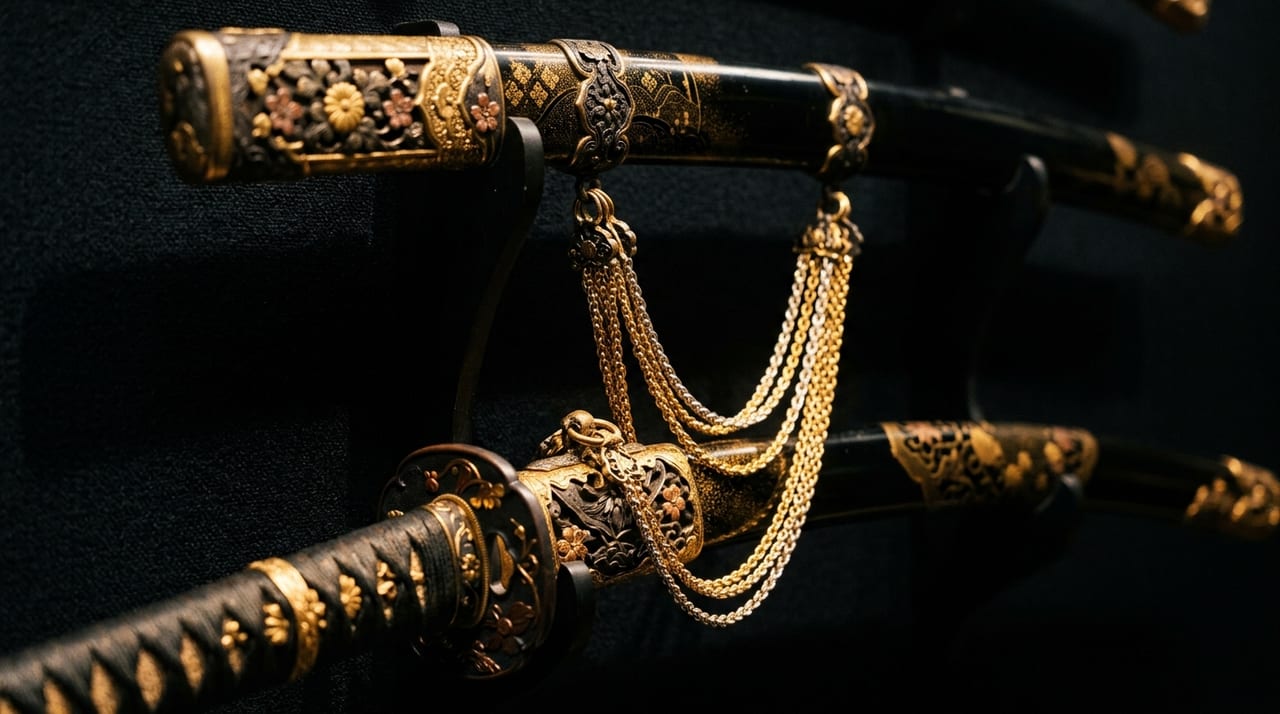 * Image is for illustrative purposes only.
Table of Contents
What Is the Hyōgo-gusari no Tachi — The Highest-Ranking Tachi Koshirae
The hyōgo-gusari no tachi is the highest-ranking form of tachi koshirae (mounting) used from the late Heian period through the Kamakura period. "Hyōgo" refers to an armory (the Hyōgo-ryō), and "gusari" refers to the metal chain attached to the saya (scabbard), by which the tachi was suspended from the waist.
Used in the formal attire of nobles and the ceremonial dress of warriors, the hyōgo-gusari no tachi is characterized by its high degree of ornamentation, aimed at being displayed rather than used in combat. Lavish fittings in gold and silver, intricate carvings, and mother-of-pearl inlay decoration were applied, embodying to the fullest the Japanese sword's aspect as a work of fine art and craftsmanship.
Whereas ordinary tachi koshirae are suspended from the waist using cords or leather known as obi-tori, the hyōgo-gusari no tachi differs significantly in that it uses metal chains directly. This distinction is the very origin of the name "hyōgo-gusari" and constitutes its greatest defining feature, setting it apart from all other forms of tachi koshirae.
Structural Features — Names and Meanings of Each Part
The structure of the hyōgo-gusari no tachi differs from that of ordinary tachi koshirae in many respects.
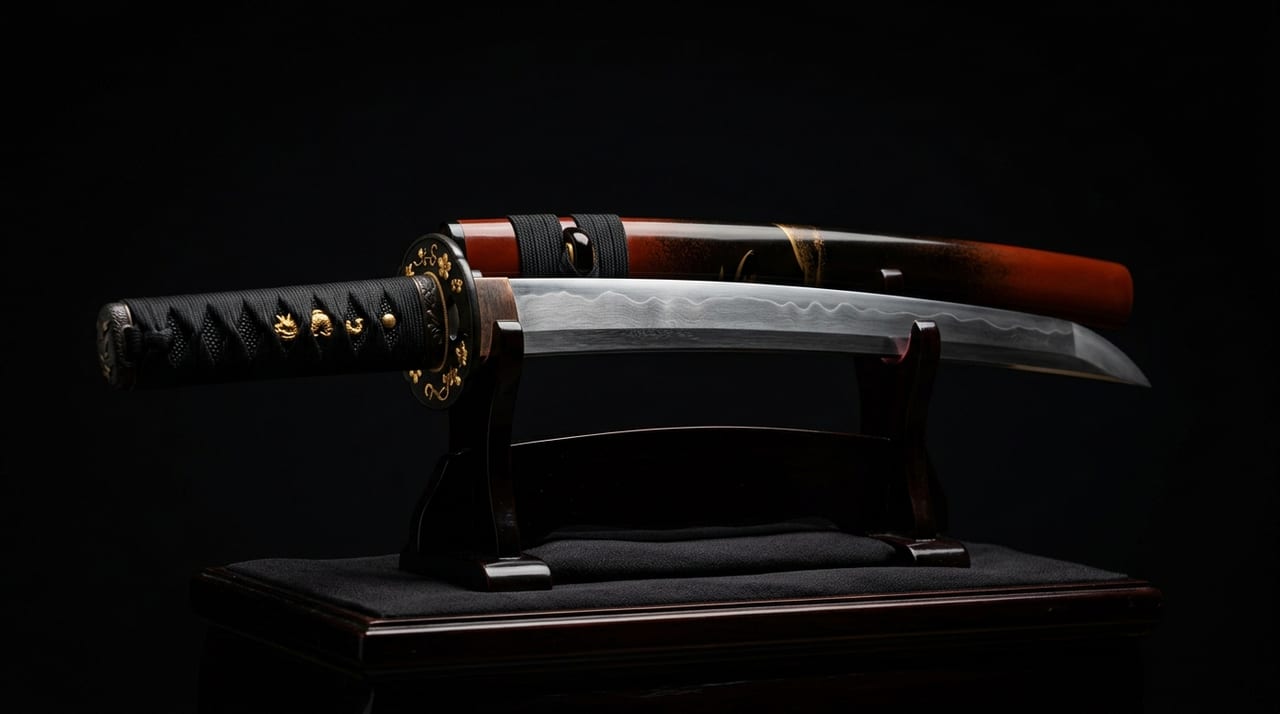
Features of the saya: The saya (scabbard) is lacquered in black or vermillion, and gold and silver fittings are attached. The seme-kanamono, a fitting at the middle of the saya, is equipped with ring-shaped fittings through which the chain passes. The ishizuki, the fitting at the tip of the saya, is often embellished with intricate carvings.
Chain and suspension fittings: The defining feature of the hyōgo-gusari no tachi is its chain. Chains of gold, silver, or gilt bronze are attached to the seme-kanamono and suspended from the waist belt. Chains range from simple linked rings to elaborate braided patterns.
Tsuka and tsuba: The tsuka (hilt) is often covered with gold and silver fittings, and some are wrapped in tōgawa (imported leather) or silk thread. The tsuba (hand guard) is often in a flat form, made from materials such as gilt bronze or shakudō.
Fukurin and ashi-kanamono: The fukurin, metal edging that covers the rim of the saya, serves both to protect the saya and to enhance its decorative effect. The ashi-kanamono, fittings attached to the saya, are equipped with rings through which the chain passes and serve as the starting points of suspension. The kabutogane, which adorns the pommel of the tsuka, and the menuki on the tsuka are also among the parts that showcase the finest gold-working techniques.
Ceremonial Sword Culture of the Heian and Kamakura Periods and the Hyōgo-gusari no Tachi
In the Heian-period court, the tachi was simultaneously a weapon, a "symbol of authority," an "offering to the gods," and a "ceremonial implement." When the emperor, nobles, and military commanders dressed in formal attire, they were expected to wear a tachi appropriate to their rank.
The hyōgo-gusari no tachi occupied the highest rank among tachi, and was used in imperial and retired-emperor ceremonies, in a warrior's audience with the shogun, and in the dedication of offerings to shrines and temples. From the time of Minamoto no Yoritomo onward, it was regarded as the highest-ranking tachi in the warrior etiquette of the Kamakura shogunate as well.
The fact that the hyōgo-gusari no tachi was prepared separately from the tachi and naginata used in actual battle — as a "display tachi" for ceremonial and formal occasions — tells us today about the social hierarchy of warrior society at the time and its culture of clearly distinguishing between practical and ceremonial uses.
Surviving Hyōgo-gusari no Tachi Designated as Kokuhō and Jūyō Bunkazai
Kinshō Hyōgo-gusari no Tachi (Kasuga Taisha collection): A kokuhō (National Treasure) held by Kasuga Taisha in Nara. Dating from the Kamakura period, it is known for the intricacy of its fittings and its excellent state of preservation.
Kinsō Hyōgo-gusari no Tachi (Itsukushima Shrine collection): Included among the group of kokuhō tachi held by Itsukushima Shrine in Hiroshima. It is a cultural property demonstrating the deep relationship between the Taira clan's government and the cult of Itsukushima.
The reason so many examples survive is that they have been carefully preserved in the form of shrine dedications. All of these kokuhō-designated works are managed as shrine treasures or as holdings of museums and art galleries, and are not of a nature that can be traded by individuals on the open market. Their character as offerings to gods and buddhas — having long been enshrined away from human hands — has contributed to their excellent state of preservation.
Differences from Other Tachi Koshirae — Kenuki-gata Tachi, Itomaki Tachi, and Kuro-urushi Tachi
The rank and characteristics of the hyōgo-gusari no tachi become easier to understand when compared with other representative forms of tachi koshirae.
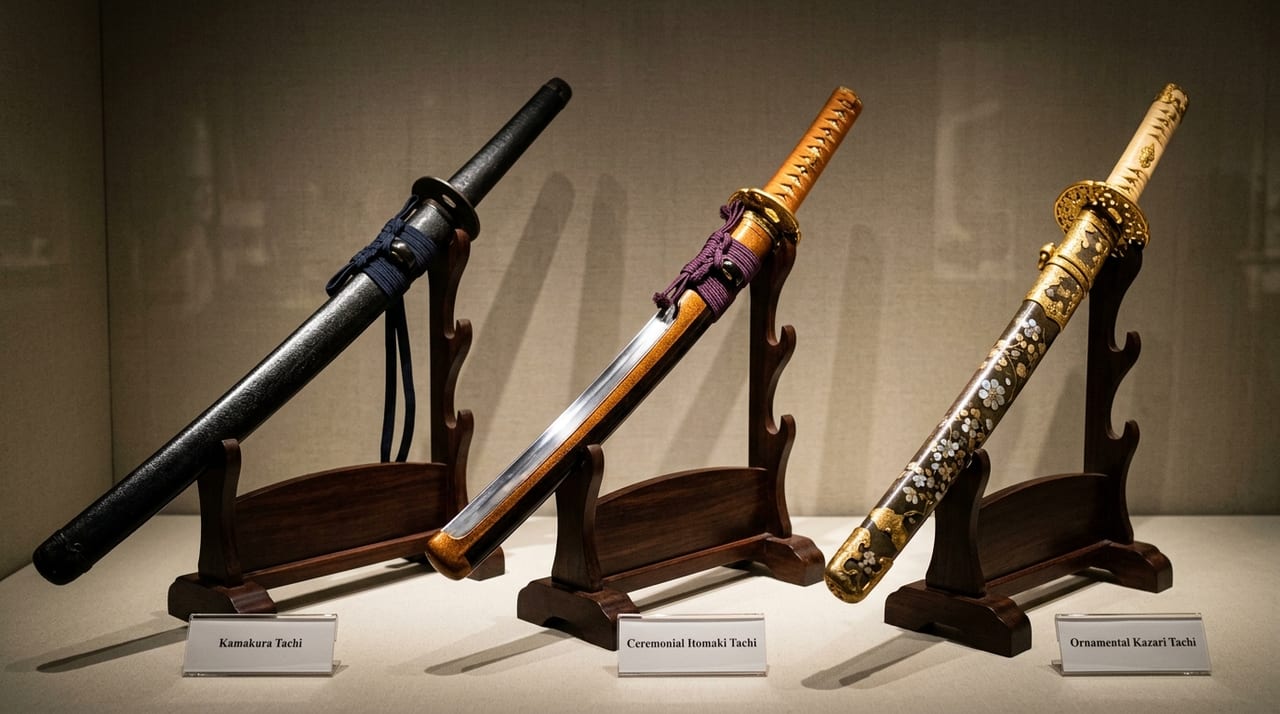
The Kenuki-gata Tachi is an archaic form of tachi koshirae dating back to the early Heian period, characterized by a simple design with openwork in the shape of tweezers (kenuki) on the tsuka. In contrast to the lavish gold-and-silver decoration of the hyōgo-gusari no tachi, it retains a plain character closer to practical use.
The itomaki tachi is a koshirae in which the tsuka is wrapped with braided cord, and was widely used in warrior society from the Muromachi period onward. While it does not possess the ornamental quality of the hyōgo-gusari no tachi, it has the sturdiness to withstand actual combat.
The kuro-urushi tachi is a plain koshirae in which the entire saya is finished in black lacquer. Whereas the hyōgo-gusari no tachi was a koshirae intended for display, the kuro-urushi tachi has a strongly practical character, suited to actual combat and everyday situations as well.
The Decline of the Hyōgo-gusari no Tachi and the Transition to Later Tachi Koshirae
After the Nanbokuchō period, the hyōgo-gusari no tachi gradually declined in frequency of use as a formal-dress tachi. During the civil strife of the Nanbokuchō period, practicality came to be prioritized over lavish decoration, and with the establishment of the Muromachi shogunate, a transition to the kuro-urushi tachi and the itomaki tachi, among others, took place. Production, which required large quantities of gold and silver, also became difficult due to resource constraints during the period of warfare.
From the Edo period onward, production was limited to shrine offerings and ceremonial items for the shogunal household.
Points of Appreciation — When Viewing in a Museum
The main points to note when appreciating a hyōgo-gusari no tachi in a museum are as follows.
- The chain's weaving technique and the texture of the metal (the differences in appearance between gold, silver, and gilt bronze)
- The carved motifs on the seme-kanamono and ishizuki (lions, arabesque, family crests, etc. — clues that speak to the period and workshop)
- The sheen and condition of the saya lacquer (reflecting the preservation environment and repair history)
- The design of the tsuka fittings and menuki (the stylistic unity of the whole)
Moreover, many surviving examples have had their blades replaced in later periods, and the temporal consistency between the koshirae and the blade is an important point in appraisal.
Owning and Appreciating the Hyōgo-gusari no Tachi — Its Position in the Modern Sword Market
Among readers, there may be those who wish to actually handle a hyōgo-gusari no tachi, or who are considering purchasing one. The first point to bear in mind is that the surviving hyōgo-gusari no tachi designated as kokuhō (National Treasure) or jūyō bunkazai (Important Cultural Property) are holdings of shrines and museums, and are not of a nature that circulates on the market.
On the other hand, in the sword market there is no shortage of examples in which the blade of a tachi made in the same era as the hyōgo-gusari no tachi has been remounted in a later period into a different koshirae (such as a uchigatana koshirae) and passed down. It is not unusual for the blade and the koshirae to differ in date of production, and in appraisal the two must be evaluated separately.
The points to confirm when purchasing or appreciating a sword may be summarized as follows.
- Confirm that the content of the kanteisho (original appraisal certificate) issued for the blade matches the mei (signature) inscribed on the blade.
- If a koshirae is included, determine whether its date of production is contemporary with the blade or a later addition.
- Read clues for estimating the period and school from the design of the fittings and the techniques of the carvings.
- Check the state of preservation (rust, damage, repair history) and use it as material for making a value judgment.
By grasping these fundamentals, one develops not only an eye for the cultural value of ceremonial koshirae such as the hyōgo-gusari no tachi, but also the discernment to judge the authenticity and provenance of the actual sword one holds.
The hyōgo-gusari no tachi embodies the "ceremonial pinnacle" of Japanese sword culture. Its form, which pursues the utmost in authority, rank, and beauty, conveys to us today that the sword is a cultural symbol transcending mere weaponry.