Complete History of the Ichimonji School: From Fukuoka-Ichimonji to Yoshioka-Ichimonji, the Full Picture of Kamakura's Mightiest Bizen Swordsmith Collective
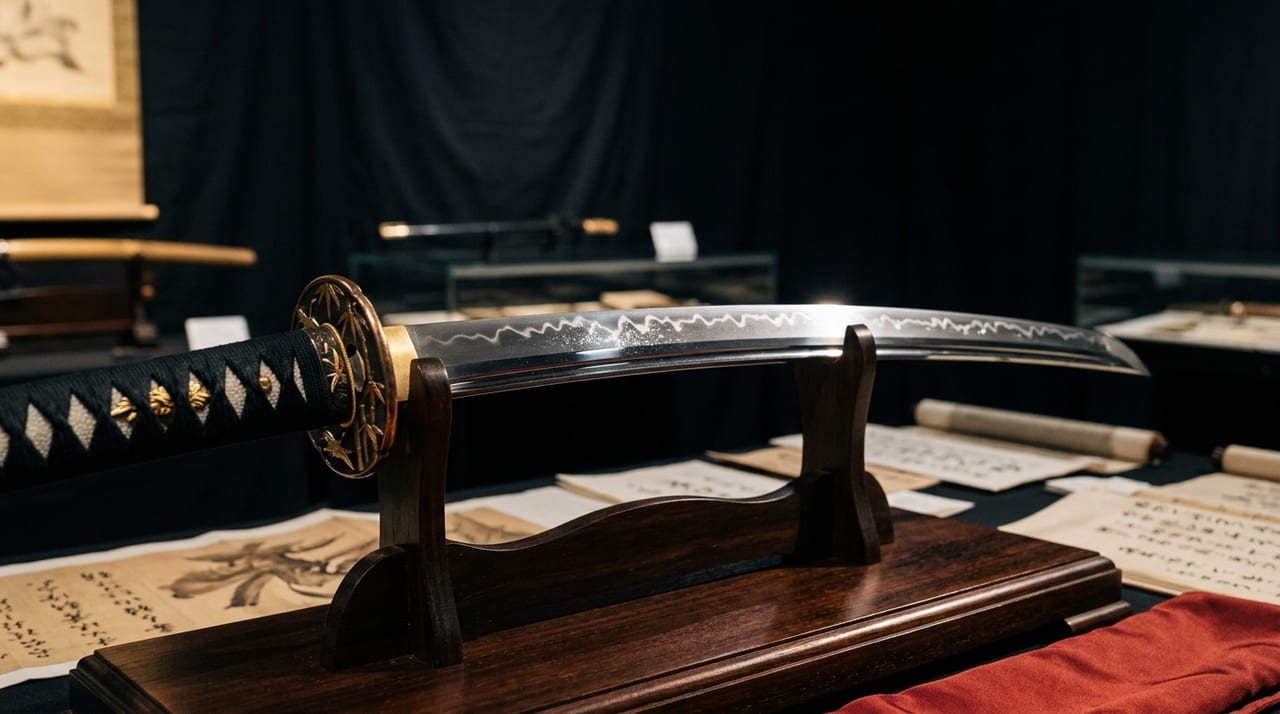 * Image is for illustrative purposes only.
Table of Contents
What Is the Ichimonji School? — Kamakura's Mightiest Swordsmith Collective
The Ichimonji school (Ichimonji-ha) is a collective term for the swordsmith group that flourished in Bizen Province (present-day area around Asakuchi District and Kurashiki City, Okayama Prefecture) during the Kamakura period. The name "Ichimonji" derives from the practice of engraving only the single character "ichi" (one) as the mei (signature) on the nakago (tang). This concise, high-prestige form of mei is considered to have denoted a status equivalent to the highest rank of the court and samurai class of the time, and it is believed to have been used when Ichimonji school tōkō (swordsmiths) crafted tachi to be presented to the highest-ranking powers, such as emperors and shoguns.
The Founding of the Ichimonji School and Its Historical Background
The Ichimonji school rose to prominence in the first half of the 13th century, a period when the power of the Kamakura shogunate had been established and samurai culture was developing rapidly. The warriors of the Kamakura period sought high-quality tachi suited to actual combat, and since Bizen had long been known as a center of kaji (smithing), the Ichimonji school was born in response to this new demand. This historical background formed the foundation for the school's development.
The goban-kaji (rotating swordsmith) system of Retired Emperor Gotoba is also said to have been deeply connected to the founding of the Ichimonji school. Retired Emperor Gotoba was devoted to swords and summoned master craftsmen from across the country to compete in their craft. Multiple tōkō from Bizen participated, and it is believed that the tradition of engraving the Ichimonji mei was established through this kind of relationship with the imperial court.
Major Branches and Representative Swordsmiths
The Ichimonji school was divided into several branches according to region and period, each with its own distinctive characteristics. The following is a description of the major branches.
Fukuoka-Ichimonji
This was the largest branch, based in Fukuoka in Bizen Province (present-day Setouchi City, Okayama Prefecture). It reached its peak flourishing from the first to the middle of the 13th century and became the dominant presence in the sword market of the time. Fukuoka-Ichimonji tachi were held in high regard and prized by many warriors.
The defining characteristic of Fukuoka-Ichimonji is above all the beauty of its jigane (steel of the blade surface). It is distinguished by a fine, uniform itame (wood-grain) texture, and the surface tends toward a clear, dark tone. Suguha (straight temper line) was the prevailing hamon, and the activity of the edge was clearly defined, with many examples conveying a sense of hardness. This quality meant that the blades were highly reliable in actual combat.
Yoshioka-Ichimonji
The Yoshioka-Ichimonji school, which was active from the latter half of the 13th century to the beginning of the 14th century, possessed regional characteristics distinct from those of Fukuoka-Ichimonji. It was a lineage known as a place that had long produced master craftsmen of Bizen, and it inherited its own technical tradition. The tōkō of the Yoshioka area were known for their superb skill and original ideas.
Yoshioka-Ichimonji blades were characterized by a broader range of hamon expression than those of Fukuoka-Ichimonji. Many smiths excelled at complex hamon such as chōji and gunome. Their style imparts a refined impression across the entire blade, and many works are of high artistic value.
Other Branches
Beyond these, swordsmiths of the Ichimonji lineage also existed in Bungo, Yamashiro, and other major production centers, each developing independently in their respective regions. As time passed, use of the Ichimonji mei declined, and from the Nanbokuchō period onward it is said to have gradually shifted to individual mei. Each branch reflected the needs and technical level of the swordsmiths of its era.
Characteristics of Ichimonji School Swords
Works of the Ichimonji school are especially highly regarded among Kamakura-period swords. The reason lies in their combination of combat effectiveness and artistic value.
Qualities of the jigane Ichimonji school blades are known for their fine, uniform surface texture. By strictly controlling carbon content and repeating orikaeshi tanren (folding) many times, they achieved a jigane that was both robust and supple. This technique demonstrates the advanced skill of the tōkō.
Precision of the hamon They possessed the skill to render various hamon accurately, from suguha to chōji. The yaki-ire (quenching) of the edge was precise, the point was sharp, and the kasane (blade thickness) was kept uniform across the entire blade. This precision continues to be held up as a model even for contemporary tōkō.
Ingenuity of the mei The concise Ichimonji mei was both an expression of the maker's confidence and a mark of deference to those in power. There was also ingenuity in how the mei was engraved, and characteristics specific to individual smiths can be observed. This makes it possible for specialists to identify the maker even within the Ichimonji school.
The Decline of the Ichimonji School
From the middle of the 14th century onward, the activities of the Ichimonji school gradually declined. Several reasons for this can be considered.
When the turbulent Nanbokuchō period arrived, the role demanded of swords changed fundamentally. Strong, combat-oriented hamon came to be sought in preference to the traditionally refined suguha, and a divergence emerged between this and the Ichimonji school's approach to production. In addition, it became fashionable to use individual mei to demonstrate personal skill and ingenuity, and the collective Ichimonji mei became outdated.
Even so, it remains unchanged that the Ichimonji school produced a great many masterpieces of Kamakura-period swordsmanship, and they continue to be highly regarded today. Even in the eyes of specialists and collectors, Ichimonji school swords are positioned as works of the highest level of value.
Appraisal and Evaluation of Ichimonji School Swords
Works of the Ichimonji school include many forgeries, and appraisal requires advanced knowledge. For authentication, it is important to make a comprehensive judgment based on multiple factors, including the jigane, the hamon, the manner in which the mei is engraved, and the condition of the nakago. The manner of the mei's engraving and the characteristics of the jigane are particularly critical points in appraisal.
Authentic Ichimonji school swords are an important legacy in the history of the Japanese sword, and masterpieces that demonstrate a perfect balance of technique and aesthetics.