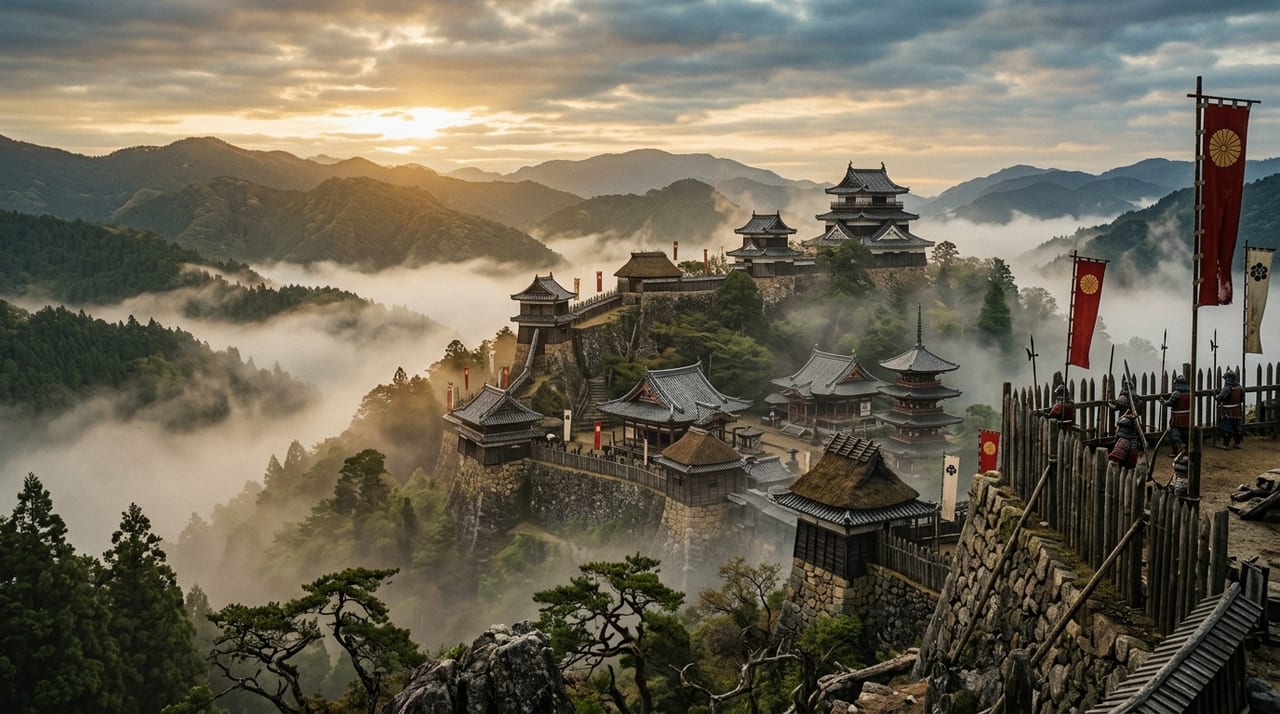
 * Image is for illustrative purposes only.
Nanbokuchō
南北朝
An era of civil war that saw the rise of ōdachi and nodachi. Bold, grand swords embodied the power of the warrior class.
Description
The Age of Warfare
With the collapse of the Kenmu Restoration (1336), an unprecedented situation arose in which the Southern Court of Emperor Go-Daigo and the Northern Court established by Ashikaga Takauji stood side by side. For more than half a century, supporters of both courts fought fierce battles across the country. This prolonged warfare brought revolutionary changes to the form and technology of Japanese swords. Tactics shifted sharply from one-on-one combat between mounted warriors to group combat on foot involving ashigaru, and longer and more powerful swords came to be demanded.
The Flourishing of Ōdachi
The ōdachi and nodachi, with a blade length exceeding 3 shaku (approximately 90 centimeters), were born in response to these practical demands. Among the representative surviving ōdachi is "Magara's ōdachi," with a blade length of 7 shaku 3 sun, dedicated to Atsuta Shrine. These ōdachi are characterized by a broad mihaba and a magnificent construction that retains sufficient dimensions even when later shortened by suriage.
The Spread of the Sōshū Tradition
In terms of technique, the influence of the Sōshū tradition, which spread nationwide through the Ten Great Disciples of Masamune (Masamune Juttetsu), was extremely great. The style in which Bizen-tradition smiths incorporated the techniques of the Sōshū tradition is called Sōden-Bizen, and Osafune Kanemitsu was its representative smith. Kanemitsu produced magnificent hamon by adding nie from the Sōshū tradition to the chōji-midare of the nioi-deki of the Bizen tradition, and he left a wide range of works from ōdachi to tantō. Osafune Chōgi excelled in hamon that were more brilliant and varied than Kanemitsu's, including the large koshi-biraki gunome-midare and mimigata-midare, in which two gunome stand side by side. His works are held in extremely high regard artistically.
Regional Development
In the Mino tradition, Shizu Saburō Kaneuji, one of the Ten Great Disciples of Masamune, transmitted the techniques of the Sōshū tradition to Mino Province and laid the foundation for the later Mino tradition. Kaneuji's works display magnificent nie-deki hamon rivaling those of Masamune, and they are also characterized by a vigorous kitae-hada, with masame mixed into the itame of the jigane. In Chikuzen Province, Samonji brought the techniques he had learned from Masamune back to Kyūshū. He was called Samonji because he cut the character "sa" into his mei. In the Yamashiro tradition, Hasebe Kunishige was active as a master of hitatsura. He is the maker of the National Treasure "Heshikiri Hasebe," famous for the anecdote that Oda Nobunaga cut down a tea-server (chabōzu) hidden beneath a zen-dana with an oshi-giri. The Nobukuni school preserved the Yamashiro tradition in Kyoto while forging many practical tachi that responded to the turmoil of the Nanbokuchō period.
Naginata and Nagamaki
In the Yamato tradition, the Taima school met the demand of temples and shrines in Nanto (Nara), and the Tegai school developed a practical style that tempered a suguha on a jigane with vigorous masame-hada. Production of naginata and nagamaki, long-shafted weapons, also flourished in this period. Many of these were later shortened and reworked into uchigatana as naginata-naoshi.
Influence on Later Generations
Swords of the Nanbokuchō period are collectively called the Nanbokuchō-period form, owing to their overwhelming power and presence, and they continue to exert a major influence on later smiths. Most surviving ōdachi were later suriage and reworked to the dimensions of uchigatana. Even suriage pieces, however, retain the rich jigane and vigorous hamon of the Nanbokuchō period, which makes them extremely appealing collecting objects for discerning connoisseurs. Ōdachi that remain in ubu nakago are treated as treasures of museum caliber and receive special regard. Their magnificent form overwhelms everyone who sees them.
Characteristics of This Era
- Large ōdachi and nodachi with blades of 3 shaku (about 90 cm) or longer were produced extensively. In response to the shift toward massed infantry combat, including ashigaru, warriors demanded longer and more destructive swords.
- The typical Nanbokuchō-period form features a wide mihaba, thin kasane, shallow sori, and an imposing large kissaki. The construction is generous enough to retain sufficient length even when the blade was later shortened by suriage.
- Hitatsura, a flamboyant and bold hamon in which the hardening extends across the entire blade surface, appeared. Hasebe Kunishige's "Heshikiri Hasebe" is one example, and the scenery of nie spreading even to the flat surfaces of the blade is considered to have extremely high artistic value.
- Through the Ten Great Disciples of Masamune (Masamune Juttetsu), Sōshū (Sagami) tradition techniques spread throughout the country. New styles that fused with local traditions, such as "Sōden-Bizen" and "Sōden-Mino," emerged one after another.
- Many extant ōdachi were later shortened by suriage and reworked into uchigatana. Examples that survive in their original ubu nakago are extremely rare and are treasured as museum-quality treasures.
- Production of naginata, nagamaki, and other polearms was also active, responding to diverse battlefield tactics. Many of these were later shortened into "naginata-naoshi."
- The bōshi (the hardening at the kissaki) often takes the form of a deep-returning ō-maru bōshi. It is an important point of focus when authenticating swords of the Nanbokuchō period.
- The jigane shows itame with flowing lines and pronounced hada-dachi, with thick ji-nie giving a powerful forged surface. Chikei and kinsuji influenced by the Sōshū tradition also appear in many places, and the rugged appearance reflects the age of war.