New Arrivals — Browse our catalog for the latest authentic Japanese sword arrivals. Browse →
July 4, 1336 (25th day, 5th month, Kemmu 3 / Engen 1)
Minatogawa, Settsu Province (present-day Hyōgo Ward, Kobe City, Hyōgo Prefecture)
Forces
Southern Court (Emperor Go-Daigo's Forces)
Ashikaga Takauji and Tadayoshi's Forces (Northern Court)
About 10 min read
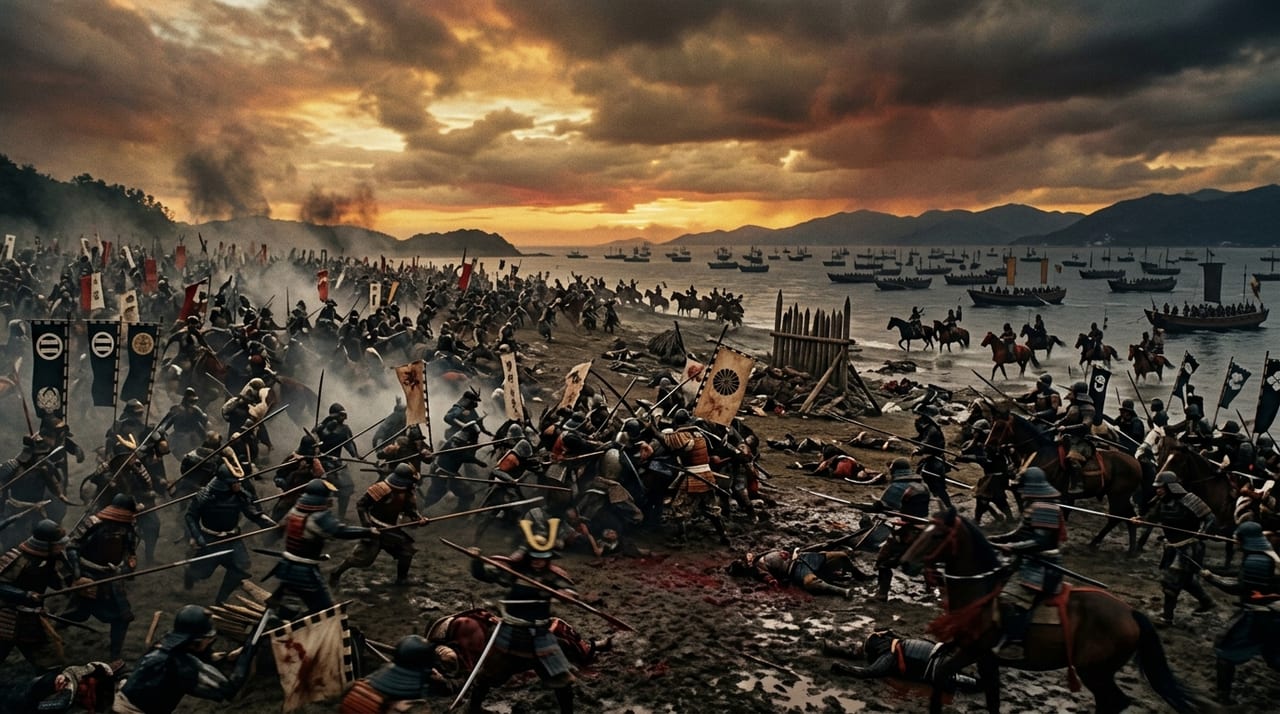
On July 4, 1336 (Kemmu 3/5/25), at Minatogawa in Settsu Province (present-day Hyōgo Ward, Kobe), one of the most dramatic "lost battles" in Japanese history was fought. Kusunoki Masashige challenged the vast army of Ashikaga Takauji. Militarily, the battle ended in a crushing defeat for Masashige. Yet his death, in which he knew defeat was coming but held fast to his loyalty to the throne, has continued to stir the hearts of the Japanese across the ages.
The Kemmu Restoration (1333–1336) of Emperor Go-Daigo was an attempt at direct imperial rule carried out after the fall of the Kamakura shogunate. However, dissatisfaction grew over how the warrior class was treated, and in 1335 (Kemmu 2), Hōjō Tokiyuki launched the Nakasendai Rebellion. Ashikaga Takauji traveled east to Kamakura on the pretext of suppressing this rebellion. He then turned against Emperor Go-Daigo, fled to Kyushu, and after gathering a large army, began marching east.
After receiving orders from Emperor Go-Daigo to intercept the enemy, Masashige coolly calculated the difference in troop numbers between his forces and Takauji's army, and saw that the battle could not be won. He proposed abandoning Kyoto for a time to lure the Ashikaga army in and trap it in a pincer, but this plan was not accepted.
On the way to Hyōgo, at Sakurai (Shimamoto, Osaka Prefecture) in Settsu, Masashige bade farewell to his eldest son, Kusunoki Masatsura. In this scene, handed down as "the Parting at Sakurai," Masashige sent the young Masatsura back to Kawachi, telling him that this was the last time he would see his face in this life. He is said to have entrusted his son with the continuation of the family and unwavering loyalty to Emperor Go-Daigo.
From the Edo period onward, this scene became a subject for paintings, jōruri, and kabuki under the title "the Parting of Dai-Nankō and Shō-Nankō." In the Meiji period it spread nationwide as a school song by Ochiai Naobumi, "Aoba shigeru Sakurai no…" ("Where the green leaves flourish at Sakurai…"). The story of the "kikusui-zukuri" sword that Masashige is said to have left to Masatsura as a keepsake is also still told today.
On the 25th day of the 5th month of Kemmu 3, the imperial loyalist army of Masashige and Nitta Yoshisada clashed with Takauji's vast army in the vicinity of Minatogawa. The "pincer attack from land and sea," with Ashikaga Tadayoshi's great army advancing from land and naval forces closing in from the sea, was exactly as Masashige had anticipated. According to the Taiheiki, Masashige fought sixteen engagements, trampling enemy formations and inflicting heavy losses. In the end, however, the difference in numbers became decisive. With only 73 mounted men remaining, Masashige entered a private house with his younger brother, Kusunoki Masasue, and the two stabbed each other and died.
Among the warriors of the Northern and Southern Courts period, works of the Rai school, such as those of Rai Kunitoshi and Rai Kunimitsu, from the late Kamakura to the Nanbokuchō period, were prized, as were the tachi of the Awataguchi school from the Kamakura period.
The long wars of the Nanbokuchō period also generated enormous demand for swords, and this was a period when the Osafune smiths of Bizen (present-day Okayama Prefecture) flourished. Moreover, in this era, extra-large tachi called ōdachi, with blade lengths of over 90 cm, were produced. This is a fine example of how the upheavals of the Nanbokuchō period affected the form of swords.
In the Taiheiki, Masasue says, "Seven times over, may we be born as ordinary men and destroy the enemies of the throne" (Shichishō made tada onaji ningen ni umarete, chōteki o horobosabaya), and Masashige replies, "I think exactly the same" (Ware mo kayō ni omou nari). In modern times, these words, which speak of destroying the enemies of the throne even after being reborn seven times, were recast as the phrase "Shichishō hōkoku" and carved as the ultimate expression of the spirit of bushidō. These words and Masashige's death clearly embody how the Japanese sword became a cultural symbol bound up with the "soul of the warrior" and the "aesthetics of death." Masashige chose to end his own life with a sword, and his death was later told as a symbol of "honorable death" in bushidō.
Kusunoki Masashige, who died at Minatogawa, was honored in the Edo period by the Mito school as "Dai-Nankō" and held up as the symbol of absolute loyalty to the throne. After the Meiji Restoration, the Meiji government enshrined Masashige as "a model of loyalty to the throne" (kinnō no kagami) at Minatogawa Shrine (founded 1872), and in 1880 it posthumously granted him Senior First Rank (shō ichii). The fact that Masashige took his own life rather than being executed is significant. It clearly shows the act of a warrior who refused "dishonorable capture" and chose to take his own life.
The kikusui, a chrysanthemum motif floating on flowing water, is known as the family crest of the Kusunoki clan and is also a symbol of Masashige's loyalty. Some sword fittings associated with Masashige bear the kikusui crest, and later warriors, out of reverence for Masashige, favored the kikusui crest. The Battle of Minatogawa remains one of the battles that most eloquently shows how the Japanese sword is a "cultural symbol of the spirit" that goes beyond being a "weapon," and it is still told today.
Nitta Yoshisada
Southern Court general who survived Minatogawa and continued fighting in Hokuriku
Ashikaga Takauji
Northern Court supreme commander; his victory at Minatogawa opened the way to the Muromachi Shogunate
Kusunoki Masashige
The supreme loyal vassal; died heroically at Minatogawa fighting for the Southern Court
Kusunoki Masatsura
Masashige's son; inherited his father's cause after the Sakurai farewell