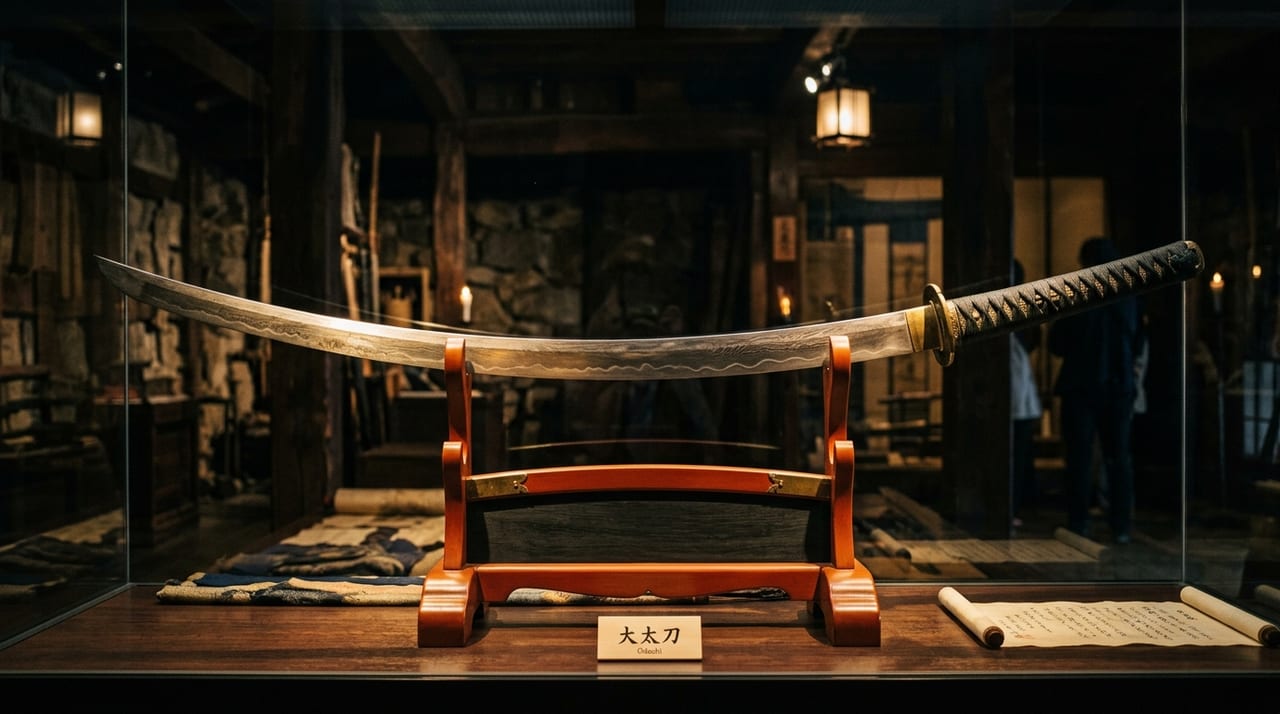
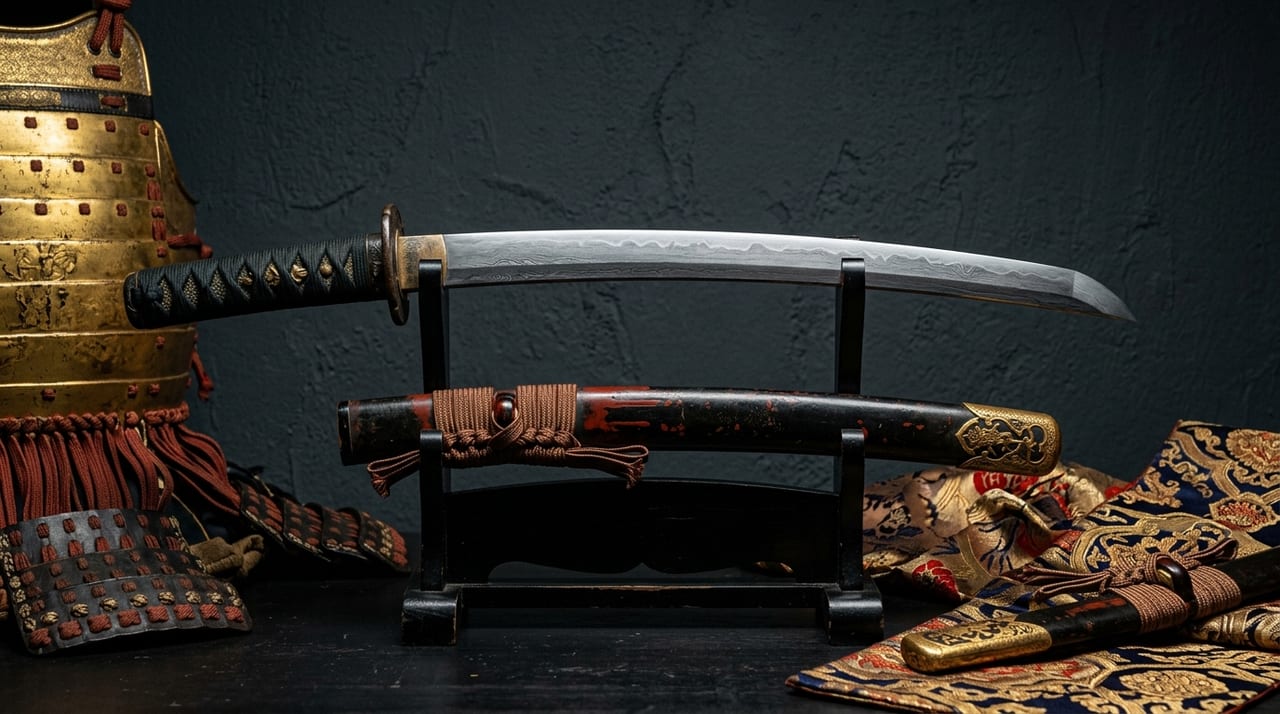
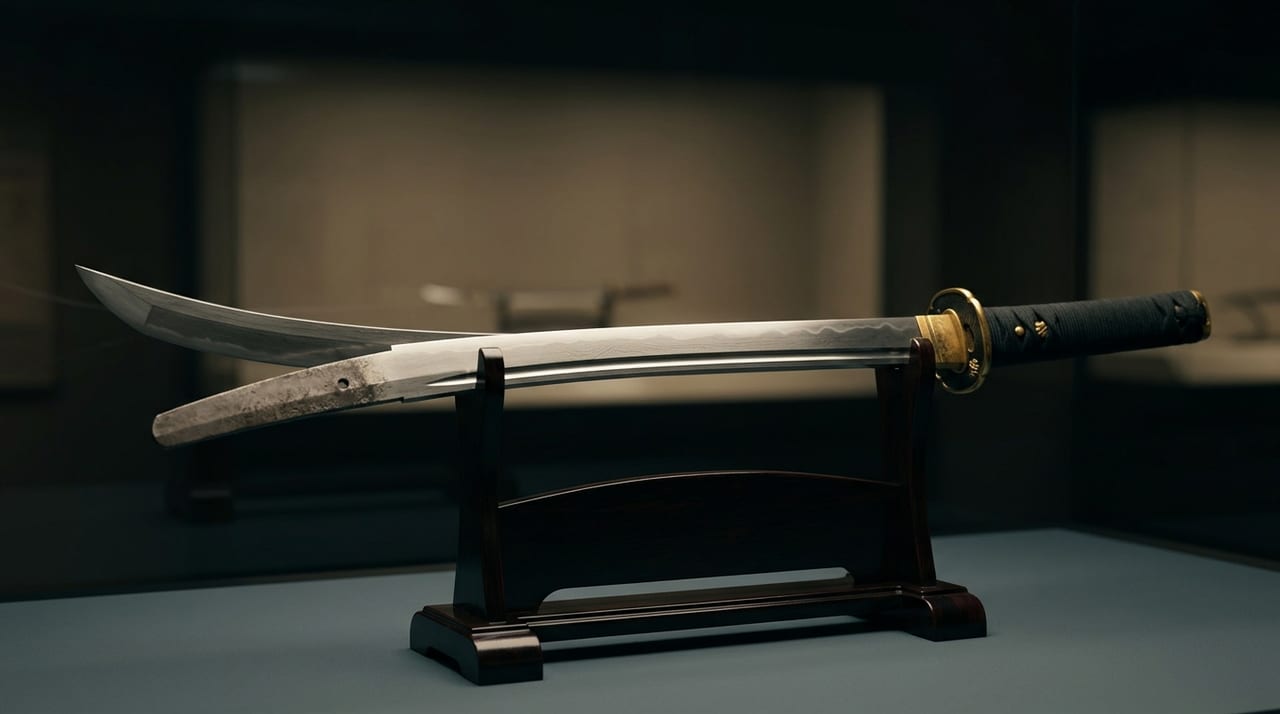
What Are Ōdachi and Nodachi | A Complete Guide to Japan's Largest Swords — Blades Over 90 cm, Their Uses, History, and Surviving Masterworks
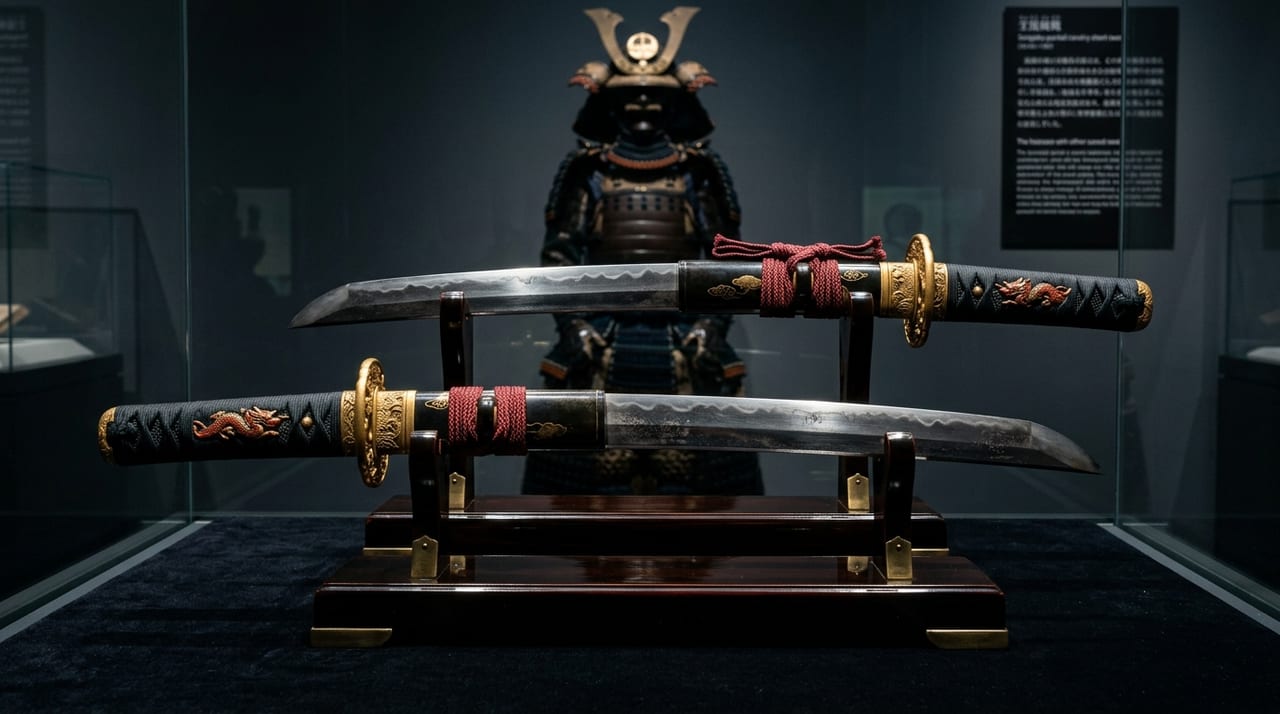 * Image is for illustrative purposes only.
Table of Contents
What Are Ōdachi and Nodachi — Definition and Scale
In the classification of Japanese swords, blades with a nagasa (blade length, excluding the nakago) of 2 shaku (approximately 60 cm) or more are called tachi or uchigatana, but there is a convention of calling those with a nagasa of 3 shaku (approximately 90 cm) or more "ōdachi" or "nodachi." The largest examples have a nagasa reaching 4 to 5 shaku (120–150 cm), sometimes approaching or exceeding the height of an adult man. Their weight, too, can be several times that of an ordinary tachi (approximately 800 g–1.2 kg), and examples exceeding 4–6 kg are not uncommon.
Ōdachi and nodachi are often used interchangeably, but there is a subtle difference in their original meanings. Ōdachi refers primarily to large tachi made for ceremonial or votive use, with many examples created as offerings to shrines. The beauty of the blade and the splendor of the fittings are emphasized. Nodachi, on the other hand, refers to large swords used in outdoor combat, where practicality takes priority. Their manner of carry also differed greatly from that of an ordinary tachi (worn at the hip): it was common to carry them on the back ("seoi") or have an attendant carry them ("mochidachi").
How a sword with a blade alone exceeding 1 meter was made — every step from selecting the iron through orikaeshi tanren (folding) and on to yaki-ire (quenching) required several times the labor of an ordinary tachi. Achieving a uniform tempered edge along the full length demanded precise temperature control and exceptional skill, and the very existence of ōdachi was itself proof of the highest level of craftsmanship among tōkō.
The yaki-ire (quenching) process in particular was the greatest challenge in forging an ōdachi. When firing the hamon (temper line), the process of applying clay differentially to the long blade and then rapidly cooling it caused uneven contraction in the steel, and imbalances in thermal stress led to distortion of the sori (curvature) or cracking. Even errors that a craftsman's experience could handle in an ordinary tachi meant an outright loss when forging an ōdachi longer than 3 shaku. Because of this high risk, the names of tōkō who completed an ōdachi were recorded with special esteem.
The Difference Between Ōdachi, Nodachi, and Tachi — "From How Many Shaku Is It an Ōdachi?"
"Ōdachi" and "nodachi" both refer in practice to the same large swords. When a distinction is drawn between the two, ōdachi is a term that emphasizes the artistic quality of swords made for ceremonial or votive use, while nodachi is a term that emphasizes practical utility in field combat — the difference is purely one of nuance, and there is no strict distinction in the form of the blade itself.
The criterion separating ordinary tachi and uchigatana from ōdachi is nagasa. While blades with a nagasa of 2 shaku (approximately 60 cm) or more are called tachi or uchigatana, those with a nagasa of 3 shaku (approximately 90 cm) or more are conventionally called ōdachi or nodachi. Some researchers, however, hold that blades of 85 cm or more qualify as ōdachi, and no definitive numerical boundary has been established. It is best understood simply as a term describing the sense of scale — "a sword that greatly exceeds the standard length of a tachi."
The military chronicle Taiheiki contains numerous descriptions of ōdachi exceeding 5 shaku (approximately 150 cm): the ōdachi of Ōtaka Shigenari at 5 shaku 6 sun (approximately 170 cm), the ōdachi of Fukuma Saburō at 7 shaku 3 sun (approximately 221 cm), and even depictions reaching as much as 9 shaku 3 sun (approximately 282 cm). However much literary exaggeration may be involved, they speak to how deeply Nanbokuchō-era warriors invested their martial prestige in extraordinarily long swords.
The Technical Challenges of Forging Ōdachi — From Sourcing Tamahagane to Yaki-ire
The production of ōdachi differed decisively from that of ordinary tachi from the very stage of material selection. Because the amount of high-quality tamahagane obtainable from a single tatara (traditional smelting) was limited, forging even one ōdachi required carefully selecting and combining material from multiple runs. When the master craftsmen of Osafune and the Sōshū-den tradition forged ōdachi, they are said to have consumed two to three times the tamahagane of an ordinary tachi, and a special procurement system was required from the material-gathering stage onward.
In orikaeshi tanren (folding) as well, spreading the long blade uniformly required a spacious workshop and multiple assistants. Forging cracks and unevenness in the lamination layers that arise during tanren (forging) can be absorbed in short blades by trimming away the affected area, but in ōdachi there is no such margin. A larger-than-usual quenching tank was also required, and the timing of rapid cooling, the water temperature, and the angle of withdrawal all depended entirely on the craftsman's intuition. That the master craftsmen of the Nanbokuchō period solved these problems is an outstanding technical achievement that even modern metallurgical researchers acknowledge.
The Nanbokuchō Period — The Golden Age of Ōdachi
Ōdachi were produced most prolifically during the Nanbokuchō period (1336–1392). With the collapse of Emperor Godaigo's Kenmu Restoration, the Northern Court led by Ashikaga Takauji and Emperor Godaigo's Southern Court fought for more than half a century, with large-scale battles unfolding across the archipelago.
A major characteristic of Nanbokuchō-period combat was the spread of "kachi-ikusa" (infantry warfare). Unlike the period from the late Heian era through the Kamakura period, which idealized individual mounted combat between warriors, Nanbokuchō battles came to rely primarily on infantry groups including foot soldiers. Against densely packed infantry, sweeping and downward strikes leveraging centrifugal force with long blades proved highly effective tactics, greatly increasing demand for ōdachi.
Notable battles of this period include the Battle of Minatogawa (1336) and the Battle of Shijōnawate (1348), and battle-scene picture scrolls from these conflicts also depict warriors carrying ōdachi. Numerous traditions hold that Southern Court commanders, including Kusunoki Masashige and his son Kusunoki Masatsura, favored ōdachi.
In the major production centers of Bizen, Sagami, Yamato, Mino, and elsewhere, master craftsmen competed in producing ōdachi. Kanemitsu and Chōgi of the Osafune school, along with the successors to Masamune of the Sōshū-den tradition, left masterworks of ōdachi from the Nanbokuchō period, and many of the ōdachi now designated as kokuhō (National Treasure) or jūyō bunkazai (Important Cultural Property) date from this era. As combat styles changed from the Muromachi period onward, production of ōdachi dropped sharply, and the more maneuverable uchigatana became the mainstream. The Nanbokuchō period was truly the golden age of the ōdachi.
Methods of Use in Combat
The combat use of ōdachi has been a subject of much debate given their weight and length. Three main modes of use are generally considered.
- Use on horseback by mounted warriors — Swinging the blade down in a wide arc from horseback, the rider could fell infantry and mounted enemies alike with a single blow to the head or shoulder. Since the sword could not be worn at the hip on horseback, it was either propped against the pommel of the saddle (maewa) or held by an attendant and received just before engaging the enemy. The elevated position of the mounted warrior, combined with the drop of the downswing, allowed the full weight of the ōdachi to be exploited to maximum effect.
- Collective use as a polearm — Following the same operational concept as the spear and naginata, there is said to have been a technique of shifting one's grip onto the long blade itself, using it for horizontal sweeping strikes in group combat. Some schools have transmitted nodachi techniques involving gripping methods unthinkable with an ordinary sword, such as "sakate-mochi" (reverse grip) and "morote-zuki" (two-handed thrust).
- Use for intimidation and display — When a warrior renowned for valor appeared with an ōdachi on his back, it exerted psychological pressure on the enemy. Accounts from the Sengoku period also include descriptions of "a large man bearing an ōdachi on his back," and the projection of martial authority in which the warrior's physique and the ōdachi formed a single imposing presence could sometimes have greater effect than an actual cut.
These specialized nodachi techniques were later systematized into schools of swordsmanship. Yakumaru-ryū (also known as Nodachi Jigen-ryū) is a line of nodachi swordsmanship passed down in the Satsuma domain, characterized by its bold technique of raising the sword high and delivering a single, decisive downward cut, and is widely known as the powerful swordsmanship of Bakumatsu-era Satsuma warriors. Shinkage-ryū was a school systematized by Kamiizumi Nobutsuna; it incorporated the management of distance and control of bearing using the long blade into the realm of nodachi swordsmanship, and went on to influence many later schools of kenjutsu.
However, wielding an ōdachi exceeding 3 shaku in everyday combat was extremely difficult in terms of physical capacity and practical function, and many examples were created with religious intent as votive swords and were never used in battle.
Votive Ōdachi — Giant Swords Dedicated to Shrines and the Meaning of Faith
A considerable number of surviving ōdachi were created and preserved as votive offerings to shrines. Warriors and powerful figures dedicated large swords to shrines to pray for good fortune in battle before setting out to war, to give thanks for victory, or as objects of prayer for the warding off of evil spirits. It was thought that offering a sword larger than an ordinary votive sword demonstrated a correspondingly deeper faith and resolve.
In Japanese Shinto, swords have long been regarded as "yorishiro" (divine vessels through which gods manifest). The belief that a larger sword houses stronger spiritual power is deeply connected to the religious motivation underlying the dedication of ōdachi. The fact that swords are enshrined as objects of worship at shrines throughout Japan also derives from this ancient notion of the sword as a mediator between humans and the divine.
Itsukushima Shrine (Hiroshima) is known as a shrine associated with the Taira clan, and many warriors including Taira no Kiyomori dedicated swords there. The group of votive swords — including a tachi said to have been donated by Minamoto no Yoritomo — is designated as kokuhō (National Treasure) and jūyō bunkazai (Important Cultural Property), and ōdachi are among them.
Kasuga Grand Shrine (Nara) attracted the reverence of the warrior class from the Heian period onward as the clan shrine of the Fujiwara. The Kasuga Taisha Kokuhōkan on the shrine grounds holds a large collection of tachi and ōdachi from the Heian through Muromachi periods, and is known as one of the largest sword collections in Japan. The collection includes multiple Nanbokuchō-era ōdachi that convey the highest technical standards of that age.
Oyamazumi Shrine (Ehime, Ōmishima) has been venerated since antiquity as the head shrine enshrining the gods of mountains and seas throughout Japan, and the successive powers of each era — the Minamoto clan, the Taira clan, the Kamakura shogunate, and the Muromachi shogunate — competed to dedicate weapons there. Today it still holds over 100 pieces of armament designated as kokuhō (National Treasure) or jūyō bunkazai (Important Cultural Property), and is acclaimed as "the foremost collection of weapons in Japan." Multiple Nanbokuchō-era ōdachi survive here, and the mei (signature) engraved on the blades and the shape of the hi (groove) allow scholars to decipher the smelting and forging techniques of the time.
Surviving Masterworks
Tachi, mei (signature): Bishū Osafune-jū Kanemitsu is one of the ōdachi regarded as the pinnacle of the Nanbokuchō period. Kanemitsu was a leading tōkō of the Bizen Osafune school who produced many ōdachi during the turbulence of the Nanbokuchō period. The sword is characterized by its powerful, imposing form and vivid undulating hamon (temper line), with a forcefulness that seems to have sealed the heat of that era into iron and steel.
The ōdachi produced by Osafune Nagamitsu and Kanemitsu are said to have consumed two to three times the tamahagane of an ordinary tachi. Because the amount of high-quality tamahagane obtainable from a single tatara (traditional smelting) was limited, forging even one ōdachi required carefully selecting and combining material from multiple runs, demanding a procurement system out of the ordinary from the material-gathering stage onward. Furthermore, among the votive ōdachi surviving at Oyamazumi Shrine and Kasuga Grand Shrine, examples with a nagasa exceeding 150 cm have been confirmed, and these masterworks — which pushed the limits of the forging technology of their time — continue to attract the attention of researchers today.
Tachi, mei (signature): Chōgi is the work of Chōgi, said to be one of the Ten Disciples of Masamune, and its striking undulating hamon (temper line) bearing the influence of the Sōshū-den tradition is its chief attraction. Some examples retain records of possession by warriors of shogunate or shugo-daimyō level, and the successive changes in ownership themselves mirror the history of power transitions in medieval Japan.
Fine examples of Nanbokuchō ōdachi left by master craftsmen of Bizen and Sagami, such as the tachi, mei (signature): Kunimune, have been exhibited repeatedly at special exhibitions at the Tokyo National Museum and the Kyoto National Museum, conveying the overwhelming sculptural beauty of that era to modern viewers.
The Largest Surviving Ōdachi — Tarō Tachi and the Shida Ōdachi
Among surviving ōdachi, two examples are well known to the general public and have been actually measured. Both have a nagasa exceeding three times that of an ordinary tachi, and they convey a concrete sense of the scale of ōdachi.
| Item | Tarō Tachi | Shida Ōdachi |
|---|---|---|
| Collection | Atsuta Shrine (Nagoya) | Yahiko Shrine (Yahiko Village, Niigata Prefecture) |
| Nagasa | 221.5 cm | 220.4 cm |
| Overall length | 303 cm | 322.2 cm |
| Weight | approx. 4.5 kg | |
| Mei / date | Sue no Aoe | Ōei 22 (1415), Iemori |
| Tradition / provenance | Said to have been wielded by Magara Naotaka at the Battle of Anegawa (1570) | Said to have been dedicated by Shida Saburō Sadashige, lord of Natsudo Castle in Echigo |
| Designation / exhibition | On display at "Tsurugi no Hōko Kusanagi-kan" | Designated as a jūyō bunkazai (Important Cultural Property) |
Tarō Tachi is a monumental ōdachi owned by Atsuta Shrine (Nagoya), with a nagasa of 221.5 cm, an overall length of 303 cm, and a weight of approximately 4.5 kg. The blade bears the mei (signature) "Sue no Aoe" and is said to be the work of the Bicchū Aoe school. It is renowned for the tradition that Magara Naotaka, a mighty warrior of the Asakura side, wielded it at the Battle of Anegawa (1570), and is displayed at the "Tsurugi no Hōko Kusanagi-kan," a treasure exhibition facility that opened in 2021.
Shida no Ōdachi is an ōdachi owned by Yahiko Shrine (Yahiko Village, Niigata Prefecture) with a nagasa of 220.4 cm and an overall length of 322.2 cm, and is designated as a jūyō bunkazai (Important Cultural Property). The nakago (tang) bears a date of Ōei 22 (1415), and the sword is said to have been forged by Iemori, a tōkō of Bizen Osafune, and dedicated by Shida Saburō Sadashige, lord of Natsudo Castle in Echigo. Among curved swords designated as jūyō bunkazai (Important Cultural Property) or kokuhō (National Treasure), it boasts the greatest length.
An even longer example is the Haja no Ontachi owned by Hanaoka Hachimangu Shrine in Yamaguchi Prefecture, known as the longest sword in Japan at 345.5 cm. However, this is a large votive sword specially forged during the Ansei era of the Bakumatsu period for prayer and dedication, and it differs in character from combat ōdachi. The existence of such record-breaking giant swords continues to convey how far the forging technology of Japanese swords was pushed to its limits.
Suriage — The Transformation from Ōdachi to Tachi and Uchigatana
From the Sengoku period onward, as combat shifted from mounted warfare to infantry-based group combat, the unwieldiness of ōdachi became increasingly apparent. As a result, the technique known as "suriage" — shortening the nakago (tang) of an ōdachi and, in some cases, also reducing the blade itself to rework it into an ordinary tachi or uchigatana — was widely practiced during the Sengoku period.
Suriage changes the dimensions and purpose of a sword, but the hamon (temper line) and the quality of the jigane (steel of the blade surface) are carried over unchanged. In other words, there was a practical benefit: the steel and hamon forged by the master tōkō of the Nanbokuchō period could be enjoyed in a more manageable size. After suriage, the nakago becomes shorter and the original mei (signature) may be lost. Even when a mei remains, the sword is often treated as "ō-suriage mumei (unsigned)" and placed below the original in sword appraisal.
One reason relatively few ōdachi survive is this historical circumstance of conversion to practical use. It is not uncommon for a sword that was originally an ōdachi to now be classified as an ordinary tachi or uchigatana. Accordingly, deciphering traces of suriage in provenance research has become an important task for reconstructing the original intent of production and the history of distribution.
Conclusion — What Ōdachi Tell Us
Ōdachi and nodachi are the embodiment of Japanese sword beauty and function in their most extreme form. The contradiction of being so large as to be difficult to handle in combat, yet achieving a uniform tempered edge along the entire length through refined tanren (forging) technique, poses a fundamental challenge to the "boundary between utility and art" in Japanese sword culture.
Born from the upheaval of the Nanbokuchō period and preserved by the sacred precincts of shrines, ōdachi are the most direct evidence that swords are cultural artifacts that transcend their role as weapons to carry spiritual and religious meaning. The prayer, martial authority, and beauty enclosed in a mass of iron and steel — through their overwhelming physical presence, ōdachi continue to convey to us the very atmosphere of that age.
Related columns: Ōdachi and Nodachi of the Nanbokuchō Period — The Form and Uses of Large Swords Born in an Age of Upheaval | The Structure and Uses of the Zanba-tō — Differences from Nodachi and Ōdachi, and Their Actual Use on the Battlefield | Tamahagane and Tatara Ironmaking — How the Steel for Japanese Swords Is Made