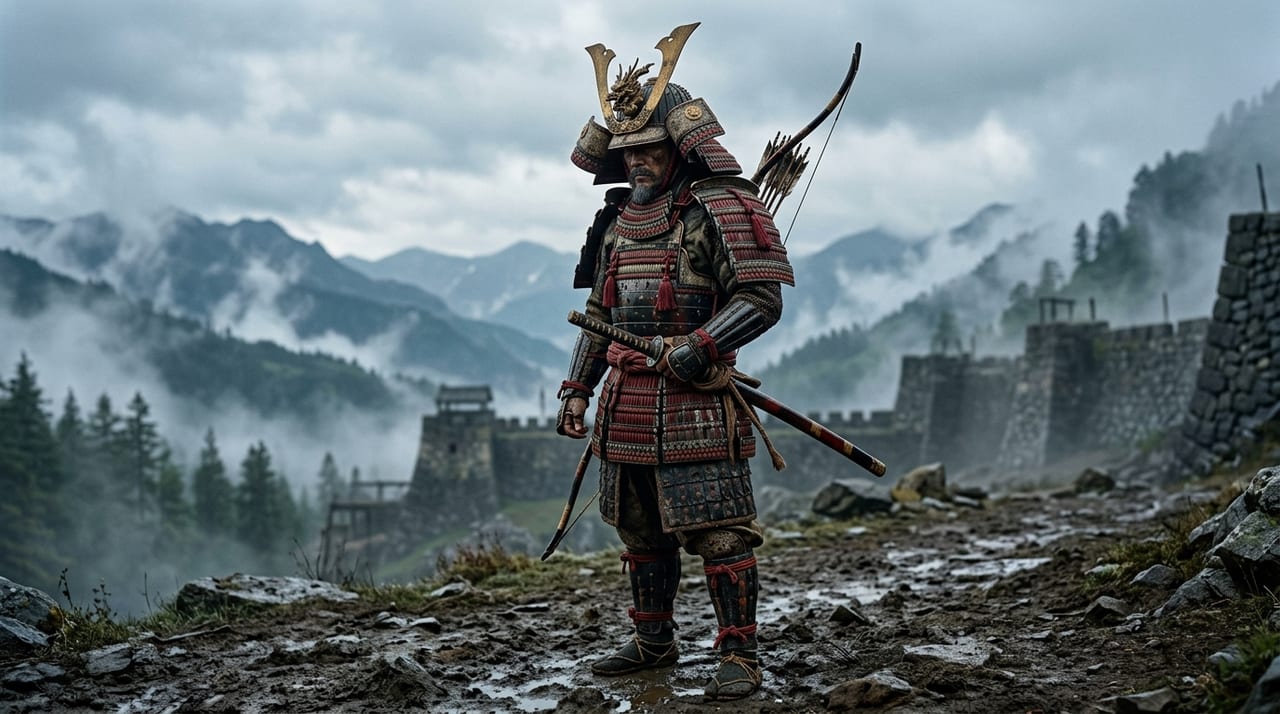
 * Image is for illustrative purposes only.
Nitta Yoshisada
新田義貞
The Warrior Who Cast His Sword into the Sea
Description
The Minamoto Descendant Rises
Nitta Yoshisada, said to have been born in Kōzuke Province (present-day Gunma Prefecture) around Shōan 3 (1301), was a descendant of the Minamoto clan, tracing his ancestry to Minamoto no Yoshikuni. In the late Kamakura period, Yoshisada answered Emperor Go-Daigo's campaign to overthrow the shogunate. In Genkō 3 (1333), he is said to have received a ryōji (prince's order) from Prince Moriyoshi calling for the overthrow of the Hōjō clan, and he raised an army to destroy the Kamakura shogunate. Yoshisada's forces rose in Kōzuke Province with only a small number of troops. They swelled like a snowball as he gathered warriors of the Kantō one after another, and they marched toward Kamakura. Behind this decision lay the long-standing resentment of the warriors toward the arbitrary rule of the Hōjō clan.
The Miracle at Inamuragasaki and the Golden Sword
The most dramatic episode in Yoshisada's life occurred at Inamuragasaki during the assault on Kamakura. The shoreline at Inamuragasaki, which blocked the road to Kamakura from the direction of Gokuraku-ji, was said at the time to be a sheer cliff face meeting the sea, making it impossible for a large army to pass. Yoshisada faced the sea, drew the golden sword at his waist, and cast it into the waves with a prayer to the sea god. The tide then receded, revealing a tidal flat wide enough for his army to pass. This miraculous event is handed down as a symbol of how Yoshisada's sincere faith and decisiveness as a warrior moved heaven and the sea god.
The Fall of the Kamakura Shogunate
After breaking through Inamuragasaki, Yoshisada's army stormed into Kamakura. After fierce street fighting, they drove shogunate leaders, including Hōjō Takatoki, into Tōshō-ji. Shogunate leaders led by Hōjō Takatoki committed mass suicide, and Hōjō rule came to an end. On the 22nd day of the fifth month of Genkō 3 (1333), Yoshisada took control of Kamakura. For this achievement, Yoshisada received the highest praise from Emperor Go-Daigo and also held an important position in the Kenmu Restoration.
The Kenmu Restoration and the Nanboku-chō Turmoil
However, the Kenmu Restoration was short-lived. Following Ashikaga Takauji's defection, civil war broke out, and Yoshisada fought across various regions as a principal general of the Southern Court (the side of Emperor Go-Daigo). In the battles in the Hokuriku region, centered on Echizen Province (present-day Fukui Prefecture), Yoshisada's martial prowess shone on many occasions, and he received fervent support from the warriors of Fukui and Echizen. But in the intercalary seventh month of Kenmu 5 (1338), at the battle in Fujishima in Echizen Province (present-day Fukui City), Yoshisada was struck by a stray arrow, fell from his horse, and died in battle. He was 38 years old.
Swords and the Spirit of a Righteous General
According to the Taiheiki, Yoshisada fought wielding two Minamoto heirloom swords, “Onikiri” and “Onimaru.” At the Battle of Minatogawa, he drew both swords, one in each hand, and cut down the arrows raining upon him. The Nanboku-chō period was a major turning point in the history of the Japanese sword, an era in which enlarged swords known as ōdachi and nodachi came into frequent use on the battlefield.
The Reputation of a Righteous General
In later generations, Nitta Yoshisada has been highly regarded as a “loyal warrior” and a “man of righteousness.” His way of life, in which he resisted the arbitrary rule of the Hōjō clan and maintained his loyalty to the Southern Court to the very end, was widely praised as a model for warriors from the Edo period through the Meiji period. In particular, the tale of the golden sword at Inamuragasaki has taken deep root in the spiritual culture of the Japanese people as a symbol of samurai sincerity, in which a warrior offers his sword, his most precious possession, as a vow to the gods and buddhas.
Notable Swords
- The golden sword of Inamuragasaki (a famous golden blade cast into Sagami Bay with a prayer to the sea god; a symbol of the ultimate vow in which a warrior offered his most precious soul to the gods and buddhas)
- Onikiri and Onimaru (the two Minamoto heirloom swords that the Taiheiki says Yoshisada wore)