New Arrivals — Browse our catalog for the latest authentic Japanese sword arrivals. Browse →
1438–1439 (Eikyō 10–11)
Kamakura, Sagami Province (Yōan-ji); Kanazawa (Musashi Province) (Shōmyō-ji); and other locations across Kantō
Forces
Muromachi Shogunate / Kantō Kanrei Uesugi Norizane's Forces
Kamakura kubō Ashikaga Mochiuji's Forces
About 16 min read
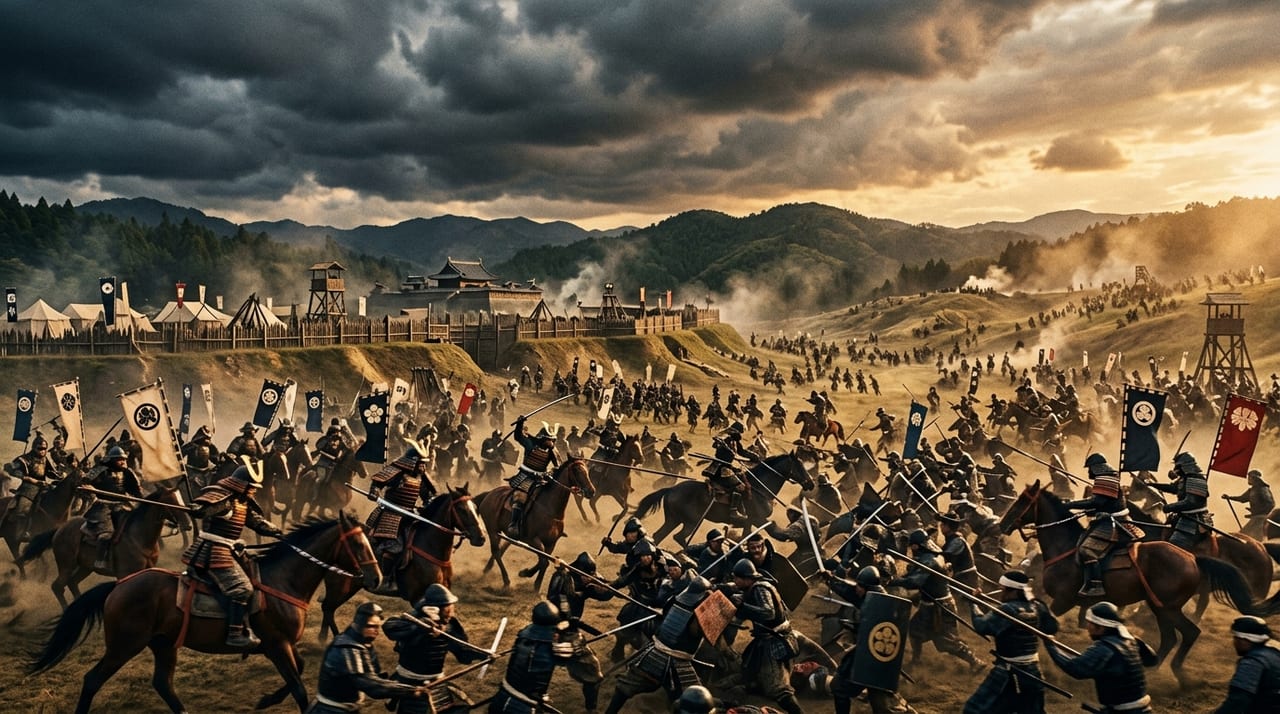
From Eikyō 10 (1438) to Eikyō 11 (1439), the "Eikyō Rebellion" (Eikyō no ran), fought across the Kantō region, was an internal war in which the fundamental contradiction between the Muromachi bakufu's system for governing the provinces and the Kamakura-fu (Kamakura kubō), which functioned as a quasi-independent regime, erupted. Through this rebellion, the Kamakura kubō Ashikaga Mochiuji (1398–1439) was driven to take his own life, and the post of Kamakura kubō was temporarily vacant. The warrior society of Kantō then moved toward the great upheaval of the "Kyōtoku Rebellion," which lasted 28 years.
The Muromachi bakufu was based in Kyoto, but in order to govern the distant Kantō region, it dispatched a powerful member of the Ashikaga clan to Kamakura as the "Kamakura kubō", entrusting him with rule over ten provinces, the eight provinces of Kantō plus Izu and Kai (with Mutsu and Dewa added in 1392). Beginning with the first Kamakura kubō, Ashikaga Motouji, his descendants succeeded to the post generation after generation. Beneath the Kamakura kubō was an assistant post called the "Kantō kanrei", which the Uesugi family held hereditarily.
The Kamakura-fu appeared to be a branch office of the bakufu, but in reality it was a quasi-independent regime separate from Kyoto. Kamakura had been the sacred ground of the eastern warriors since the time of Minamoto no Yoritomo, and the Kamakura kubō, as the "lord" of the Kantō warriors, possessed his own authority and base of power. From the time of Ashikaga Mitsukane, father of Ashikaga Mochiuji, the Kamakura-fu had been carrying out independent policies that ignored the intentions of the bakufu, and the relationship between the shōgun and the Kamakura kubō was in a state of chronic tension.
The turning point was Yoshinori's assumption of the position of shōgun in Eikyō 1 (1429). Yoshinori, known for his authoritarian rule, had no intention of tolerating Mochiuji's independent conduct.
Ashikaga Mochiuji was a warrior who excelled in martial prowess, but in his political judgment he was at times self-righteous. Mochiuji did not follow the change of era from Shōchō to Eikyō and continued to use the old era name Shōchō, which was an open act of defiance against the bakufu. Furthermore, in the 6th month of Eikyō 10 (1438), when his heir Ken'ōmaru was undergoing his coming-of-age ceremony, Mochiuji broke the custom of receiving a character from the shōgun and had him adopt the name "Yoshihisa" without the bakufu's permission. The relationship between the two sides deteriorated beyond repair.
Norizane was originally in a position to assist the Kamakura kubō, but he had come to feel the limits of Mochiuji's self-righteous political management and open defiance of the bakufu. Norizane had a deep understanding of learning and culture and was a warrior-cultural figure who devoted himself to reviving Ashikaga Gakkō (present-day Ashikaga City, Tochigi Prefecture). The deterioration of relations between Norizane, who valued "letters over arms," and Mochiuji, who took pride in martial prowess, reflected a fundamental difference in their personalities and political views. In the 8th month of Eikyō 10 (1438), Norizane retreated to Hirai Castle in Kōzuke and requested rescue from the bakufu against the pursuit army sent by Mochiuji. Yoshinori responded immediately, and the dispatch of a bakufu army was decided.
In the mid-Muromachi period (first half of the 15th century), when the Eikyō Rebellion occurred, the relationship between warrior culture and swords in the Kantō region is especially interesting. Since the Kamakura period, Kantō warriors had been called "bandō musha", and their fierce martial style was known throughout the country. Kantō warriors, who had gained battle experience through the wars of the Nanboku-chō period, had formed a distinctive warrior culture that valued practical swords.
As the foremost swords favored by the warriors of Kantō in this period, swords descending from the "Sōshū-den" are cited. Swords of the Sōshū-den, which developed centered on Sagami Province (present-day Kanagawa Prefecture), namely Kamakura, are a technical tradition completed by Masamune, Yukimitsu, and Sadamune. Their characteristic lies in a rugged yet beautiful jigane in which sand-like crystals called "nie" appear in the hamon. The ō-nie of the Sōshū-den gives overwhelming power to those who see it.
Meanwhile, Kantō kanrei Uesugi Norizane is known as a warrior-cultural figure with a deep understanding of learning and culture. Norizane devoted himself to reviving Ashikaga Gakkō and valued the spirit of "letters over arms."
Reinforced by the bakufu army, the forces of Uesugi Norizane defeated Mochiuji's troops one after another. Mochiuji's retainers also yielded to bakufu pressure and dispersed, and Mochiuji rapidly became isolated. In Eikyō 10 (1438), Mochiuji took Buddhist vows at Shōmyō-ji in Kanazawa and took the Buddhist name "Dōkei", and he was confined at Yōan-ji in Kamakura. However, Yoshinori did not permit his life to be spared, and on the 10th day of the 2nd month of Eikyō 11 (1439), when he was attacked at Yōan-ji by the forces of Norizane and others, Mochiuji took his own life. He was 42 years old at his death.
Mochiuji's surviving sons Yasuōmaru and Haruōmaru escaped the danger. In the following year, Eikyō 12 (1440), Yūki Ujitomo of Shimōsa raised an army at Yūki Castle (present-day Yūki City, Ibaraki Prefecture), taking the surviving children as figureheads. This is the "Yūki War." In the 4th month of Kakitsu 1 (1441), Yūki Castle fell, and Yasuōmaru and Haruōmaru were captured and killed in Mino. The bloodline of Mochiuji ended here, or so it appeared. Later, however, one of Mochiuji's surviving children, Ashikaga Shigeuji, became Kamakura kubō and revived the Kamakura-fu.
Although the Eikyō Rebellion ended superficially in victory for the bakufu, when we look at subsequent history, the difficulty of ruling Kantō was not resolved. Mochiuji's son, Ashikaga Shigeuji, later returned to the post of Kamakura kubō, and in Kyōtoku 3 (1455) he caused the "Kyōtoku Rebellion" (Kyōtoku no ran) by assassinating the Kantō kanrei, Uesugi Noritada. This rebellion lasted 28 years, overlapping in time with the Ōnin War (1467), and it marked the dawn of the Sengoku period in Kantō. The Eikyō Rebellion was its direct trigger and the starting point of the political turmoil in the east centered on Kamakura.
From the viewpoint of sword history, the mid-Muromachi period to which the Eikyō Rebellion belongs was a transitional period in which the shapes of Japanese swords changed greatly. As the shift from the great ō-tachi of the Nanboku-chō period to the uchigatana of the Muromachi period advanced, the warriors of Kantō carried swords adapted to the age while trying to protect their region's distinctive warrior culture. The sword Mochiuji held at the end, whatever it was, symbolized the pride of the quasi-independent Kamakura-fu regime and its resistance to the centralization of the bakufu. The sword on which a warrior stakes his life is not merely a weapon but an embodiment of that person's very way of life. As a story of such warrior souls, the Eikyō Rebellion is deeply engraved in the history of Japanese swords, together with the wild nie of the Sōshū-den hamon.
Uesugi Norizane, who participated on the bakufu side in the suppression of Mochiuji during the Eikyō Rebellion, was not merely a warlord but is also an important figure in Japanese cultural history. Norizane became lord of Ashikaga in Eikyō 4 (1432) and devoted himself to reviving Ashikaga Gakkō, which had long existed in Ashikaga, Shimotsuke Province. Ashikaga Gakkō was called the "university of Bandō," and students who studied Confucianism, military strategy, medicine, and ekigaku gathered there from across the country.
After the Eikyō Rebellion, political conditions in Kantō remained unstable, but Ashikaga Gakkō alone continued to exist as a "sacred ground of learning" separated from political upheaval. Norizane, who carried the sword, the symbol of martial prowess, while at the same time devoting himself to spreading learning, embodies the ideal of Japanese warrior culture that combines the way of arms and the way of letters.
The core of the Eikyō Rebellion was the collision of two lines: Mochiuji's "independence of Kantō through arms" and Norizane's aspiration for "rule combining letters and arms." The quiet of Yōan-ji, where Mochiuji took his own life, and the scent of the books of Ashikaga Gakkō, which Norizane revived, show that in the same era and the same Kantō, entirely different ideals of the warrior coexisted and then clashed. Within the history that swords bear witness to, the Eikyō Rebellion is positioned as one of the eras that most vividly engraved the eternal theme of the conflict between martial and literary values.
Ashikaga Yoshimasa
Ashikaga Yoshimasa — inherited the unresolved Kantō governance problems left by the Eikyō Rebellion as 8th shogun
Ashikaga Yoshimitsu
Ashikaga Yoshimitsu — the shogun who formalized the Kamakura kubō system, the institutional architect of the tensions that led to Eikyō
Hosokawa Katsumoto
Hosokawa Katsumoto — key figure in shogunate politics after the Eikyō Rebellion, involved in efforts to stabilize the eastern provinces
Nitta Yoshisada
Nitta Yoshisada — historical predecessor connecting to the Kantō warrior tradition that the Eikyō Rebellion's combatants inherited
Ōta Dōkan
Ōta Dōkan — embodiment of Kantō warrior culture who rose to prominence during the disorder following the Eikyō Rebellion
Eikyō-Kyōtoku Disturbances Period
Eikyō-Kyōtoku disturbance era; the Eikyō Rebellion was its starting point and the direct prehistory of the Kantō Warring States period
Early to Mid Muromachi
Early-to-mid Muromachi era; the Eikyō Rebellion exposed the fundamental contradiction between shogunal power and regional kubō authority
Nanbokuchō
The Nanbokuchō period; the Eikyō Rebellion was the collision between Nanbokuchō-era institutional legacies and Muromachi centralizing ambitions