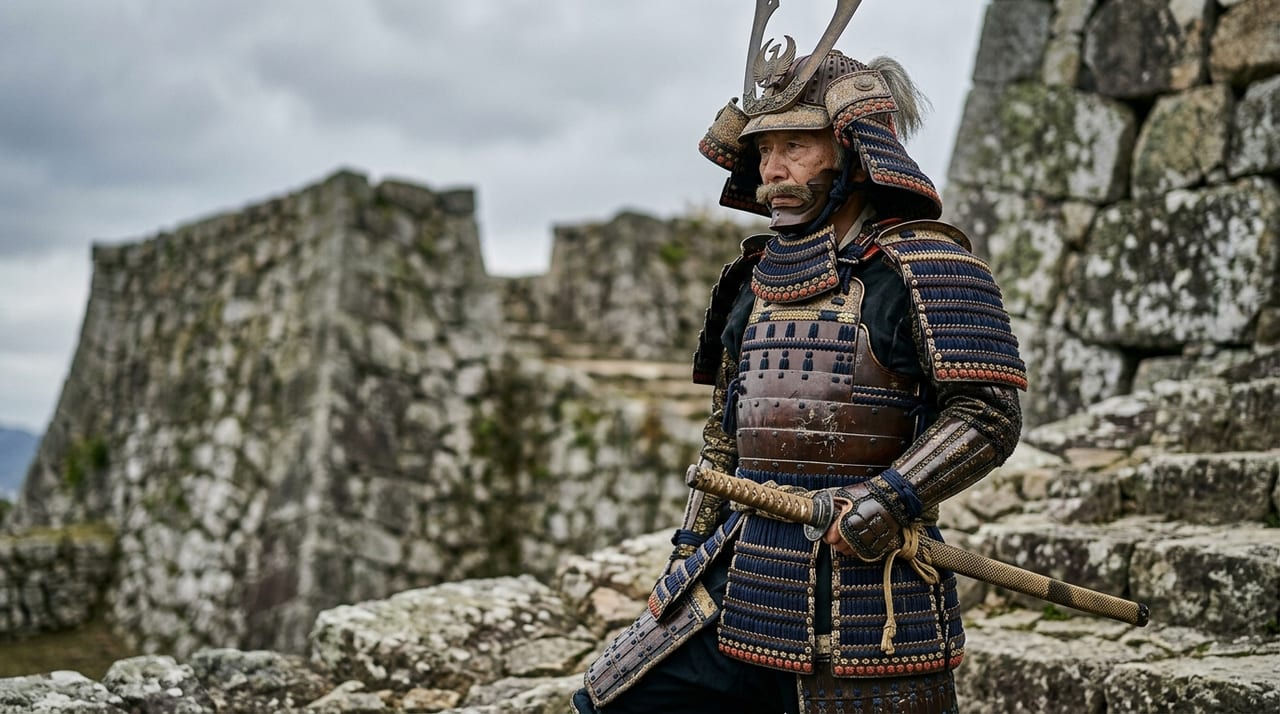
 * Image is for illustrative purposes only.
Hosokawa Katsumoto
細川勝元
The Kanrei Who Burned Kyoto — architect of the Onin War and pillar of the Ashikaga shogunate
Description
The Hosokawa Lineage and the Office of Kanrei
Hosokawa Katsumoto was born in Eikyō 2 (1430), the eldest son of Hosokawa Mochiyuki. The Hosokawa family was a distinguished house and one of the three kanrei families (Hosokawa, Shiba, Hatakeyama) that held the political reins of the Muromachi shogunate. Katsumoto succeeded to the family headship at a young age and took the office of kanrei in Bun'an 2 (1445) at the age of sixteen. The Hosokawa domains extended across a wide area of the Kinai and Shikoku regions, including Awa, Sanuki, Tosa, Awaji, Tanba, and Settsu, making the Hosokawa the most powerful family in the Muromachi shogunate. Katsumoto was known as a perceptive statesman who sought to maintain the stability of the shogunate while assisting Shogun Ashikaga Yoshimasa. However, political conflict over the question of succession would eventually spark one of the greatest civil wars in Japanese history.
The Outbreak of the Ōnin War—As Commander of the Eastern Army
In Ōnin 1 (1467), the Ōnin War began, a conflict in which the daimyo divided into Eastern and Western armies and clashed, centered on the rivalry between Hosokawa Katsumoto and Yamana Mochitoyo (Sōzen). As commander of the Eastern Army, Katsumoto, backed by the authority of the shogunate, faced the Western Army led by Yamana Sōzen. At first, the fighting took the form of a war of attrition with no clear prospect of a decisive victory. Because the streets of Kyoto became the main battlefield, the townscape of Heian-kyō, once proud in its splendor, gradually turned to ashes. The residences of court nobles, temples, and merchant houses burned down, and Kyoto's accumulated cultural heritage suffered enormous damage.
Devotion to Zen and Culture
Katsumoto was not only a military commander but also a devout adherent of Zen Buddhism and a patron of culture. The most eloquent testament to this is Ryōan-ji, which he founded in Kyoto. Ryōan-ji, founded by Katsumoto in Hōtoku 2 (1450), became a Zen temple renowned worldwide for its stone garden (karesansui dry landscape garden), which was built later. Ryōan-ji was burned once during the Ōnin War, but its stone garden, rebuilt afterward, remains registered today as a UNESCO World Heritage Site as a symbol of the aesthetic sense of Japanese culture.
Marriage Ties and Rivalry with Yamana Sōzen
As an irony of history, Katsumoto's greatest political rival, Yamana Sōzen, was also his father-in-law. Katsumoto had taken an adopted daughter of Sōzen as his principal wife in Bun'an 4 (1447) and cooperated with Sōzen. However, the two deepened their rivalry over the expansion of the Yamana family's power, the revival of the Akamatsu family, and the succession disputes within the Hatakeyama and Shiba houses, until they ultimately brought on a war that burned Kyoto to the ground. When Sōzen died in the third month of Bunmei 5 (1473), Katsumoto also passed away in the fifth month of the same year. In the following year, Bunmei 6 (1474), Katsumoto's son Masamoto and Sōzen's grandson Yamana Masatoyo reached a reconciliation, but the war itself continued until Bunmei 9 (1477).
Cultural Change and Swords after the Ōnin War
The Ōnin War also had a profound impact on Japanese sword culture. Many famous swords were burned or scattered by the fighting. The Ōnin War, which Hosokawa Katsumoto either instigated or was drawn into, was a historic event that became a turning point in the history of Japanese swords, changing the fate of countless famous blades.