New Arrivals — Browse our catalog for the latest authentic Japanese sword arrivals. Browse →
July 12, 1441 (Kakitsu 1, 6th month, 24th day)
Yamashiro Province, Kyoto—Akamatsu Mitsusuke's residence (Later events in Harima Province)
Forces
Akamatsu Mitsusuke's Forces (assassination)
Shogunate Punitive Forces
About 19 min read
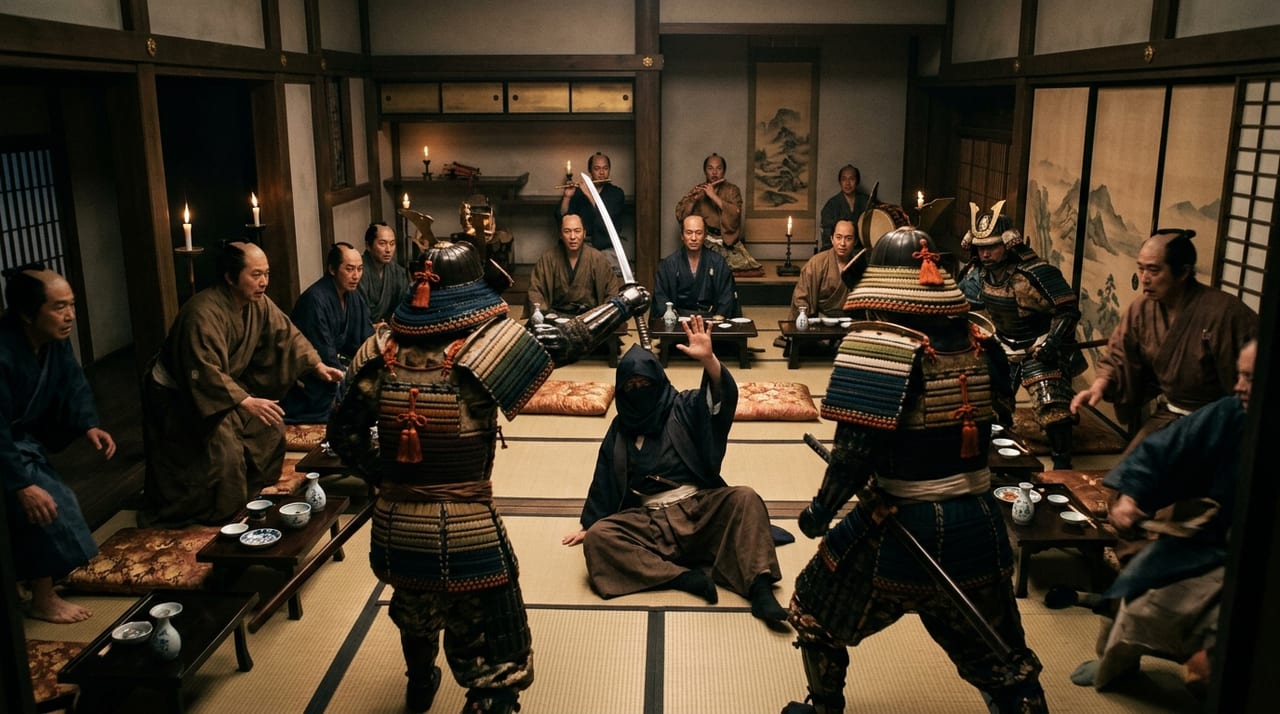
On the evening of the 24th day of the 6th month in Kakitsu 1 (1441), a banquet was held at the residence of Akamatsu Mitsusuke in Kyoto. The honored guest invited was Ashikaga Yoshinori (1394–1441), the sixth shogun of the Muromachi shogunate—a figure whom his contemporaries feared as the embodiment of "Terror of All Men" (bannin kyōfu), wielding authority with an iron grip. As the sarugaku performance continued in a harmonious atmosphere, the armed retainers of the Akamatsu family suddenly took up their weapons and surrounded the shogun. With no way to escape, Yoshinori was beheaded, and an unprecedented event in Japanese history—the assassination of a shogun—came to pass. On that day, a single katana altered the course of Japanese history.
This incident is called the Kakitsu Uprising (Kakitsu no Ran). Akamatsu Mitsusuke (1381–1441), the daimyo of Harima, Bizen, and Mimasaka, had been driven to desperation by Yoshinori's reign of terror, which threatened him with the confiscation of his domains, and launched a desperate counterattack. This uprising became an event that fundamentally questioned the power structure of the Muromachi shogunate and the very nature of the daimyo system, marking an important turning point in the political turmoil that would lead to the later Ōnin War.
Ashikaga Yoshinori was an unusual figure: a high monk from Mount Hiei who was chosen as shogun by lottery (kuji). After the previous shogun Yoshimochi died in Ōei 35 (1428) without designating a successor, the shogunate turned to divine will and selected the heir through an unprecedented method. As "the shogun chosen by heaven," Yoshinori's unique origins paradoxically became the justification for wielding absolute power.
Yoshinori's authoritarian rule fundamentally threatened the autonomous power bases of the daimyo, which had persisted since the Kamakura period. The daimyo, who had grown stronger after the fall of the Kamakura shogunate and through the turmoil of the Southern and Northern Courts, had become effectively semi-independent powers with autonomous political and military authority. Yoshinori sought to place them directly under shogunal control, successively removing daimyo from office and reducing their territories. Akamatsu Mitsusuke also became a target, and rumors spread in Eikyō 9 (1437) that he would lose his domains in Harima and Mimasaka. Mitsusuke's desperate "counterattack" became the Kakitsu Uprising.
In Japanese banquet culture, swords held complex symbolic meanings. In the samurai society of the Kamakura and Muromachi periods, formal attire was required to attend a banquet, and it was customary to remove one's large sword in the presence of one's lord. However, carrying a short blade (waistcloth dagger) for self-defense was a samurai custom, and the act of "wearing a sword" itself held ritual significance, displaying the status and honor of a samurai.
Detailed historical sources about the swords used by Akamatsu's retainers in the Kakitsu Uprising are scarce, but considering sword culture in the mid-Muromachi period (1441), the era was a transition period between the "uchigatana" and "tachi" styles. In addition to the tachi (suspended point-down from the waist), which had been the mainstream since the Kamakura through Southern and Northern Courts periods, the uchigatana (worn point-up at the waist) was beginning to spread in the Muromachi period. In the confined space of a banquet and surprise attack, a shorter, more maneuverable uchigatana or wakizashi would be more effective than a long tachi.
Harima and Bizen, where Akamatsu Mitsusuke was based, had long been renowned as a major production center for Bizen blades. The swordsmiths of the Osafune school of Bizen, which flourished in the Kamakura period and maintained its legacy through the Southern and Northern Courts and Muromachi periods, forged tachi and uchigatana that were praised as possessing unsurpassed sharpness and beauty of their era. The retainers who assassinated the shogun may well have carried such Bizen swords. The question of what manner of blade was used to carry out this unprecedented "assassination of a shogun" sheds light on the diversity and practical character of sword culture in the Muromachi period.
After the assassination of Yoshinori, Mitsusuke swiftly led his retainers away from Kyoto and fled to his base in Harima Province (present-day Hyogo Prefecture). Due to the unrest among the daimyo, the formation of the punitive force was delayed, but eventually a large army led by Yamana Mochitoyo (who would later become Yamana Sōzen and expand his power through his role in the Kakitsu Uprising) and Hosokawa Mochitsune marched toward Harima. The Akamatsu forces defended their base at Sakamoto Castle and then at Kinoyama Castle in Harima, but were overwhelmed by superior numbers. In the 9th month of the same year, Mitsusuke took his own life. The Akamatsu clan lost their three provinces of Harima, Bizen, and Mimasaka and temporarily fell from power.
However, the Akamatsu family's history did not end there. Approximately sixteen years after the Kakitsu Uprising, in Chōroku 1 (1457), former retainers of the Akamatsu clan launched the Chōroku Incident. By recovering the "Sacred Regalia" (one of Japan's three sacred treasures) that the Later Southern Court had carried off, the Akamatsu clan was permitted to revive. Akamatsu Masanori succeeded to the family headship and was granted the shugo post of the northern half of Kaga Province, among other rewards. It was a complex interweaving of samurai logic: vengeance against "those who killed the shogun" and the desire for "family restoration," a cause-and-effect relationship uniquely characteristic of the Muromachi period.
The fact that the stage for assassination in the Kakitsu Uprising was a "sarugaku banquet" is deeply symbolic. Sarugaku (the precursor to Nō theater) was revered as the highest art form in Muromachi samurai and aristocratic society. Ashikaga Yoshinori himself was an ardent patron of sarugaku, and was deeply connected with Zeami, the great developer of Nō theater. Yet in his later years, Yoshinori exiled Zeami to Sado, extending his reign of terror even into the realm of art.
Bringing large swords into a banquet was nearly taboo in samurai society. However, short blades and wakizashi, carried as weapons for self-defense, were exceptionally permitted. When the Akamatsu retainers drew their swords in the midst of the banquet and advanced upon Yoshinori, two samurai norms collided violently: "bearing a sword" and "the etiquette of the banquet hall." This contradiction—the sudden intrusion of sword violence into an elegant cultural setting—vividly reveals the fundamental tension inherent in Muromachi samurai society. The Japanese katana embodies the unity of "beauty and function," yet the Kakitsu Uprising proved that the "potential for violence" wielded by the sword never disappears, no matter what social setting one finds oneself in.
The Kakitsu Uprising's impact on Japanese history was manifold. The greatest impact was the actual loss of the shogun's authority. Yoshinori sought to elevate shogunal authority through absolute power, but his assassination paradoxically created a precedent: "even a shogun can be killed by a daimyo," fundamentally damaging the shogunate's prestige.
Yoshinori's successor, the seventh shogun Ashikaga Yoshikatsu, assumed office at age eight and died the following year. During the era of the eighth shogun, Ashikaga Yoshimasa, the daimyo's tendency toward autonomy advanced further, and in 1467 (Ōnin 1), the Ōnin War erupted. From the Kakitsu Uprising to the Ōnin War was merely twenty-six years—within this quarter century, the Muromachi shogunate's authority suffered irreparable loss.
From the perspective of sword history, the era of the Kakitsu Uprising (mid-Muromachi period) was a transition period in which the form and style of swords underwent significant change. As the shift from the large blades of the Southern and Northern Courts period (nodachi and ōdachi) to the uchigatana and wakizashi of the Muromachi through Sengoku periods progressed, swordsmiths throughout the land continued to forge blades—both practical and artistic—in response to the era's demands. The assassin's sword that took the life of a shogun was not merely a weapon; it was the final recourse chosen by samurai as their response to "intolerable tyranny." The Kakitsu Uprising remains remembered as an event that inscribed into the pages of history the dual nature of the sword—both as an instrument of destruction and as a means of justice.
Harima and Bizen, governed by the Akamatsu clan, held special significance as regions of Japanese sword production. Particularly in the Osafune area of Bizen Province (present-day Okayama Prefecture), a large collective of swordsmiths known as the Bizen Osafune school had been active since the Kamakura period, earning renown as Japan's largest sword-producing region. Bizen Osafune blades, embodying the ideal of a practical sword—"sharp, unbreakable and unbendable"—gained overwhelming support from samurai.
In the mid-Muromachi period (the era of the Kakitsu Uprising), a lineage called "Sue-Bizen" (Late Bizen) began to gain prominence within the Bizen Osafune school. Though Sue-Bizen blades showed some decline in craftsmanship compared to Kamakura-period examples, their rational forging techniques enabled mass production to meet the demands of the coming Sengoku period. In Harima Province during the final battles where Akamatsu Mitsusuke was defeated, samurai bearing Bizen swords surely galloped across the battlefield.
After the Kakitsu Uprising, the lands of Harima, Bizen, and Mimasaka, which had been the Akamatsu base, were confiscated. Yet the swordsmiths of Bizen continued their craft undisturbed by political upheaval. As demand exploded with the coming of the Sengoku period, Bizen Osafune became "a great factory of swords," supplying blades to military lords throughout Japan. Though the political fortunes of samurai rose and fell in cycles, the culture of iron and fire practiced by the swordsmiths continued unbroken—this is the resilient life force that flows beneath the history of the Japanese katana.
Akamatsu Mitsusuke
Mastermind of the Kakitsu Rebellion; daimyo of Harima, Bizen, and Mimasaka who assassinated Shogun Yoshinori
Yamana Sōzen
Yamana Sōzen — participated in crushing the Kakitsu Rebellion and expanded his influence through the achievement
Hosokawa Katsumoto
Hosokawa Katsumoto — managed shogunate politics after the Kakitsu Rebellion and later became a central figure in the Ōnin War
Ashikaga Yoshimasa
Ashikaga Yoshimasa — lost his father Yoshinori in the Kakitsu Rebellion and later presided over the outbreak of the Ōnin War as 8th shogun
Akamatsu Norimura
Akamatsu Norimura — founder of the Akamatsu daimyo power base in the Nanbokuchō era, the origin of the rise that led to the Kakitsu Rebellion
Early to Mid Muromachi
Mid-Muromachi period; the Kakitsu Rebellion was its defining political turning point and symbol of declining shogunal authority
The Ōnin War and the Transformation of the Sword Industry
The Ōnin War and its sword industry transformation; the shogunate's weakening after Kakitsu laid the groundwork for the Ōnin War
Eikyō-Kyōtoku Disturbances Period
Eikyō-Kyōtoku disturbance era; contemporaneous with the Kakitsu Rebellion in the broader context of mid-Muromachi disorder