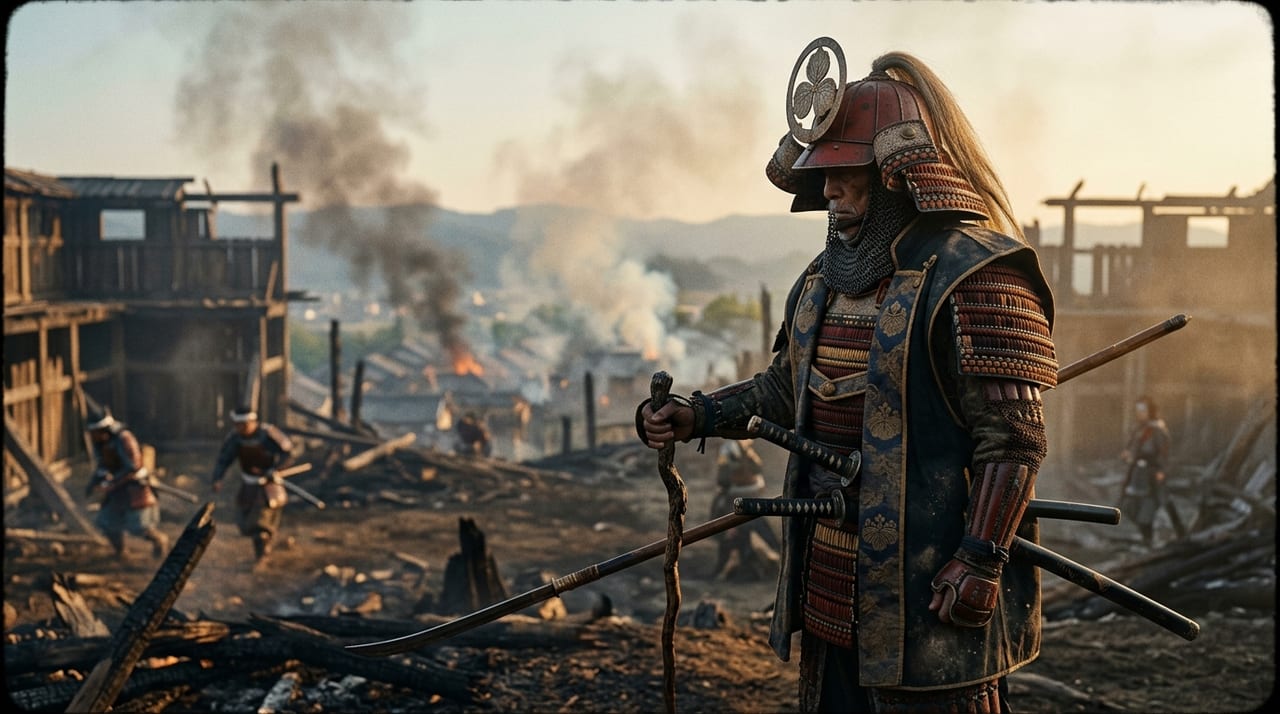
 * Image is for illustrative purposes only.
Yamana Sōzen
山名宗全
Aka-Nyudo (the Red Monk) — The Great Daimyo Called the "One-Sixth Lord," Who Led the Western Army in the Onin War and Set Kyoto Aflame Despite His Advanced Age
Description
The Appearance of Rokubun-no-ichi-dono
Yamana Sōzen (personal name Mochitoyo) was born in Ōei 11 (1404), the son of Yamana Tokihiro. At one point the Yamana clan controlled eleven of the country's sixty-six provinces. Its house was known as the Rokubun-no-ichi-dono (Lord of One-Sixth), a great daimyō family said to rule one-sixth of Japan. Its power was greatly reduced after its conflict with the shogunate (the Meitoku Rebellion, 1391). In Sōzen's time, however, it was still a formidable clan that ruled many provinces in the San'in and San'yō regions, including Tajima, Harima, Inaba, Hōki and Iwami. Sōzen took Buddhist vows in Kakitsu 2 (1442), taking the name Sōhō, and later changed his name to Sōzen. He was also known by the nickname Aka-nyūdō (the Red Lay Monk), from his reddish complexion.
Interference in Shogunal Politics and Rivalry with Hosokawa Katsumoto
As a powerful shugo daimyō of the Muromachi shogunate, Yamana Sōzen had great influence over shogunal politics. His rivalry with Hosokawa Katsumoto in particular had a structure of political and military opposition that went beyond a personal feud. Both sides intervened in the succession disputes of the Shiba and Hatakeyama families, which intensified the conflict. It became entangled with the question of Ashikaga Yoshimasa's successor, and became impossible to resolve. In the succession question, Katsumoto at first backed Yoshimasa's younger brother Ashikaga Yoshimi, while Sōzen backed Yoshimasa's son Yoshihisa. As the war unfolded, however, Yoshimi switched to the Western Army (Sōzen's side), and the alignment of opposing forces changed repeatedly. This became the core of the Ōnin War.
The Ōnin War and the Western Army's Commander
In the Ōnin War, which began in Ōnin 1 (1467), Sōzen as commander of the Western Army faced the Eastern Army led by Hosokawa Katsumoto. According to the Ōninki, the Western Army led by the sixty-four-year-old veteran numbered more than 110,000 men. Sōzen established his base at Nishijin (present-day Nishijin, Kamigyō Ward, Kyoto City). The war then became a prolonged contest lasting eleven years. The place name Nishijin survives today as a district name in Kyoto, deriving from the Western Army's encampment there. The fighting became a bitter war of attrition in the streets of Kyoto. With neither side achieving a decisive victory, the cultural treasures of Kyoto were lost to fire one after another.
Swords and a Warrior's Pride
Yamana Sōzen never lost his pride as a warrior. Despite his advanced age, he personally took the front lines and sustained the Western Army's morale, and his presence left a deep impression on the people of his time. When the Eastern Army attacked the Western Army's headquarters in Ōnin 3 (1469), the Ōnin Bekki records that Sōzen, although sixty-six years old, put on armor, took up a sword, went out into the garden and drove off the enemy soldiers.
An Odd Resonance with Arch-Rival Hosokawa Katsumoto
Hosokawa Katsumoto, who became his arch-rival, had taken Sōzen's adopted daughter as his principal wife in Bun'an 4 (1447). The two had originally been joined as in-laws. There is a record that Sōzen in his later years wished for reconciliation with Katsumoto. This shows that the parties themselves fully recognized that the Ōnin War had become a war of attrition that benefited no one. In Bunmei 5 (1473), Sōzen died of illness in camp, less than two months before Katsumoto. He was seventy years old.
Legacy of the Ōnin War and Sword Culture
Yamana Sōzen's death opened the way to the de facto end of the Ōnin War. However, the influence that eleven years of war had on Japan's sword culture is incalculable. Many famous swords were lost in the fighting, and as smiths scattered across the country, smithing techniques spread throughout Japan. The Ōnin War, which the aged commander known as the Red Lay Monk either set in motion or was drawn into, should be remembered as an important turning point in the history of the Japanese sword as well.