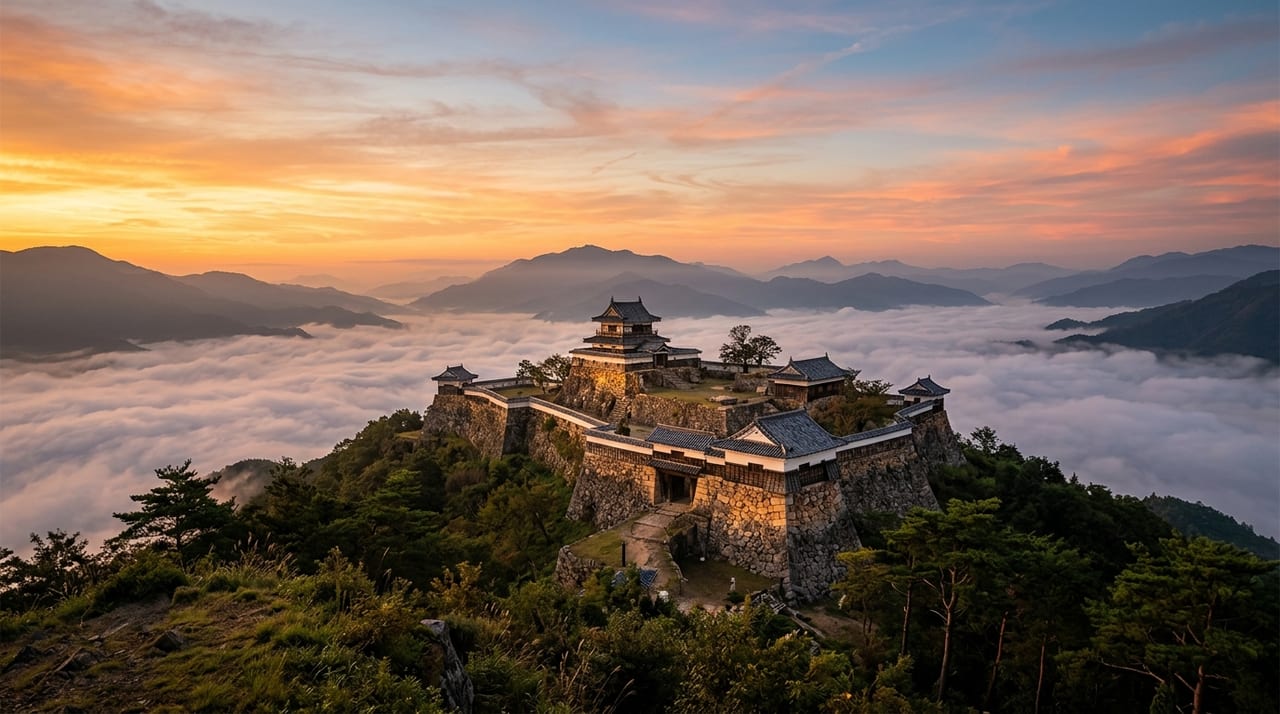
 * Image is for illustrative purposes only.
Takeda Castle
竹田城
Takeda Castle is a historic castle in the Kansai region (Built circa the Kakitsu era (1441–1444)). Its lord was Yamana Sōzen (founder) / Akamatsu Hirohide (last lord).
Overview
A Mountain Castle Floating in the Sky: The Legend of Takeda Castle
Takeda Castle is a mountain castle on the summit of Mt. Kojō (353.7 meters above sea level) in Asago City, Hyōgo Prefecture. It is known nationwide as the "Castle in the Sky" and "Japan's Machu Picchu," and is a castle ruin with spectacular views. From early morning in autumn through winter, temperature differences cause a sea of clouds to form in the valley of the Maruyama River. The fantastic sight of only the stone walls appearing to float above the clouds attracts many photography enthusiasts and tourists, as one of the most striking scenes among Japan's castle landscapes.
There are various theories about the founding of Takeda Castle, but the leading theory holds that it was built around the Kakitsu era (1441–1444) by Ōtagaki Terukage, a general serving under Yamana Sōzen, on the orders of Yamana Sōzen, the shugo daimyō of Tajima Province. The Yamana clan was a powerful shugo daimyō who held one of the four shishiki positions of the Muromachi shogunate, and Takeda Castle functioned as a key stronghold in their control of Tajima.
The Beauty of the Stone Walls: Craftsmanship Carved into a Mountain Castle in Tajima
One of Takeda Castle's greatest attractions is the elaborate group of stone walls built by the Anōshū across the summit. The Anōshū were a guild of stonemasons originating from Anō in Ōmi Province (present-day Shiga Prefecture). From the Sengoku period through the Edo period, they undertook the construction of castle stone walls throughout the country. The stone walls of Takeda Castle extend 400 meters north to south and 100 meters east to west, and their scale is among the largest of any mountain castle in Japan.
The stone walls were built using the Anō-style stone-stacking technique, and their masonry is said to closely resemble that of Azuchi Castle. More than 400 years after construction, most of the stone walls remain intact, serving as a living testimony that conveys the high level of Sengoku-period stone wall technology to the present day.
Standing on the summit and looking out in all four directions, you can see the chain of Tajima's mountains to the north, Harima's farmland to the south, the highway to Kyoto extending east, and the San'indō road running west. It is immediately clear that the castle was built on a strategic site commanding the key routes in all four directions, and one is left admiring the geographic insight of the general who built Takeda Castle.
The History of Takeda Castle: The Trajectory of Rise and Fall
The history of Takeda Castle is a story that condenses the rise and fall of the Sengoku period. Begun as a castle of the Yamana clan, Takeda Castle changed hands and developed amid the various wars over hegemony in Tajima Province. Yamana Suketoyo held real power in Tajima from the late Muromachi period into the Sengoku period, and Takeda Castle also came under his control.
In the latter half of the 16th century, during Hashiba Hideyoshi's (later Toyotomi Hideyoshi) pacification of Inaba and Tajima, Takeda Castle came under attack by Hideyoshi's forces and fell in Tenshō 5 (1577). Afterward, Hideyoshi's younger brother Hashiba Hidenaga became castellan (jōdai), followed by Kuwayama Shigeharu as castellan, and then Akamatsu Hirohide entered the castle as its last lord.
After the Battle of Sekigahara (1600), Akamatsu Hirohide joined the attack on Tottori Castle as part of the Eastern Army. However, he was held responsible for arson in the castle town and was ordered by Tokugawa Ieyasu to commit seppuku. From then on, Takeda Castle was abandoned, and no lord has been installed there to this day. The fact that the stone walls have continued to survive for more than 400 years after the castle was abandoned is the result of the quality of Takeda Castle's stone walls and the history of people who have carefully preserved this castle ruin.
Viewing the Sea of Clouds: The Best Time and Place
The sea of clouds at Takeda Castle is most often seen in the early morning from autumn through winter (roughly 4 to 8 a.m., from about September to November). When rain falls the previous night and the next morning is calm and cold, a dense sea of clouds forms in the valley of the Maruyama River. The most popular viewing spot for the sea of clouds is Ritsuunkyō (Asago City), located southeast of Takeda Castle. Ritsuunkyō has an observation deck, from which you can photograph Takeda Castle and the sea of clouds from an angle across the valley.
The view from the Takeda Castle honmaru ruins is equally exceptional. The experience of standing directly within the sea of clouds from the castle ruins offers a special sensation that can be found only here. The sea of clouds at dawn, which can be seen only by those who rise early and stand on the summit, is truly a spectacular view worthy of the name "Castle in the Sky."
The Philosophy of the Sengoku Mountain Castle: The Summit of Martial Force and Beauty
The philosophy of the Sengoku mountain castle, as shown by Takeda Castle, is to make maximum use of the steep terrain itself as the castle's defense. Flatland castles (hirajiro) require vast enclosures and complex baileys and moats, whereas for a mountain castle the steepness of the terrain is the greatest defense. Even a small garrison can resist the attack of a large army. In the case of Takeda Castle, the routes up to the summit are limited to one or two, so even a small force holed up on the summit could defend the castle for a considerable period.
This design philosophy of the Sengoku mountain castle, a "fusion of terrain and man-made construction," deeply resonates with the philosophy of "fusion of material and technique" in sword forging. In Japanese swords too, the properties of the material, iron sand, are drawn out to the fullest, and through the swordsmith's skill, a beauty beyond the material itself is realized. The stone walls of Takeda Castle likewise respect the power of the mountain's terrain as their "material," and are a masterpiece in which that power is maximized through the skill of the Anōshū.
Takeda Castle and TOUKENZA
The reason TOUKENZA introduces Takeda Castle is not simply that it is a famous tourist destination. The "fusion of harmony with nature and strategic thinking" embodied by the Sengoku mountain castle has a deep philosophy that resonates with the aesthetics of Japanese swords. Standing on a steep summit and gazing at stone walls floating in the sky is one of the experiences that most intuitively conveys how Japan's warrior culture combined nature, materials, and technique to realize beauty and function at the same time.
For sword enthusiasts visiting the Kansai region, Takeda Castle forms a rich itinerary together with Himeji Castle, Sasayama Castle, and others, touring the castles of Tajima, Harima, and Tanba. A journey that reflects on the aspiration of "Tenka Fubu" held by Sengoku warlords while gazing at Takeda Castle floating in the sea of clouds on an autumn morning will surely bring a special emotion to fans of Japanese swords.
Connection to Swords
The connection between Takeda Castle and Japanese swords lies less in the direct provenance of famous blades than in the deep bond with the entire warrior world that the Sengoku mountain castle symbolizes. Across the Chūgoku Mountains, from northern Hyōgo Prefecture to Tottori Prefecture, rich sources of iron sand were scattered. This iron sand is also the raw material of tamahagane, the steel used for Japanese swords.
Akamatsu Hirohide, the last lord of Takeda Castle, was known as a general excelling in both letters and arms, and he also worked to promote Confucian learning, including supporting Fujiwara Seika. A warrior's cultural refinement and his interest in swords are inseparable. Hirohide was the owner of the famous blade "Shishiō," but it is said that it was confiscated by the Tokugawa side at the time of his seppuku.
The area around Asago City, where Takeda Castle is located, was also a mining region known for the Ikuno Silver Mine.
Takeda Castle, as a key stronghold of Tajima, was also a place that warriors of each era passed through with swords at their waists. When warriors such as the Yamana clan, Hashiba Hideyoshi, and the Akamatsu clan took up swords at Takeda Castle during the Sengoku period, it is not hard to imagine that those swords were the work of famous smiths from either Bizen, Yamashiro, or Sōshū. A castle is a space where warriors most needed swords, and countless sword stories are woven into the history that Takeda Castle's stone walls have watched over.
Highlights
- Castle keep ruins floating in the sea of clouds — The phantasmagoric vista appearing in early morning autumn and winter hours, a Japanese landscape second to none, worthy of the 'Castle in the Sky' name
- Stone walls by Anao craftsmen — A network of precisely crafted stonework spanning 400 meters north-south and 100 meters east-west, the largest scale for mountain castles, remaining solid and unbroken after four centuries
- 360-degree panorama from the main keep, second keep, and south second keep — A sweeping vista of Tajima's mountains, Harima's farmlands, and the flow of the Maruyama River
- Ritsunkyo observation platform — The finest vantage point to photograph Takeda Castle and the clouds from the opposite shore, a breathtaking early-morning spectacle
- Natural environs of Kojosan — Wildflowers, birds, and autumn foliage on the mountain path merging with the castle ruin in a richly unified environment
- Stroll through Takeda's castle town — A town preserving Edo-period urban planning, where one can also savor Tajima beef and Iwazu leeks, local culinary treasures
* Opening hours and admission fees are subject to change. Please check the official website before visiting.