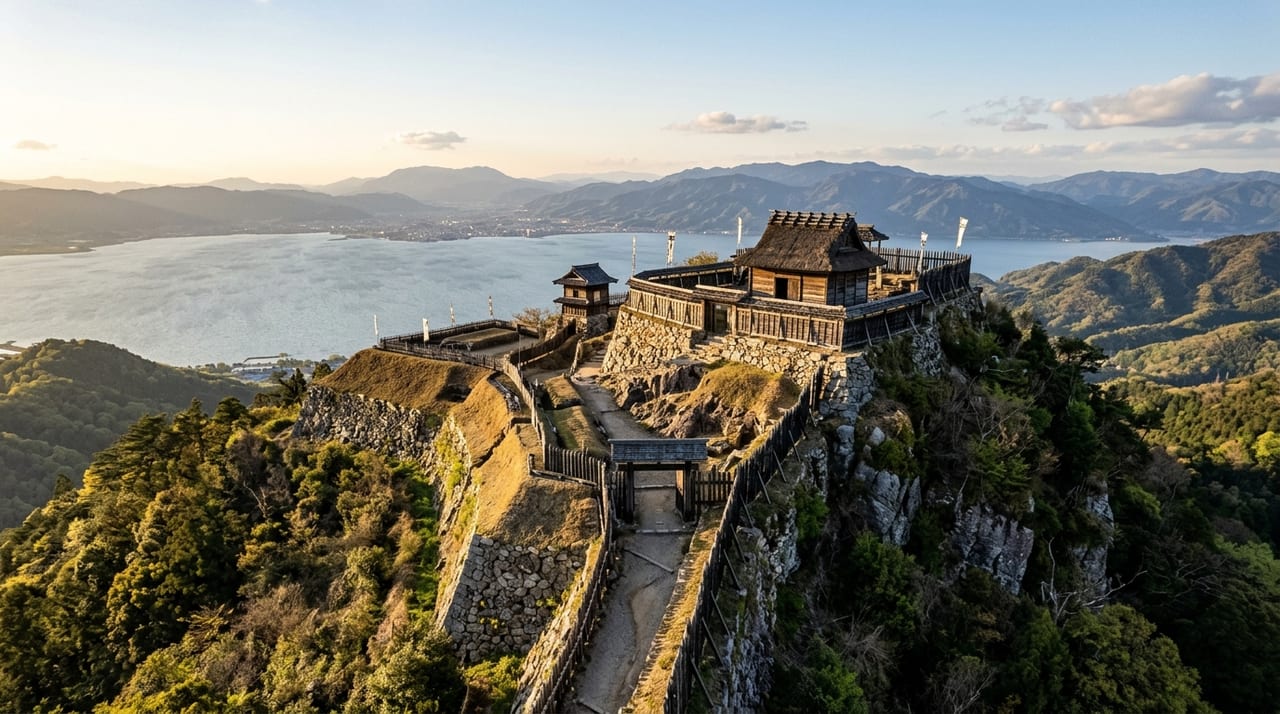
 * Image is for illustrative purposes only.
Shizugatake Fortress
賤ヶ岳砦
Shizugatake Fortress is a historic castle in the Kansai region (Tenshō 11 (1583), principal stage of the Battle of Shizugatake). Its lord was Toyotomi Hideyoshi (Hashiba Hideyoshi).
Overview
Shizugatake is a mountain in Nagahama City, Shiga Prefecture, famous as the site of the Battle of Shizugatake in Tenshō 11 (1583), centered on a 421 m peak on the north shore of Biwako. This battle was the decisive clash in the greatest succession struggle of the Sengoku period, in which Hashiba Hideyoshi and Shibata Katsuie fought over the position of successor to Oda Nobunaga, who had met a violent death in the Honnōji Incident (1582).
In the area around Shizugatake, both Hideyoshi's and Katsuie's forces built numerous forts, and complex fighting unfolded across the mountainous terrain. Following the Chūgoku Ōgaeshi, Hideyoshi again displayed rapid maneuvering, also known as the Mino Ōgaeshi, and launched a surprise attack on the forces of Sakuma Morimasa on Katsuie's side. Even after taking Ōiwayama fort, Morimasa remained at the front line, not following Katsuie's order to withdraw.
Particularly noteworthy are the exploits of the young warriors known as the Seven Spears of Shizugatake. Seven men, namely Fukushima Masanori, Katō Kiyomasa, Katagiri Katsumoto, Katō Yoshiaki, Kasuya Takenori, Wakisaka Yasuharu, and Hirano Nagayasu, distinguished themselves with feats of spear combat and received special praise and rewards from Hideyoshi. Their exploits went on to form the core of the warrior group in Hideyoshi's regime.
Today, the Shizugatake Lift has been developed, and the area is a sightseeing spot where visitors can enjoy spectacular views of Biwako and the surrounding mountain ranges from the summit.
Connection to Swords
The connection between the Battle of Shizugatake and Japanese swords and weapons is symbolized by the very name 'Seven Spears of Shizugatake.' This battle, in which the spear (yari) took center stage, is a typical example of the differing use of spears and swords as weapons in the Sengoku period. At the same time, the warriors of the Seven Spears also fought at close quarters with Japanese swords between spear actions, so both spears and swords were used in actual combat.
Katō Kiyomasa, one of the Seven Spears, later became lord of Kumamoto Castle and is known for having patronized the Dōtanuki school of Higo swordsmiths.
After his defeat at Shizugatake, Shibata Katsuie retreated to Kitanoshō Castle in Echizen, where he took his own life.
Highlights
- Shizugatake summit (accessible by lift) — spectacular views of Biwako and the battlefield
- Historic sites of the Seven Spears warriors — places associated with the seven men who distinguished themselves in the battle
- Yogo Lake (Yogoko) — a tranquil lake that became a scene of fierce fighting in the battle
- Shibata Katsuie's encampment site — remains of the main encampment of Katsuie, who ended as the losing commander
- Remains of the Shizugatake fort group — a historic landscape where the ruins of multiple forts remain in the mountains
* Opening hours and admission fees are subject to change. Please check the official website before visiting.