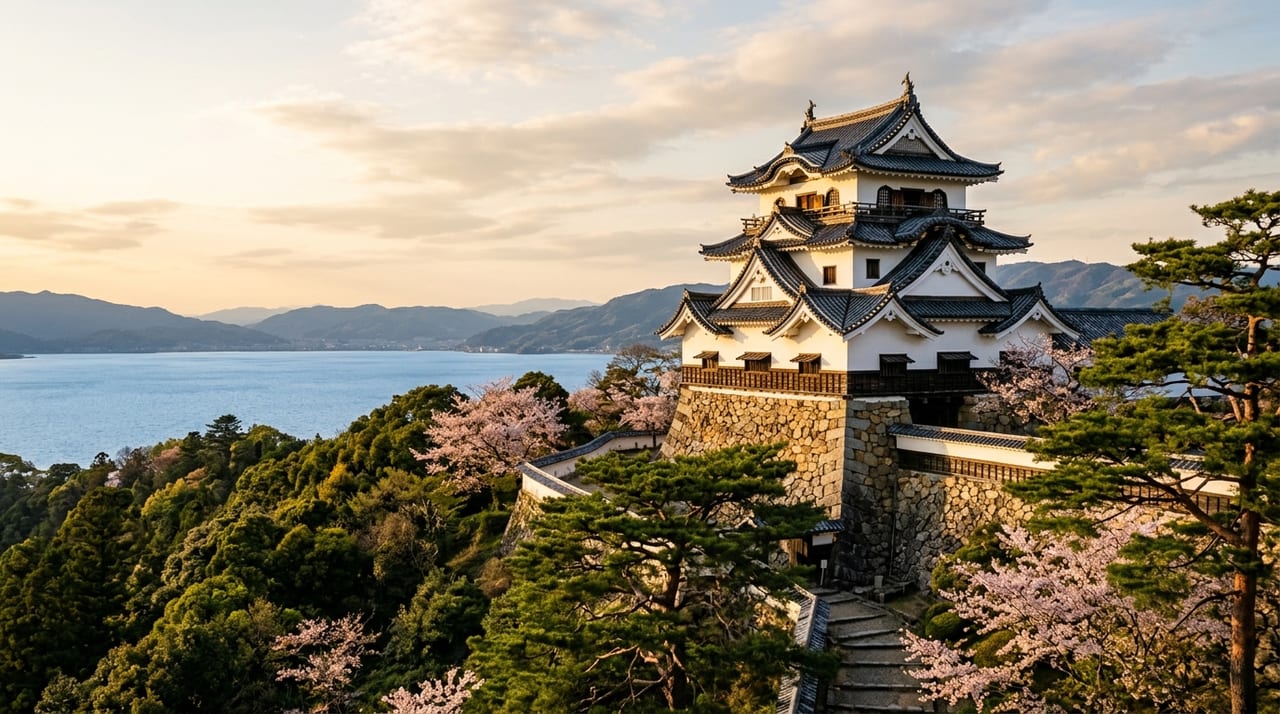
 * Image is for illustrative purposes only.
Hikone Castle
彦根城
Hikone Castle is a historic castle in the Kansai region (Construction began 1604, completed 1622). Its lord was Ii Naomasa / Ii clan.
Overview
About the Castle
Hikone Castle is a National Treasure castle built to carry on the wishes of Ii Naomasa, one of the Four Heavenly Kings of the Tokugawa, and it has etched more than 400 years of history atop Mount Konki overlooking Lake Biwa. Naomasa was shot while pursuing Shimazu Yoshihiro's forces of the Western Army at the Battle of Sekigahara, and he died of the wound in Keichō 7 (1602). Construction was begun by his eldest son, Ii Naotsugu, in Keichō 9 (1604), and completed in Genna 8 (1622). Legend has it that materials were transferred to the castle from Sawayama Castle (the stronghold of Ishida Mitsunari), Odani Castle (the stronghold of Asai Nagamasa), Ōtsu Castle, and other sites, making it a castle that condenses the history of Ōmi.
Architecture and Structure
The three-story, three-tier keep has a graceful, highly designed appearance that makes heavy use of katōmado windows, karahafu gables and irimoya gables, and it is counted among the five National Treasure castles. The arrangement of gables differs on each face of the keep, giving it variety and realizing the ideal of castle architecture that it is beautiful from any angle. The Ii family was a formidable warrior house known for the Ii 'Red Devils' armored corps, and Naomasa served as military inspector (gunkan) for the Eastern Army at Sekigahara, a fierce commander who also personally joined the fighting. The imposing Ii army, uniformly clad in red armor, astonished friend and foe alike and was feared as the 'Red Oni of the Ii'. As the lords of the 350,000-koku Hikone Domain, the Ii family governed Ōmi, and it was one of the most distinguished houses of all, producing five tairō from among its successive domain lords.
Development of the Castle Town
The Bakumatsu-era tairō Ii Naosuke decided to open the country by concluding the Treaty of Amity and Commerce with the United States in Ansei 5 (1858), and he suppressed opponents in the Ansei Purge, but he was assassinated in the Sakuradamon Incident in Man'en 1 (1860). Opinions remain divided today on Naosuke's achievements and failings, but he is highly regarded historically as a figure who opened the door to Japan's modernization. Many Important Cultural Properties survive, including the Tenbin Yagura, Taikomon Yagura and Nishinomaru Sanjū Yagura, and the view of the keep from Genkyū-en, laid out in imitation of the Eight Views of Ōmi, is renowned as a spectacular vista. Samurai residences and temples and shrines remain in the castle town, and Yume-Kyōbashi Castle Road, a stroll route recreating the atmosphere of the Edo period, is popular.
Culture and Crafts
Hikone Castle is also known nationwide for its mascot character, Hikonyan, who appears inside the castle every day and is loved by a wide range of generations, from children to adults. Hikone Castle, where the dignity of a National Treasure coexists with the approachability of a yuru-kyara mascot, symbolizes a form of Japanese culture in which tradition and the present harmonize. Hikone, the castle town of the Ii family's 350,000-koku domain, is also one of the birthplaces of the Ōmi merchants and has a distinctive urban character in which samurai culture and merchant culture coexist. Hikone's landscape, where the scenery of Lake Biwa and the beauty of the castle merge as one, is a spectacular view that condenses the richness and depth of history of Ōmi.
Sightseeing and Experiences
Hikone is also known as a home of Ōmi beef, and eating Ōmi beef after touring the castle is a special indulgence. Hikone, where the culture of the warrior and the culture of food coexist, is a town where you can experience history with all five senses. Hikone Castle's nighttime illumination is also popular, and the keep floating against the jet-black night sky is fantastical.
Connection to Swords
The Ii family was a formidable warrior house known for its Ii 'Red Devils' armored corps, and its sword collection boasts a richness befitting a daimyō house representative of Ōmi. The founder, Naomasa, inherited the red-armor tradition and its retainers after the fall of the Takeda family, served as military inspector (gunkan) for the Eastern Army at the Battle of Sekigahara, and was a fierce commander who was shot while pursuing the retreating Shimazu forces. Naomasa's discerning eye for arms, grounded in his combat experience, became a tradition of the Ii family, and successive domain lords collected and passed down famous swords. The Ii family's sword collection includes works from a wide range of periods, from Kotō-era masterpieces to Shintō-era fine works. The Bakumatsu-era tairō Ii Naosuke is known not only as a statesman but also as a master of the martial arts. Naosuke was deeply devoted to iaijutsu and founded his own school, Shinshin Shinryū. Shinshin Shinryū was a school that pursued the essence of iaijutsu, cutting at the moment of drawing the sword, and it is said that Naosuke, although he was a domain lord himself, never missed his daily practice. In the political sphere, Naosuke showed a resolute stance in the Ansei Purge; on the other hand, his pursuit of the way of the sword shows that the samurai spirit dwelled in both politics and the martial arts. When Naosuke was assassinated in the Sakuradamon Incident, it is said that the retainers guarding him had put hilt covers (tsuka-bukuro) on their swords to keep off the snow, and so could not draw them in an instant. Hikone Castle Museum displays many Ii-family swords, red-armor suits and tea utensils, allowing visitors to experience at once the aesthetic sense of the Ii family, which excelled in both the martial and the cultural arts.
Highlights
- National Treasure tower (three stories)
- View of the tower from Genkyū-en Garden
- Hikone Castle Museum (Ii clan swords and red armor)
- Tenbin Turret and Taiko Gate Turret (Important Cultural Properties)
- Yumekyōbashi Castle Road (recreated Edo-period townscape)
- Azuchi Castle Ruins (about 30 minutes by car)
* Opening hours and admission fees are subject to change. Please check the official website before visiting.