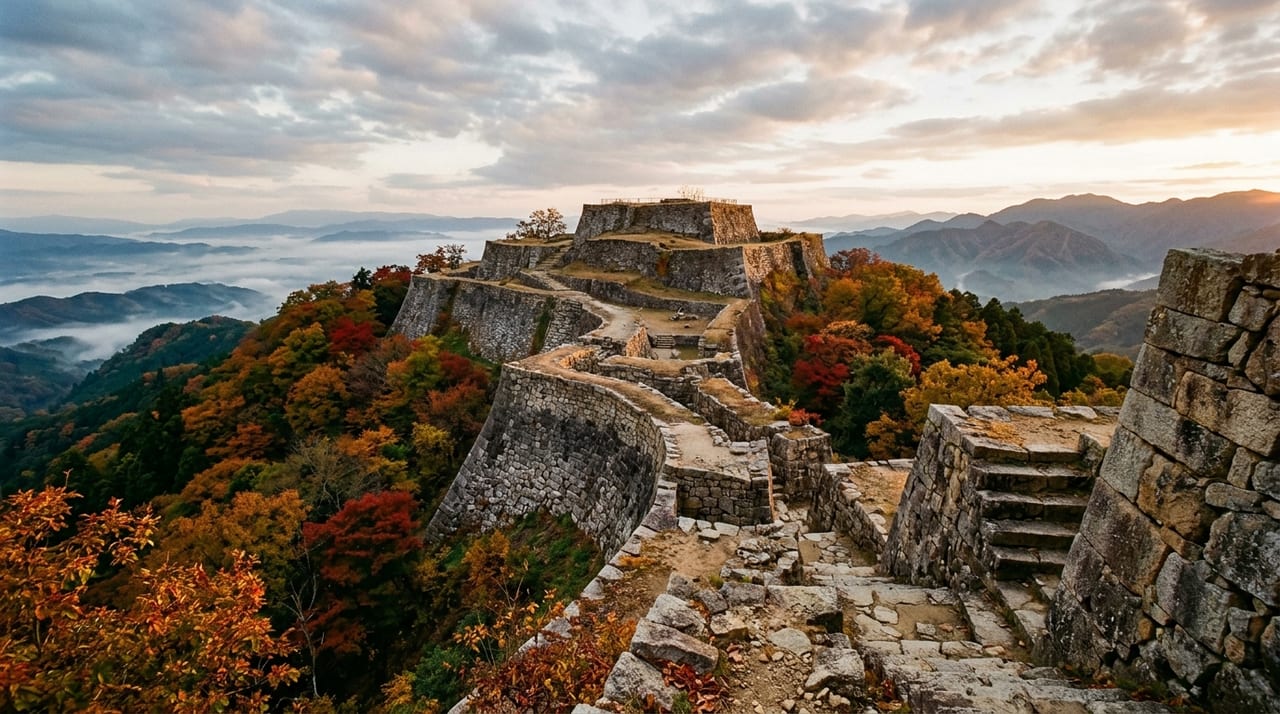
 * Image is for illustrative purposes only.
Takatori Castle
高取城
Takatori Castle is a historic castle in the Kansai region (Founded 1332 (Genkō 2); greatly expanded in the Tenshō era (1573–1592)). Its lord was Ochi Kunizumi / Honda Toshihisa / Uemura Iemasa.
Overview
About the Castle
Takatori Castle is a mountain castle built on the summit of Mount Takatori (583 m) in Takatori Town, Takaichi District, Nara Prefecture. Together with Bitchū Matsuyama Castle and Iwamura Castle, it is counted among Japan's Three Great Mountain Castles. Its elevation and the scale of its layout make it one of the largest mountain castles in Japan. The long chain of stone walls that runs from the foot of the mountain up to the honmaru on the summit still overwhelms visitors after many centuries. Tradition holds that the castle was built in Genkō 2 (1332) by the Southern Court general Ochi Kunizumi, but most of the vast stone wall remains that survive today were developed in the late Sengoku period and the early Edo period.
Architecture and Structure
In the Tenshō era (1573–1592), Honda Toshihisa, a senior retainer of Toyotomi Hidenaga, became lord of the castle. Together with his son Honda Toshimasa, he carried out a major renovation that turned it into an early-modern castle with stone walls. In the early Edo period, Uemura Iemasa became lord, and the Uemura family then ruled the Takatori Domain, with 25,000 koku, until the Meiji Restoration. The stone walls of Takatori Castle show techniques such as uchikomi-hagi and sangi-zumi at the keep base, and they are a valuable remnant that conveys the appearance of early-modern mountain castles. A three-story keep once rose on the honmaru, but it was torn down after the Meiji-era abolition of castles. Today only the keep base and numerous stone walls remain.
Nature and Scenery
There are several routes up to the castle, including one from the direction of Tsubosaka-dera and one that climbs on foot from the castle town along the Tosa-kaidō. The castle town along the Tosa-kaidō retains a pharmacy townscape from the Edo period that speaks to its history as a town of medicines. Takatori was also famous as a town of medicines and produced a variety of Japanese and Chinese herbal medicines. The defensive strength drawn from the steep terrain of the mountain castle and the fantastic scenic beauty created by its elevation are the two elements that make Takatori Castle worthy of its place among Japan's Three Great Mountain Castles. The season when autumn foliage dyes the stone walls is especially splendid, and throughout the year the castle draws many visitors as a destination for mountain-castle hiking.
Strategic Importance
Yamato Province (Nara Prefecture) has been at the center of Japan since ancient times. Located at the southern edge of the Nara Basin, Takatori Castle played an important role at each turning point of Japanese history, from the rivalry between the Southern and Northern Courts, through the warfare of the Sengoku period, to the transfer of power from the Toyotomi to the Tokugawa. From the honmaru on the summit, the mountains of Yoshinoyama, Katsuragi-san, and Kongō-san can be seen in a panoramic view. Standing there, one takes the vantage point of a castle that has looked down over the long history of Yamato. In its overwhelming scale and depth of history, Takatori Castle is a sacred site that represents Japan's mountain-castle culture. More than a century has passed since it was abandoned, yet each stone of its walls still conveys the will of the samurai of that era.
Castle Town and Traditions
The castle town of Takatori, the Tosa-kaidō, retains a townscape that strongly evokes the Edo period. Its streets, lined with the old houses of medicine merchants, form a unique landscape rarely matched elsewhere. The culture of the town as a center of medicinal herbs and the history of its castle town give this region its distinctive historical character.
Connection to Swords
Yamato Province holds an extremely important place in the history of Japanese swords as the home of Yamato-den, one of the Gokaden, the five major traditions of Japanese swordsmithing. Yamato-den originated with groups of swordsmiths who served the great temples of Nara. Five schools (Tegai, Taima, Senju-in, Shikkake, and Hoshō) were active from the late Heian period through the Kamakura period. These swordsmiths were patronized by major temples and shrines such as Kasuga Taisha, Tōdai-ji, and Kōfuku-ji. They established a distinctive style that combines religious solemnity with martial practicality. In the Yamato region that spreads at the foot of Takatori Castle, a smithing tradition has taken root that has continued unbroken since antiquity, and its lineage is carried on even into the cutlery culture of modern Nara.
Highlights
- Stone walls on the summit — remains of one of Japan's largest mountain castles, with stone walls well preserved on the mountaintop, including the tenshudai (keep base)
- Medicine townscape along the Tosa-kaidō — the castle town of the Takatori Domain, lined with old houses of Edo-period medicine merchants
- Tsubosaka-dera (Minami-Hokke-ji) — a renowned temple along the approach road to Takatori Castle, known for its giant cliff-carved Buddha and its flowers
* Opening hours and admission fees are subject to change. Please check the official website before visiting.