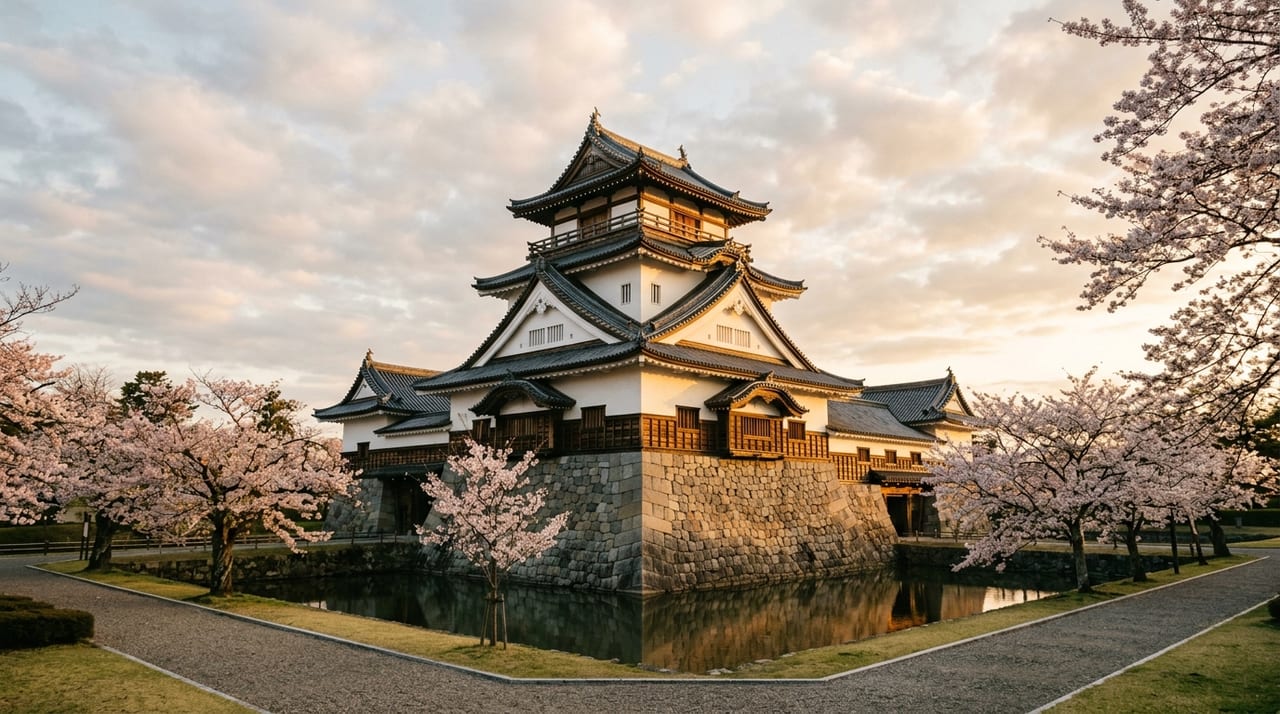
 * Image is for illustrative purposes only.
Kitabatake Clan Residence (Tage Kitabatake Clan Castle and Residence)
北畠氏館(多気北畠氏城館)
Kitabatake Clan Residence (Tage Kitabatake Clan Castle and Residence) is a historic castle in the Kansai region (Nanboku-chō to Sengoku period (the clan seat moved to Tage in the mid-14th century; Kitabatake rule at Tage ended with the Mise Incident of 1576)). Its lord was Kitabatake Akiyoshi (who moved the clan seat to Tage), successive heads including Mitsumasa, Noritomo, Masasato, Kichika, and Harutomo, Kitabatake Tomonori (eighth head), and Kitabatake Tomofusa.
Overview
Overview
The Kitabatake Clan Residence was the seat of the Kitabatake, a courtier-daimyo house that ruled southern Ise Province as provincial governors from the Nanboku-chō through the Sengoku periods. The residence site and its refuge fortress on the heights above, Kiriyama Castle, are together designated the National Historic Site "Tage Kitabatake Clan Castle and Residence Site." Tage lay near the Ise Hon-kaidō highway, ringed by mountains whose seven passes controlled all approaches.
The Move to Tage
After Kitabatake Chikafusa entered Ise in 1336, the family served as a pillar of the Southern Court in the province. When Tamaru Castle fell in 1342 they withdrew to mountainous Tage, and for roughly 240 years across eight generations they governed Ise from there. Their authority extended over the districts south of Ichishi and reached into neighbouring Iga and southern Yamato. A strong flow of culture from Kyoto and Yamato made this mountain valley a provincial cultural centre.
The Residence and Its Garden
The residence occupied flat ground in the valley, now the precincts of Kitabatake Shrine. The surviving Kitabatake Residence Garden covers some 850 tsubo and combines a dry landscape composition with a pond garden. Attributed to Hosokawa Takakuni, a shogunal deputy of the Muromachi bakufu, it is counted with the Ichijōdani Asakura garden and the old Shūrin-ji garden among the three great warrior gardens of Japan. The central stone of the dry landscape stands about two metres high, in the bold arrangement characteristic of a Sengoku warlord's garden.
Kiriyama Castle
The refuge fortress of Kiriyama Castle was built on the mountain rising behind the residence. A rectangular platform and earthworks remain at the summit, and to the south lies a level area called the Kanetsuki-dō, taken to be the site of a watchtower. Near the foot of the slope the place name Ōmiyado preserves the memory of a castle gate. The national cultural properties database records the castle as "built making use of the steepness of Kiriyama, also called Tage Castle, the residence of Kitabatake Akiyoshi and his descendants."
Tomonori, the Swordsman Daimyo
The eighth head, Kitabatake Tomonori, is remembered as a swordsman daimyo said to have studied under the master Tsukahara Bokuden and received the secret technique hitotsu no tachi. In 1569 he submitted to Oda Nobunaga, accepted Oda Nobukatsu as his adopted heir, and retired. On the twenty-fifth day of the eleventh month of 1576 assassins acting on the orders of Nobunaga and Nobukatsu attacked him at the Mise residence and killed him along with his sons and retainers — the Mise Incident. Tradition holds that he took up his sword and fought fiercely but was cut down because a treacherous retainer had tampered with the blade. With this the Kitabatake hold on Tage came to an end.
Present State and Access
The residence site is maintained as Kitabatake Shrine, and the garden is open to visitors. The stamp for the Continuation of Japan's Top 100 Castles is kept at the shrine office (8:30–17:00). About 10 minutes by community bus from Ise-Okitsu Station on the JR Meishō Line, or about 60 minutes by car from the Hisai interchange of the Ise Expressway.
Connection to Swords
The eighth head of the house, Kitabatake Tomonori, was a swordsman daimyo said to have studied under the master Tsukahara Bokuden and to have received the secret technique *hitotsu no tachi*. Tradition holds that during the Mise Incident of 1576 he fought fiercely with his own sword but was cut down because a treacherous retainer had tampered with the blade. This residence, seat of the Kitabatake governors of Ise, was where Tomonori was raised.
Highlights
- Seat from which the Kitabatake governed Ise for some 240 years across eight generations
- The residence site and Kiriyama Castle together form the National Historic Site "Tage Kitabatake Clan Castle and Residence Site"
- The residence garden, attributed to Hosokawa Takakuni, is one of the three great warrior gardens of Japan (National Place of Scenic Beauty)
- Associated with Kitabatake Tomonori, the swordsman daimyo said to have received the *hitotsu no tachi* from Tsukahara Bokuden
* Opening hours and admission fees are subject to change. Please check the official website before visiting.