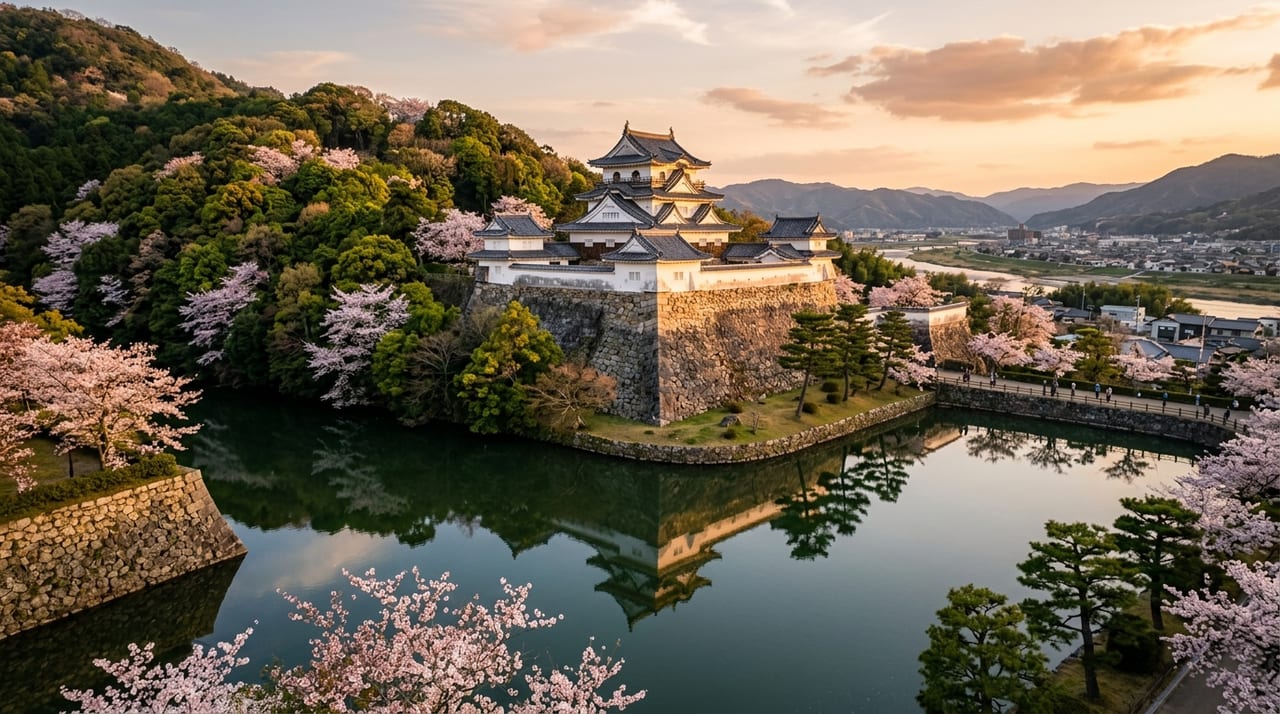
 * Image is for illustrative purposes only.
Tatsuno Castle
龍野城
Tatsuno Castle is a historic castle in the Kansai region (Built around Meio era (1492–1501)). Its lord was Akamatsu Murahide / Wakisaka Yasumasa / Wakisaka clan.
Overview
About the Castle
Tatsuno Castle is a hirayama-style castle. It originated as a mountain castle built on the hills of Keirōzan on the west bank of the Ibo River, and later a palace complex was developed at the foot of the mountain. The mountain castle that Akamatsu Murahide is said to have built on the summit of Keirōzan around the Meiō era (1492–1501) became a prize contested throughout the Sengoku period as a key stronghold of Harima Province. The Honmaru Palace, Uzumemon gate, and corner turret that stand today were rebuilt in the Shōwa 50s, and the castle quietly presides over the center of Tatsuno's elegant castle town, which is also called Harima's Little Kyoto. The layout, which makes skilled use of the terrain of Keirōzan, is a typical example of a composite castle that combines a mountain castle on the summit with a flatland castle at the foot, and it clearly shows the characteristics of castle architecture in Harima. No tenshu was built, and the fact that palace architecture was set up in the Honmaru is also one of Tatsuno Castle's features, and is an interesting example of how castles changed during the peaceful Edo period.
The Wakisaka Family and the Castle's History
Wakisaka Yasuharu was a fierce warrior who made a name for himself as one of the Seven Spears of Shizugatake, and he survived the Battle of Sekigahara through his martial prowess and wisdom. The Wakisaka family came to Tatsuno through Yasuharu's grandson, Wakisaka Yasumasa, who entered the domain in Kanbun 12 (1672) with 53,000 koku. (Yasuharu himself was a daimyo of Sumoto (Awaji) and Ōzu (Iyo) and had no connection with Tatsuno.) At the Battle of Sekigahara the family was initially on the Western Army's side, but it defected to the Eastern Army on the day of the battle, which secured the confirmation of its domains after the war. This historical 'defection' is attracting the interest of historians as an aspect of the survival skills of Sengoku warriors. The Wakisaka family moved through Sumoto (Awaji) and Ōzu (Iyo) to Iida (Shinano), and under Yasumasa it finally entered Tatsuno. Through the Edo period it maintained domain governance up to the late Edo period as a daimyo with 53,000 koku (later 51,000 koku). The Wakisaka family also had a household tradition of excelling in literary arts, and it cultivated the culture of waka, haikai, and the tea ceremony in Tatsuno's castle town. For this reason, although Tatsuno was a samurai castle town, it also has the character of an elegant cultural city, which is why it is called Harima's Little Kyoto.
Harima's Culture and Soy Sauce
Tatsuno is known nationwide as the birthplace of usukuchi (light-coloured) soy sauce. Usukuchi soy sauce, which the Maruo family, soy sauce brewers in Tatsuno, is said to have devised in Kanbun 6 (1666), became the foundation of Kansai cuisine culture as an excellent seasoning that makes the most of the color and flavor of ingredients, and it fundamentally supports Japan's food culture today. The soy sauce industry of Tatsuno, which developed under the patronage of the Wakisaka family, supplied products to the national market throughout the Edo period and formed the economic foundation of the castle town. The two seemingly unrelated elements of castle and soy sauce blend beautifully in the small castle town of Tatsuno. The high-quality water of the Ibo River and Harima's mild climate created an environment ideal for soy sauce fermentation, and Tatsuno's soy sauce industry made dramatic progress from the middle of the Edo period onward. The development of this industry encouraged the growth of the merchant class in the castle town and gave rise to Tatsuno's distinctive urban culture, in which samurai culture and merchant culture coexist.
Castle-Town Scenery and Culture
The area around the ruins of Tatsuno Castle is known as Harima's Little Kyoto, and its castle-town scenery, with traditional merchant houses with white plaster walls and lattice windows lined up, has been selected as an Important Preservation District for Groups of Traditional Buildings. Surrounded by the clear waters of the Ibo River and the greenery of Keirōzan, this castle town is small in scale but condenses the essence of Japan's castle-town culture, and it is loved by many travelers. It is also the birthplace of Miki Rofū, known as a poet and children's song writer, and his poem monument for 'Akatombo' (Red Dragonfly) in Tatsuno Park evokes nostalgia in the hearts of visitors. The soy sauce breweries, sake breweries, and merchant houses that remain in the castle town today are living cultural heritage that testifies to the prosperity from the Edo to the Meiji period, and the scenery of continuous white-walled storehouses and stone-paved lanes embodies the ideal form of Japan's castle town, where castle and townhouses are unified.
Connection to Swords
Wakisaka Yasuharu, one of the Seven Spears of Shizugatake, lies at the heart of the sword culture of Tatsuno Castle. Each of the Seven Spears was an elite warrior whom Hideyoshi favored, and the swords they wore are recorded in history as proof of their loyalty to their lord and their personal martial prowess. Harima Province borders Bizen (Okayama), a famous producer of Japanese swords. Near the ruins of Tatsuno Castle is the Tatsuno City Museum of History and Culture, which introduces Tatsuno's history and culture. As you walk through the white-walled castle town and listen to the babbling of the Ibo River, the weight of the sword that Wakisaka Yasuharu wore at his waist on the battlefield of Shizugatake seems to return to your imagination. Harima's Little Kyoto, Tatsuno, is small in scale but is in no way inferior to the castle towns of major cities in the density of its history and culture. As one of the best places to learn deeply about both the cultural background of Japanese swords and castle-town culture, it promises every visitor rich experiences and new discoveries. The walking route linking the Tatsuno Castle site, the Important Preservation District, and the soy sauce breweries is a rare route where you can walk through and experience the ideal form of Japan's castle-town culture, in which samurai, industry, and literary arts are united.
Does Tatsuno Castle Have a Tenshu?
No so-called high-rise tenshu was built at Tatsuno Castle. In the early Edo period, in a peaceful age, the Wakisaka family, a tozama daimyo, set up the castle as its domain administrative seat. For this reason, rather than a tenshu focused on defense, a Honmaru Palace for government affairs and residence was placed at the center of the castle. The Honmaru Palace, corner turret, and Uzumemon gate that can be seen today were restored in 1979 (Shōwa 54) based on old drawings. The layout, which has no tenshu and centers on palace buildings, is known as a good example of how the castle's role shifted from a practical Sengoku castle to a base of governance in a peaceful age. Together with the remains of the medieval mountain castle on the summit of Keirōzan, the appeal of Tatsuno Castle lies in the fact that the form of castles from each era can be read in one place.
Connection to Swords
The sword culture of Tatsuno Castle is told through Wakisaka Yasuharu, an outstanding warrior and one of the Seven Spears of Shizugatake. The Battle of Shizugatake (Tenshō 11 (1583)) was the decisive battle in which Toyotomi Hideyoshi defeated Shibata Katsuie and established his dominance over the realm, and the seven warriors who distinguished themselves particularly in this battle were recorded in history as the Seven Spears of Shizugatake. Fukushima Masanori, Katō Kiyomasa, Wakisaka Yasuharu, Katō Yoshiaki, Hirano Nagayasu, Kasuya Takenori, and Katagiri Katsumoto were all elite warriors deeply trusted by Hideyoshi, and their exploits in the battle made their martial fame known throughout the realm. The Seven Spears' warriors naturally wore swords of the highest standard, and in those swords their loyalty to Hideyoshi and their own martial prowess were embodied. The Wakisaka family moved to Ōzu (Iyo) and Iida (Shinano) after the Battle of Sekigahara. It was Wakisaka Yasumasa, a foster grandson of Yasuharu, who entered Tatsuno, and in Kanbun 12 (1672) he rebuilt Tatsuno Castle as the first Tatsuno domain lord of the Wakisaka family. Harima Province borders Bizen (Okayama), a famous producer of swords. At the Tatsuno City Museum of History and Culture near the ruins of Tatsuno Castle, Tatsuno's history and culture are introduced. Also, at the old-established soy sauce breweries in the Tatsuno castle town, you can sense the history of Tatsuno, where the life of the old castle town and samurai culture were united, along with brewing tools from the Edo period. The unexpected combination of swords and soy sauce forms the rich cultural layers of Tatsuno, a castle town. In understanding the sword culture of Harima Province, visiting Himeji Castle and Akō Castle (the setting of Chūshingura) along with Tatsuno Castle brings the full picture of Harima's samurai culture into clearer focus.
Highlights
- Tatsuno Castle Honmaru Palace and corner turret: the Honmaru Palace, corner turret, and Uzumemon gate, rebuilt in the Shōwa 50s
- Harima's Little Kyoto, Tatsuno's castle town: Important Preservation District for Groups of Traditional Buildings, with merchant houses featuring white walls and lattice
- Tatsuno City Museum of History and Culture: a museum introducing the history and culture of Tatsuno
- Usukuchi Tatsuno Soy Sauce Museum: introduces the history of soy sauce brewing in Tatsuno, the birthplace of usukuchi (light-coloured) soy sauce
- Miki Rofū's poem monument for 'Akatombo' (Red Dragonfly): in Tatsuno Park, the birthplace of the children's song poet, evoking nostalgia
- Mountain castle remains on the summit of Keirōzan: a medieval castle site where you can enjoy the views and history of Harima
* Opening hours and admission fees are subject to change. Please check the official website before visiting.