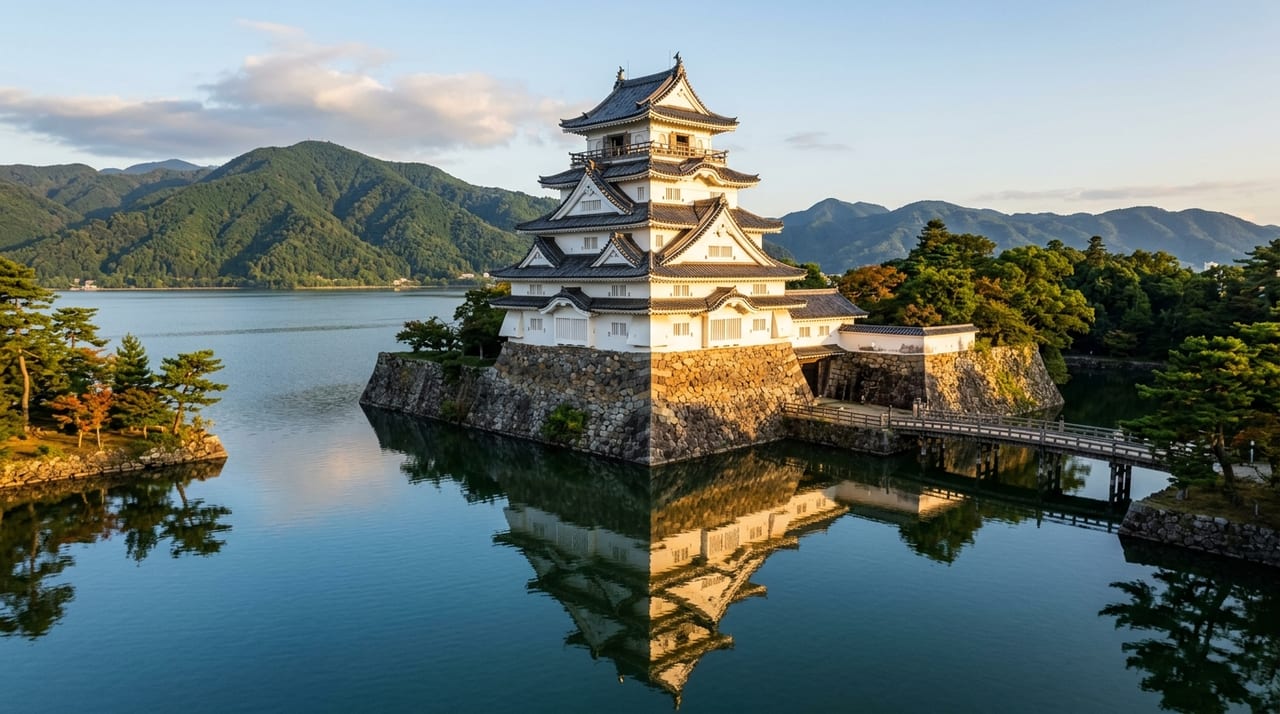
 * Image is for illustrative purposes only.
Sakamoto Castle
坂本城
Sakamoto Castle is a historic castle in the Kansai region (Built around 1571 (Genki 2)). Its lord was Akechi Mitsuhide.
Overview
Sakamoto Castle was a water castle (mizujiro) built on the western shore of Lake Biwa at the foot of Mt. Hiei in Otsu, Shiga Prefecture, and was a genuine early modern castle that Akechi Mitsuhide developed as his residence. In Genki 2 (1571), Akechi Mitsuhide, who carried out the burning of Mt. Hiei under orders from Oda Nobunaga, was granted the land of Sakamoto in Ōmi Province as a reward for this achievement, and built his castle there.
Sakamoto Castle was a masterpiece of a "lake castle" (umijiro) built to project dramatically into the lake facing Lake Biwa, and is said to have embodied the finest castle-building techniques of the Oda-Toyotomi period. Luís Fróis's História de Japam records that, after the castle Nobunaga built on Mount Azuchi, there was no castle in the realm as famous as this one of Akechi's, revealing that it was a magnificent fortified castle into which Mitsuhide's cultural refinement and economic power were invested.
The castle had a tenshu (main tower) composed of a large and a small tower, and was a water castle into which the waters of Lake Biwa were drawn. From the main tower (tenshu), panoramic views of Lake Biwa spread out, and Mitsuhide held linked-verse poetry (renga) gatherings and tea ceremonies here, demonstrating his aspect as a cultured gentleman.
Following the Honnō-ji Incident of Tensho 10 (1582), Mitsuhide, defeated by Hashiba Hideyoshi at the Battle of Yamazaki, fell in battle during his retreat. Sakamoto Castle became a tragic site: tradition holds that, as the castle fell, Akechi Hidemitsu killed Mitsuhide's wife and children, set fire to the castle and took his own life. Afterwards the castle was rebuilt by Niwa Nagahide, but when Asano Nagamasa built Ōtsu Castle and moved there in Tenshō 14 (1586), it was abandoned, and its stone walls and other materials were reused for the construction of Ōtsu Castle. Today most of the castle site lies beneath the town, and Sakamoto Castle Ruins Park has been laid out along National Route 161.
Connection to Swords
The relationship between Sakamoto Castle and swords is directly connected to Akechi Mitsuhide's multifaceted talents and the sword culture of the Sengoku period in which he lived. Mitsuhide was not merely skilled as a military commander, but was also cultured in waka poetry, renga linked-verse, and the tea ceremony—refinements that extended to his appreciation of swords.
The best-known episode linking Sakamoto Castle with swords comes from its fall. In the 6th month of Tenshō 10 (1582), with the castle surrounded by Hori Hidemasa's forces, Akechi Hidemitsu, unwilling to let famous treasures be lost, packed up a katana by Kuniyuki, a wakizashi by Yoshimitsu, calligraphy by Kidō and other meibutsu, attached an inventory, and sent them to Hori Naomasa of the besieging army. Asked why Mitsuhide's treasured wakizashi by Gō Yoshihiro was missing from the list, Hidemitsu is said to have replied that he would wear it himself so as to hand it to Mitsuhide on the mountain path to the afterlife.
Just before the Honnō-ji Incident, at the Atago Hyakuin renga gathering that Mitsuhide hosted, he is said to have composed the verse "The time is now, / Heaven rules below, / This fifth month"—a verse hinting at rebellion. Even amid such spiritual tension, Mitsuhide's resolve to take up his sword and go to battle as a warrior reveals his special relationship with swords.
Highlights
- Sakamoto Castle Site Park monument — stone marker and explanatory panels at the Lake Biwa shoreline
- Lake Biwa panorama — expansive lake views from the water-castle setting
- Mt. Hiei backdrop — the historical relationship between the castle and the mountain Mitsuhide burned
- Hiyoshi Taisha Shrine — the head shrine of the Sannō faith, guardian shrine of the castle town
- Former Chikurin-in (National Scenic Site) — the garden of a surviving Enryaku-ji satobō, a stroll garden borrowing Mt. Hachiōji as scenery
- Sakamoto ribo district — historic monastic guest quarters of Enryakuji scattered through the town
* Opening hours and admission fees are subject to change. Please check the official website before visiting.