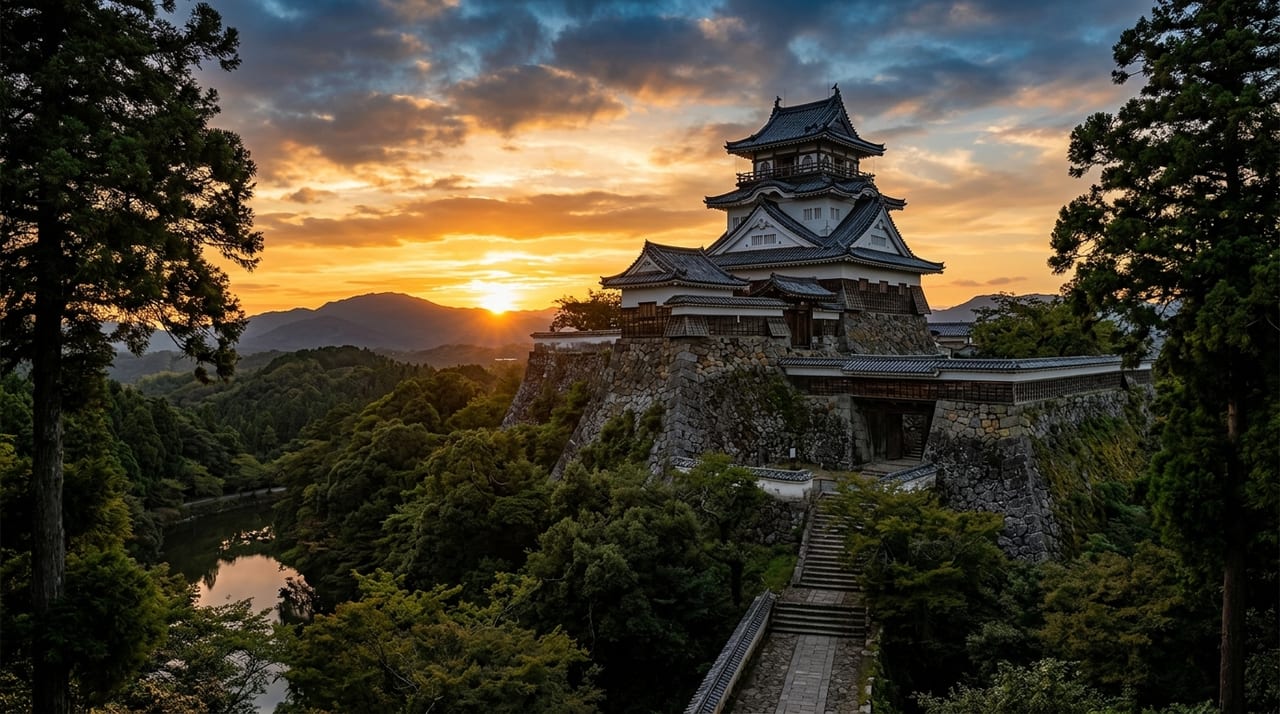
 * Image is for illustrative purposes only.
Tamaru Castle
田丸城
Tamaru Castle is a historic castle in the Kansai region (Southern and Northern Courts period through Meiji Restoration). Its lord was Kitabatake clan, Tamaru clan, Oda Nobuo, Gamo Ujisato, Kii Domain.
Overview
Overview and Location
Tamaru Castle is a hillside castle located in Tamaki Town, Watarai District, Mie Prefecture, constructed on a plateau formed by the Tokida River, a tributary of the Miyagawa River, and is a strategic stronghold in southern Ise Province. The castle ruins are a Mie Prefecture-designated Historic Site and have been selected as No. 154 in the Continued Selection of Japan's 100 Famous Castles. Currently, the ruins of the tenshu foundation, stone walls, and moats are preserved and maintained. The site is also beloved as a cherry blossom viewing destination in spring.
Founding and the Kitabatake Clan Era
Tamaru Castle's origins trace back to the Southern and Northern Courts period. Around Engen 1 (1336), it is said to have been built by Kitabatake Chikafusa and Kitabatake Akinobu, military leaders of the Southern Court, as a strategic stronghold for Southern Court forces in Ise. The Kitabatake clan served for generations as Ise Provincial Governors ruling southern Ise, and Tamaru Castle functioned as one of their strongholds.
Akiharu, the fourth son of Kitabatake Masasato, took up residence at Tamaru Castle and established the "Tamaru clan." As a branch family of the Kitabatake, the Tamaru clan took root in southern Ise and consolidated their control of the region. Throughout the medieval period, Tamaru Castle played an important role in conflicts with neighboring clans, continuing to function as the southern wedge supporting Kitabatake dominion in Ise.
Transformation into an Early Modern Castle by the Oda Clan
When Oda Nobunaga invaded Ise in Eiroku 12 (1569) (the Siege of Ōkōchi Castle), the Kitabatake clan, as a condition of peace, accepted Oda Nobuo, the second son of Nobunaga, as the adopted heir of Kitabatake Tomofusa of the main line. In Tenshō 3 (1575), Nobuo relocated his headquarters from Okōchi Castle to Tamaru Castle and initiated major renovation works.
Through this renovation, Tamaru Castle was transformed into an early modern castle featuring a three-tiered, three-story tenshu. Nozura-zumi (unmortared dry-stacked) stone walls were constructed throughout the site, embodying the most advanced castle-building techniques of the late Sengoku period. Tamaru Castle became the central base of Oda rule in Ise. However, in Tenshō 8 (1580), a fire of unknown origin destroyed the tenshu and many other structures. Subsequently, Nobuo constructed Matsugashima Castle (Matsusaka City) near a maritime trade hub and relocated his base there, causing Tamaru Castle to temporarily lose prominence.
From Gamo Ujisato through the Toyotomi Era to the Edo Period
Following the Battle of Komaki-Nagakute in Tenshō 12 (1584), Ise came under the influence of Toyotomi Hideyoshi. Gamo Ujisato took control of Matsugashima Castle. Tamaru Castle also came under his rule. At the beginning of the Edo period Inaba Michitō entered the castle as lord of the Tamaru Domain, and after a period under the Tōdō clan, it became part of the Kii Domain (under Tokugawa Yorinobu) in Genna 5 (1619).
During the Edo period, Tamaru Castle became an important administrative center for the Kii Domain, with a castellan assigned to govern Watarai District. The stone walls underwent further renovation reflecting early modern standards, marking the continued transformation from a medieval mountain fortress into an early modern castle. Following the Meiji Restoration and the Castle Abolishment Edict of 1873, nearly all structures were dismantled, though the tenshu foundation, stone walls, and moats survived in good condition.
Connection with Swords and Martial Artifacts
There are few records documenting a direct connection between Tamaru Castle and swords. In Ise Province, the Sengo Muramasa school is known to have been active at Kuwana in northern Ise from the late Muromachi period.
Current Status and Points of Interest
Currently, Tamaru Castle Ruins function as a historic park maintained by Tamaki Town. Visitors can view the tenshu foundation, secondary citadel (ninomarū), tertiary citadel (sannomarū) stone walls, and empty moats. The Fujimi Gate and the oku-shoin (inner study hall) of the sannomarū, which had been moved elsewhere, have been relocated back to the castle grounds, allowing visitors to recall the architecture of former times. In 2017, it was designated as part of the Continued Selection of Japan's 100 Famous Castles and continues to attract castle enthusiasts throughout the year. The cherry blossom season in early April is particularly bustling, making it the center of Tamaki Town's tourism.
Transportation access is approximately 10 minutes on foot from Tamaru Station on the JR Sangū Line. Tamaki Town also has a memorial hall to Murayama Ryōhei, a native of the town who founded the Asahi Shimbun; its second floor houses a local history museum.
Connection to Swords
There are few records documenting a direct connection between Tamaru Castle and swords. In Tenshō 3 (1575), Oda Nobuo rebuilt Tamaru Castle with a three-tiered keep, but the keep was lost in a fire in Tenshō 8 (1580). In Ise Province, the Sengo Muramasa school was active at Kuwana in northern Ise from the late Muromachi period.
Highlights
- Main tower base and natural-faced dry-stack stone walls (Japan's 100 Famous Castles [Continued]; Mie Prefecture historic site)
- Castle lord transition from Kitabatake clan to Oda Nobukatsu and renovation to early modern fortress (1575)
- Fujimi Gate and the san-no-maru oku-shoin (inner study hall), relocated back to the castle grounds
- Noted cherry blossom viewing site (spring season)
* Opening hours and admission fees are subject to change. Please check the official website before visiting.