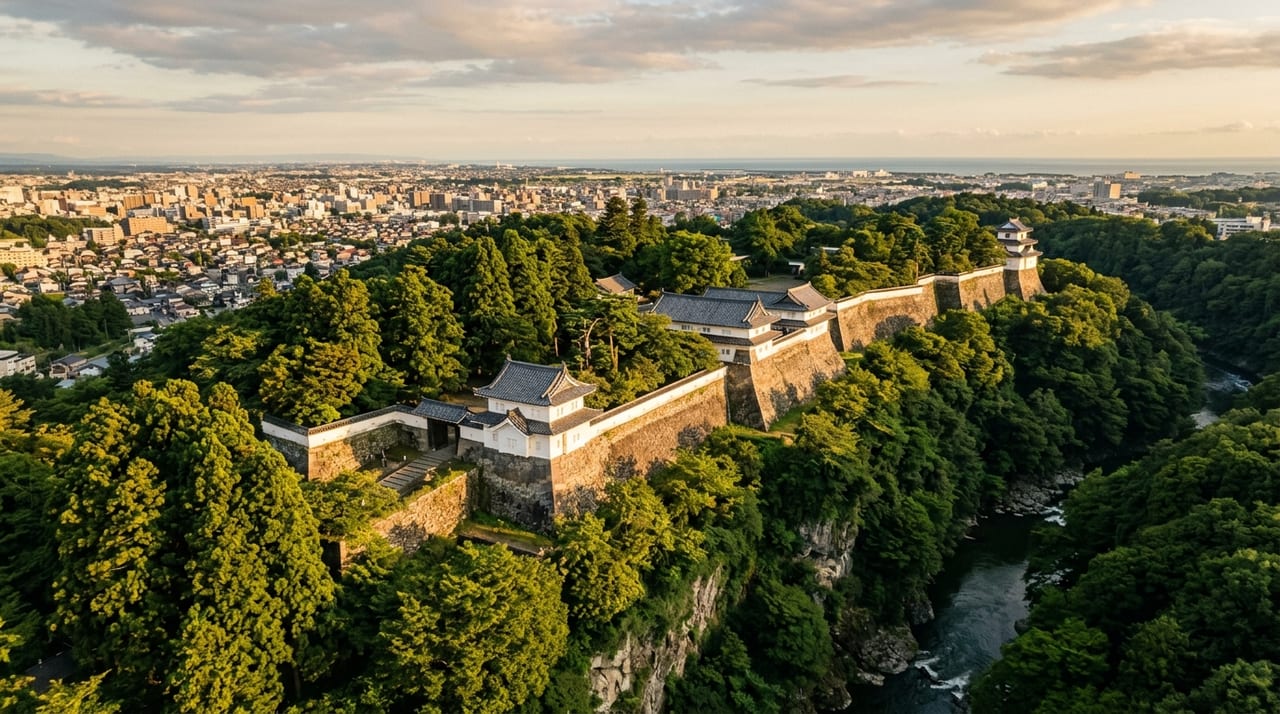
 * Image is for illustrative purposes only.
Sanda Castle
三田城
Sanda Castle is a historic castle in the Kansai region (Late Muromachi period to Meiji era). Its lord was Arima clan; Araki clan; Yamazaki clan; Arima Noriyori; Matsudaira Shigenao; Kuki clan (approximately 240 years in the Edo period).
Overview
Overview and Location
Sanda Castle was a castle in Settsu Province, located in the central urban area of Sanda City, Hyogo Prefecture. It stood on a tongue-shaped plateau on the right bank of the Muko River and was built to take advantage of the natural defensive terrain, with cliffs roughly 20 meters high on three sides of the plateau. In the Edo period, the government of Sanda Domain (also known as Kuki Domain) was based here, and the castle formed the core of the castle town that the Kuki clan governed for about 240 years. Today it is the site of Hyogo Prefectural Arima High School and Sanda City Sanda Elementary School, with only a stone marker standing and no structures remaining.
Construction and the Muromachi and Sengoku Periods
The origins of Sanda Castle are subject to several theories, and few reliable records survive. One theory holds that the Settsu Arima clan built it in the Muromachi period, which is consistent with the Arima clan having governed the surrounding area during the Nanboku-chō period of conflict.
During the Tenshō era (1573–1592) of the Sengoku period, Araki Heidayū, a retainer of Araki Murashige, entered Sanda Castle and governed it. In Tenshō 6 (1578), when Araki Murashige rebelled against Oda Nobunaga (the Siege of Arioka Castle), Sanda Castle, which lay within Murashige's sphere of influence, also became a target of Oda forces. After Araki rule ended, the Ikeda clan and Miyoshi Nobuyoshi (Toyotomi Hidetsugu) entered the castle in succession. From Tenshō 10 (1582), Yamazaki Kataie, who came from Ōmi Province with 22,000 koku, took control and carried out improvements to the castle. His son Yamazaki Iemori became castle lord and gave the castle the form of an early modern castle.
Early Edo Period Transitions
After the Battle of Sekigahara (1600), the Sanda area was reorganized under daimyo allied with the Tokugawa. In Keichō 6 (1601), Arima Noriyori entered Sanda with 20,000 koku. The following year Noriyori died, and Sanda was merged into the domain of his son, Arima Toyouji. The Arima clan governed until Toyouji was transferred to Kurume in Genna 6 (1620). Matsudaira Shigenao then entered the castle in Kan'ei 3 (1626) with 30,000 koku, but only seven years later, in Kan'ei 10 (1633), he was transferred. Kuki Hisataka replaced him, moving to Sanda from Toba Castle in Shima Province with 36,000 koku.
The Kuki Clan's Rule (1633–1871)
From Kan'ei 10 (1633) until the abolition of domains in Meiji 4 (1871), the Kuki clan governed Sanda for about 240 years. The Kuki family originated at Kuki-ura in Kii Province and was a clan of naval warriors based in Shima Province, known for the Kuki suigun naval forces. They became well known for their role in Toyotomi Hideyoshi's invasions of Korea. After moving to Sanda as inland domain lords, however, they turned to agricultural administration and cultural governance and worked to stabilize the domain's government.
Sanda Castle was not officially recognized as a castle (shiro) by the shogunate and was formally called the Sanda Jin'ya (garrison). This was because the Kuki, although daimyo with 36,000 koku, were a mujō (castle-less daimyo), and new castle construction was not permitted under the Laws for the Military Households. The main enclosure of the jin'ya is a rectangle measuring 100 by 150 meters, partitioned by dry moats, one on the east and two on the west. Earthen ramparts and moats provided its main defense.
Under Kuki rule, Sanda developed as a castle town, with both commerce and agriculture flourishing. In the late Edo period, the domain's position unified around overthrowing the shogunate. After the Meiji Restoration, the Kuki lost their status as domain lords through the return of lands and registers (hanseki hōkan, 1869) and the abolition of domains (haihan chiken, 1871).
Connections to Swords and Arms
The Kuki clan, who governed Sanda as descendants of the Kuki suigun naval forces, kept the naval tradition alive even after moving inland. The Ōike pond of the Sanda Jin'ya is said to have been used for training, with boats floated on it so that the clan would not forget their naval skills.
Also, during the Sengoku period at Sanda Castle, the castle lords changed rapidly among the Araki, Yamazaki, and Arima clans. It is therefore presumed that arms and swords were moved or seized with each change. Excavations have also found a smithing hearth (kajiro) from the medieval Sanda Castle period, thought to date to the late 16th century.
Current Status
The Sanda Castle ruins are included in the grounds of Hyogo Prefectural Arima High School (secondary enclosure) and Sanda City Sanda Elementary School (main enclosure), and no castle structures survive. Stone markers have been set up within and around the school grounds to convey the castle's former existence. Part of the inner moat remains, allowing visitors to imagine the castle's former extent. The Black Gate (Kuromon) of the Oshimo-yashiki (the lord's secondary residence) was moved to Konshin-ji temple, where it serves as the main gate (sanmon), and it can be viewed as a remnant of Sanda Castle. The graves of successive domain lords are preserved at Shingetsu-in temple.
Connection to Swords
The Kuki clan, known as descendants of the Kuki suigun naval warriors, ruled for about 240 years. At the Ōike pond of the Sanda Jin'ya, they are said to have floated boats to train so as not to forget naval skills. With each change of castle lord among the Araki, Yamazaki, Arima, and Kuki clans, the movement and seizure of swords are presumed to have taken place.
Highlights
- About 240 years of rule (1633–1871) by the Kuki clan, descendants of the Kuki suigun naval warriors
- Natural defensive position on a tongue-shaped plateau beside the Muko River
- Kuromon (Black Gate) of the Oshimo-yashiki, relocated to Konshin-ji temple
- Connection to Araki Murashige's rebellion (Tenshō 6 (1578))
* Opening hours and admission fees are subject to change. Please check the official website before visiting.