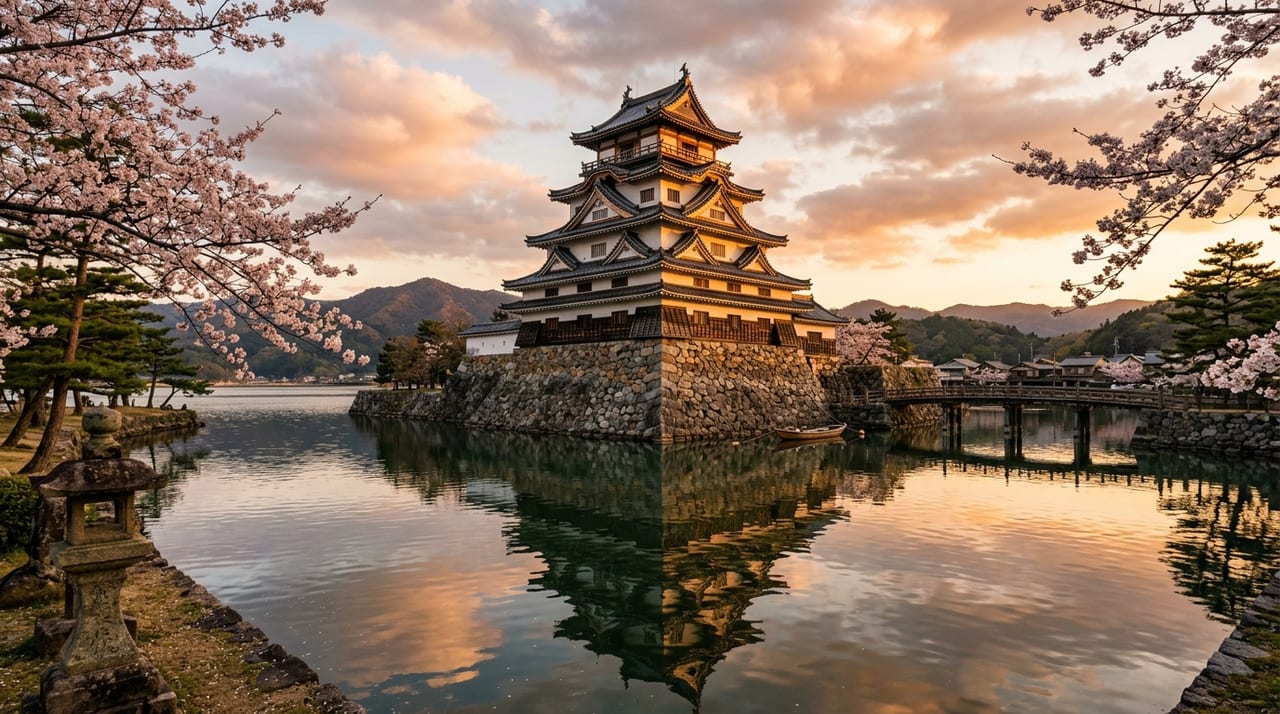
 * Image is for illustrative purposes only.
Miyazu Castle
宮津城
Miyazu Castle is a historic castle in the Kansai region (Founded in 1580 (Tenshō 8), when Hosokawa Fujitaka fortified Miyazu Castle; served as the central stronghold of Tango Province throughout the Edo period). Its lord was Hosokawa Fujitaka (Yūsai) → Hosokawa Tadaoki → Kyōgoku clan → Nagai clan → Abe clan → Okudaira clan → Aoyama clan → Honjo-Matsudaira clan.
Overview
Miyazu Castle is a flatland castle located in Miyazu City, Kyoto Prefecture, that functioned as a base for controlling Tango Province (present-day northern Kyoto Prefecture). Miyazu is widely known as the home of Amanohashidate, one of Japan's Three Great Scenic Views, but Miyazu Castle was a water castle built at the innermost part of Miyazu Bay, where Amanohashidate lies, and it stood at a strategic location commanding the maritime traffic of the Tango region.
Miyazu Castle was built by Hosokawa Fujitaka (Yūsai). Fujitaka was a warrior who served the Ashikaga shogunate, and he was both a military man and a cultured figure well versed in waka poetry, Noh, and the tea ceremony. In particular, his inheritance of the secret transmission of the Kokin Denju, a waka treatise, would later create a dramatic scene on the eve of the Battle of Sekigahara.
In the 7th month of Keichō 5 (1600), preceding the Battle of Sekigahara, Hosokawa Yūsai, who had holed up in Tanabe Castle (present-day Maizuru City), was besieged by the Western Army. Emperor Go-Yōzei and the imperial court regarded Yūsai's siege as problematic, fearing that the Kokin Denju transmission would be cut off, and the Emperor himself dispatched an imperial envoy to broker a peace, an extremely rare event in Japanese history.
After Sekigahara, the Hosokawa clan was transferred to Buzen (Fukuoka) and later to Kumamoto. Miyazu came under the rule of the Kyōgoku clan, after which the Nagai, Abe, Okudaira, and Aoyama clans held it, and then the Honjo-Matsudaira clan took over. The castle continued to function as a central stronghold of Tango until the end of the Edo period. After the Meiji Restoration, the castle was abandoned and its structures were dismantled, but part of its stone walls remain today.
Connection to Swords
The relationship between Miyazu Castle and Japanese swords is best discussed through the figures of Hosokawa Fujitaka (Yūsai), the castle's lord, and his son Hosokawa Tadaoki, as warriors and cultural figures.
Hosokawa Tadaoki was a senior disciple of Sen no Rikyū (one of the Seven Disciples of Rikyū) and was renowned as a tea master. As a warrior, he was a combat veteran who took part in many battles, including the Komaki-Nagakute campaign, the Odawara campaign, the Bunroku campaign, and the Battle of Sekigahara. The Hosokawa family has transmitted famous swords, beginning with the Kasen Kanesada. The Kasen Kanesada, a katana Tadaoki favored, is still housed at the Hosokawa family's Eisei Bunko today and is considered one of the finest swords in existence. It was made by the second-generation Kanesada, a swordsmith of Seki in Mino Province (Seki City, Gifu Prefecture), commonly known as 'Nosada'. It is said that Tadaoki named the sword after the Thirty-Six Poetry Sages, because he put 36 people to death with it.
The outer mounting of the Kasen Kanesada, the 'Kasen koshirae,' was devised by Tadaoki himself and later served as the model for the 'Higo koshirae' of the Higo Kumamoto domain.
Miyazu Castle is an indispensable castle for discussing the Hosokawa family's sword culture, namely the aesthetic discernment and martial achievements that produced the Kasen Kanesada.
Highlights
- Miyazu Castle Ruins Stone Walls — The castle walls along the Ōte River were restored in Heisei 22 (2010), and the Taiko Gate remains at Miyazu Elementary School
- Amanohashidate — One of Japan's Three Great Scenic Views, a scenic sandbar spreading out in front of Miyazu Castle
- Kasen Kanesada, associated with the Hosokawa family — A masterpiece Japanese sword named by Miyazu Castle lord Hosokawa Tadaoki (held at the Eisei Bunko)
- Chion-ji Temple (Monjudō) — A famous temple of the Myōshin-ji branch of the Rinzai sect, adjacent to Amanohashidate, known as 'Kirido no Monju'
- Tanabe Castle (Maizuru Castle) — The neighboring castle where Hosokawa Yūsai held out in a siege over the Kokin Denju transmission (about 40 minutes by car)
* Opening hours and admission fees are subject to change. Please check the official website before visiting.