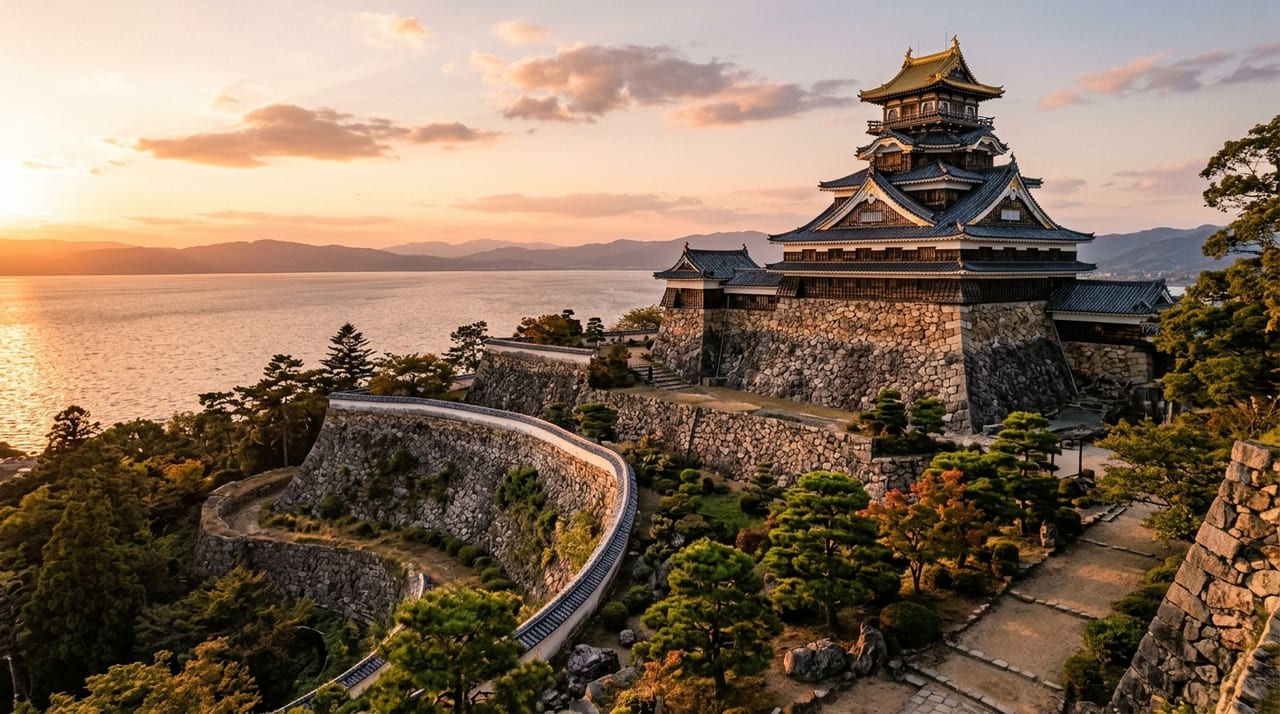
 * Image is for illustrative purposes only.
Azuchi Castle
安土城
Azuchi Castle is a historic castle in the Kansai region (Built in 1576 (Tenshō 4)). Its lord was Oda Nobunaga.
Overview
About the Castle
Azuchi Castle is an unprecedented, revolutionary fortress in which Oda Nobunaga gave architectural form to his ideal of tenka fubu. It fundamentally transformed not only the history of Japanese castles but the history of architecture as a whole. In Tenshō 4 (1576), Nobunaga ordered construction on Azuchi Mountain on the shore of Lake Biwa, and after roughly three years of work it was completed in Tenshō 7 (1579). The magnificent tenshu (written 天主 at Azuchi rather than the usual 天守), six stories above ground and one below, was the first structure in Japan to place a high-rise building atop a stone-walled base. This groundbreaking design became the prototype for all subsequent castle keeps.
History of Construction
The interior of the tenshu was decorated with brilliantly colored wall paintings by Kanō Eitoku and other painters of the Kanō school, and the exterior gleamed with gold-leaf roof tiles. Luís Fróis, a Jesuit missionary then residing in Japan, wrote in his Historia de Japam that the tenshu was a building more dignified and magnificent than the towers of Europe. Azuchi's innovation went beyond architecture. Nobunaga established rakuichi-rakuza in the castle town, improved the highways, and invited missionaries to the city, designing Azuchi as the central city of the realm. It was not merely a military base but a new capital for Japan as Nobunaga envisioned it.
Present Condition
However, in the 6th month of Tenshō 10 (1582), Nobunaga was killed by Akechi Mitsuhide in the Honnōji Incident. In the chaos, the tenshu burned, and within just six years it vanished. Several theories about the cause of the fire exist, including arson and accidental fire, and it remains shrouded in mystery. The six years Azuchi Castle stood coincided with one of the most turbulent periods in Japanese history, and the castle symbolizes both Nobunaga's revolutionary vision and his tragic end. Today the magnificent stone walls, the Ōte-michi (main approach), and the foundation stones of the tenshu platform remain. Visitors can experience the splendor of the past at the Azuchi Castle Archaeological Museum and at Nobunaga no Yakata, a full-scale reconstruction of the tenshu's upper floors.
Architecture and Structure
As you walk the approach road up Azuchi Mountain, the weight of history reaches you through the soles of your feet: the master of the realm once walked this very road. Azuchi Castle existed for only six years, yet its revolutionary architectural concepts influenced every Japanese castle that followed. Only by standing on the site can one truly grasp the scope of Nobunaga's vision. Ōmihachiman City, where Azuchi Castle is located, is also known as the birthplace of the Ōmi merchants. Considering that the rakuichi-rakuza of Azuchi's castle town became the foundation of later commercial culture, the foresight of Nobunaga's economic policy stands out anew.
Battles and Warfare
Climbing the Ōte-michi of the Azuchi Castle ruins, you pass a spot traditionally said to be the site of the residences of Hashiba Hideyoshi and Maeda Toshiie. From the placement of Nobunaga's retainers, you can read the power structure of the Sengoku period. The entire castle ruin is a historical space that could be called a 'textbook of the Sengoku period.'
Connection to Swords
Oda Nobunaga was a revolutionary who overturned the course of Japanese history, and he is also an extremely important figure in the history of the sword. Nobunaga devoted extraordinary passion to collecting famous swords, and in the course of unifying the realm he gathered an enormous number of them from daimyo houses across the country. The most famous sword Nobunaga owned is Heshikiri Hasebe. Designated a National Treasure, this blade was made by Hasebe Kunishige, a swordsmith of Yamashiro Province in the Nanboku-chō period. Its name comes from an incident in which Nobunaga, in a rage, cut down a tea attendant who had hidden beneath a food-tray shelf, cutting through the shelf as well (heshikiru means 'to press-cut'). The sword was later bestowed on Kuroda Kanbei (Josui), and it is now held by the Fukuoka City Museum. Sōza Samonji is a tachi said to have been worn by Imagawa Yoshimoto at the Battle of Okehazama. Nobunaga, who slew Yoshimoto, acquired it in Eiroku 3 (1560). Nobunaga had a gold-inlaid inscription added to this sword reading: 'On the 19th day of the 5th month of Eiroku 3 (1560): carved from the sword that Yoshimoto, whom I slew, had worn. Oda Owari no Kami Nobunaga.' This was not a mere record of spoils. By carving the feat of defeating Imagawa Yoshimoto into the blade, Nobunaga sought to prove his own legitimacy forever. Samonji later passed to Toyotomi Hideyoshi and Toyotomi Hideyori, and then to Tokugawa Ieyasu. It is also called 'the sword of the realm's conquerors.' It is now held by Kenkun Shrine (Kyoto). Nobunaga strategically used swords as rewards for his retainers, leveraging their political value to secure loyalty and clarify the lord-vassal relationship. For a retainer granted a famous sword, it was both a token of the lord's trust and a chain that bound him against betrayal. Nobunaga's sword policy was inherited by Hideyoshi and Ieyasu.
Highlights
- Grand approach road and stone wall remains
- Tenshu foundation ruins
- Azuchi Castle Archaeological Museum
- Nobunaga-no-Yakata (reconstruction of upper tenshu)
- Lake Biwa views from the castle ruins
- Kenkun Shrine (Kyoto, enshrining Nobunaga)
* Opening hours and admission fees are subject to change. Please check the official website before visiting.