New Arrivals — Browse our catalog for the latest authentic Japanese sword arrivals. Browse →
July 2, 1582 (13th day, 6th month, Tenshō 10)
Yamazaki, Otokuni County, Yamashiro Province (present-day Shimamoto Town, Mishima County, Osaka Prefecture to Oyamazaki Town, Otokuni County, Kyoto Prefecture)
Forces
Hashiba (Toyotomi) Forces
Akechi Forces
About 20 min read
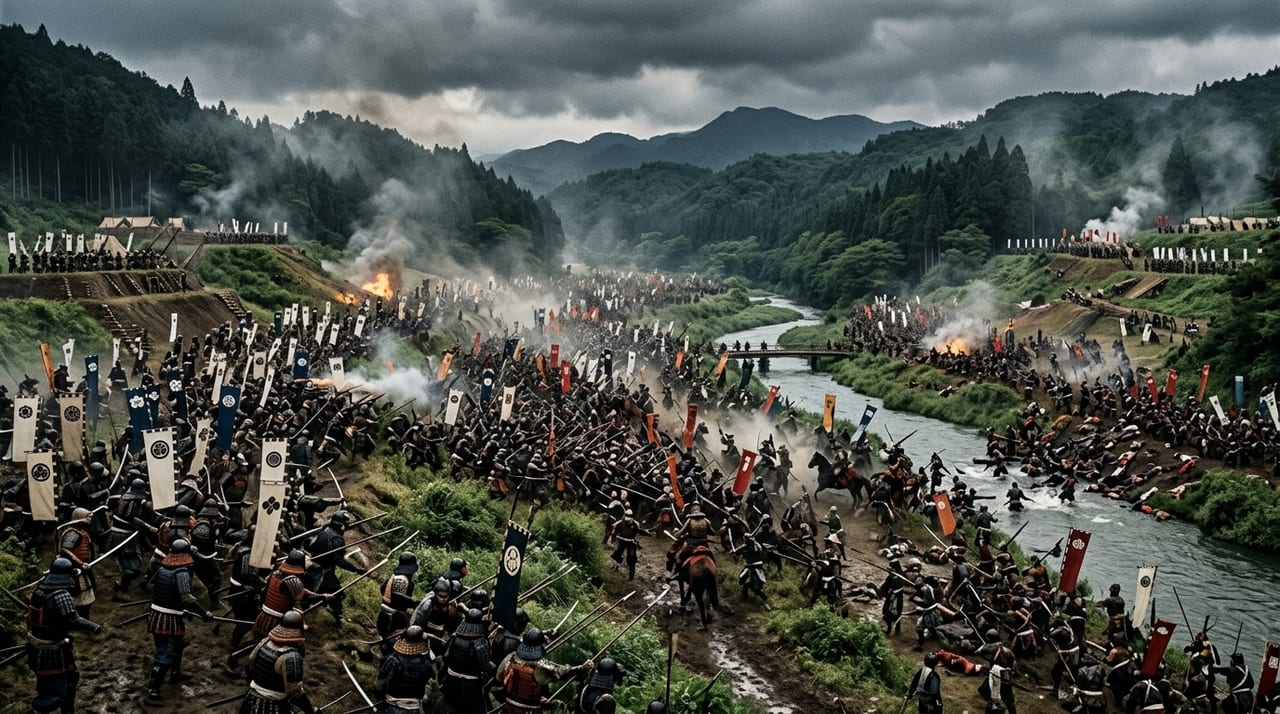
On the 13th day of the 6th month of Tenshō 10 (1582), at Yamazaki in Yamashiro Province (present-day Shimamoto Town, Osaka Prefecture, to Ōyamazaki Town, Kyoto Prefecture), an army of about 40,000 led by Hashiba Hideyoshi clashed with an army of about 16,000 led by Akechi Mitsuhide. The fighting took place in a narrow area between the foot of Mount Tennō and the flow of the Yodo River. Just 11 days after the Honnō-ji Incident (the 2nd day of the 6th month), Akechi Mitsuhide's rule, mocked as a “three-day reign” (mikka tenka), came to an end here.
This battle also holds an important place in the cultural history of the Japanese sword. It was the greatest turning point of the Sengoku period, where three heroes, Oda Nobunaga, Akechi Mitsuhide, and Hashiba Hideyoshi, crossed paths, and their swords have been passed down to the present day through many legends and real famous blades.
In the early hours of the 2nd day of the 6th month of Tenshō 10, Akechi Mitsuhide, a senior retainer, suddenly surrounded Oda Nobunaga, who was staying at Honnō-ji in Kyoto. Nobunaga took his own life, and his eldest son Oda Nobutada also killed himself at Nijō Shin-gosho. Mitsuhide had struck down a lord he had served for thirteen years, and he was immediately branded a rebel. He nonetheless tried to quickly fill the vacuum left by the absence of a master of the realm.
However, what Mitsuhide had overlooked was the movement of Hashiba Hideyoshi, who was deployed in the Chūgoku region on the front against the Mōri clan. On receiving word of the incident, Hideyoshi, although he was in the midst of the water siege of Bitchū Takamatsu Castle, concluded a lightning peace with the Mōri clan. He then led about 20,000 troops and covered roughly 230 km from Bitchū Takamatsu to Yamazaki in about 10 days. This march, known as the Chūgoku Ōgaeshi, is recognized as one of the most remarkable forced marches in Japanese military history. After reorganizing his forces at Amagasaki in Settsu Province, Hideyoshi gathered reinforcements including Niwa Nagahide, Ikeda Tsuneoki, and Nakagawa Kiyohide, swelling his army to 40,000.
Meanwhile, Mitsuhide tried to persuade the lords who had relied on Nobunaga's authority, but most did not respond. Hosokawa Fujitaka (Yūsai, Tadaoki's father) shaved his head, mourned Nobunaga, and refused the invitation. Tsutsui Junkei also secretly sided with Hideyoshi and began preparing to hold out at Yamato-Kōriyama Castle. The anecdote of Junkei hedging his bets at Hora-ga-tōge cannot be confirmed in reliable sources. Mitsuhide faced the decisive battle without allies.
The Yamazaki area was a key crossroads where the Saigoku Kaidō, connecting Kyoto with western Japan, and the river transport of the Yodo River passed. Whoever held Mount Tennō (270 m above sea level) could control the route to Kyoto, making it a vital stronghold. The saying “Whoever controls Mount Tennō controls the realm” is partly a later invention, but it is certain that the area was a strategic stronghold.
According to the conventional account, both armies contested possession of Mount Tennō, and the Hideyoshi army is said to have seized the initiative. This contest cannot be confirmed in reliable sources, and recent reexamination has advanced. The Hashiba army placed its forward line by having Settsu retainers, including Nakagawa Kiyohide and Takayama Ukon, occupy the Yamazaki village, while Kuroda Yoshitaka and Hashiba Hidenaga deployed at the foot of Mount Tennō. With forces of 40,000 against 16,000, even controlling Mount Tennō could no longer reverse the situation.
The full-scale fighting began around 4 p.m. on the 13th day of the 6th month and was settled in a short time of about two hours. The overwhelming numbers of the Hashiba army surrounded Mitsuhide's army from three sides, and Mitsuhide's army could not hold its line and collapsed.
Hosokawa Tadaoki is cited as a warrior who left his name in the sword culture of this era. Tadaoki studied the tea ceremony under Sen no Rikyū and is counted among the Seven Sages of Rikyū (Rikyū Shichitetsu). He is also known for establishing the Higo-goshirae style of mounting for uchigatana. His beloved sword, Kasen Kanesada, is said to have been named after the Thirty-Six Immortals of Poetry because he had cut down 36 men, and it has since been passed down as a symbol of his prowess and cultural tastes. By choosing a plain, practical blade as the sword he wore while devoting aesthetic care to its mounting, Tadaoki still exemplifies the warlord who pursued the union of martial power and beauty.
The defeated Mitsuhide tried to escape, but in a bamboo grove at Ogurisu in Yamashiro Province (present-day Fushimi Ward, Kyoto City), local farmers struck him with a spear in the hunt for fleeing warriors (ochimusha-gari), and he suffered a fatal wound. The dramatic end, a ruler who had raised a rebellion being killed by farmers, was received by the people of the time as a sign of the verdict of heaven.
The series of events leading to the Battle of Yamazaki is directly tied to several famous sword legends.
The sword Yoshimoto Samonji, said to have been used by Oda Nobunaga, is held to be the waist sword of Imagawa Yoshimoto, whom Nobunaga slew at the Battle of Okehazama, and it is one of the famous swords Nobunaga treasured his whole life. Nobunaga had this sword shortened (suriage) and had a gold-inlaid inscription placed on the tang: “the sword carried by Yoshimoto, taken when he was slain on the 19th day of the 5th month of Eiroku 3.” Regarding Nobunaga's final moments at the Honnō-ji Incident, the Shinchō Kōki records that after his bowstring snapped, he fought with a spear, was wounded in the elbow, withdrew inside, and took his own life. Luís Fróis records that he fought fiercely, wielding a naginata. In either case, Nobunaga's extraordinary interest in swords, as weapons and also as cultural properties and political symbols, spread that view of swords among Sengoku daimyō and is deeply etched into later sword culture.
It is also said that many of the famous swords Nobunaga kept at Azuchi Castle were lost in the fire that consumed the castle immediately after the Honnō-ji Incident. Whether this is true is unknown, but the sense of loss that the collection of renowned treasures gathered through Nobunaga's so-called meibutsu-gari (hunt for famous treasures) disappeared all at once has long stirred the imagination of later sword enthusiasts.
As for Akechi Mitsuhide, his origins and great ability have led to his evaluation as a scheming general skilled in both the pen and the sword. Yet his extremely brief period as the “ruler of the realm,” only 11 days after the Honnō-ji Incident, remains in history as the “three-day reign.” Few certain relics of Mitsuhide's swords survive, but in later works he has been depicted many times as the sword of a scheming retainer.
The outcome of the Battle of Yamazaki, Hashiba Hideyoshi's establishment of his position as Nobunaga's successor, had a direct impact on the culture of appreciating and collecting Japanese swords.
Following Nobunaga's example, Hideyoshi was eager to collect famous swords, and his collection of tea utensils and famous swords functioned as proof of political authority. His interest in swords went beyond valuing them merely as weapons and developed into an aesthetics of power, alongside the tea ceremony. The aesthetic sense he cultivated through his friendship with Sen no Rikyū was also applied to sword appreciation, and it became one factor in establishing the value standards for famous swords (meibutsu).
The Sword Hunt that Hideyoshi later promoted along with the establishment of the Toyotomi regime (Tenshō 16, 1588) was a policy of confiscating weapons from peasants and monks. At the same time, by limiting the right to carry a sword to the warrior class, it further strengthened the political and status meaning of swords. Swords vanished from the hands of peasants, and only warriors carried them. This formed the basis of the Edo-period idea of the Japanese sword as the soul of the samurai. The path by which Hideyoshi, who had defeated Akechi Mitsuhide at the Battle of Yamazaki, began walking the road to the rule of the realm, and refined sword policy along the way, lies at the core of the turning point from the Sengoku period to the early modern era in sword culture.
The trajectory by which the Japanese sword, having left the battlefield, rose to become an art object and a symbol of power has certainly accelerated from the Battle of Yamazaki onward.
Hosokawa Tadaoki, who with his father rejected Mitsuhide's invitation and remained neutral at the Battle of Yamazaki, occupies a special place in the history of sword culture. A disciple of Sen no Rikyū, Tadaoki mastered the tea ceremony and also studied the iai art of the Katayama Hōki-ryū. His beloved sword, Kasen Kanesada, is passed down as showing the highest peak of the samurai aesthetic sense and swordsmanship.
Regarding the name Kasen Kanesada, the well-known tradition holds that Tadaoki cut down 36 men. However, this can rather be interpreted as a name that overlaid the literary culture of the Heian period, the Thirty-Six Immortals of Poetry, with the martial authority of a Sengoku swordsman. The very act of giving a sword an aesthetic and literary name shows the sword views of the warlords of this era.
Tadaoki's father, Hosokawa Fujitaka (Yūsai), shaved his head and mourned Nobunaga after the Honnō-ji Incident, refusing to join Mitsuhide's side. This was not mere fence-sitting but also an expression of sincere grief over Nobunaga's death. Yūsai was also known as a master of poetry, a typical Sengoku daimyō who combined martial and literary arts.
Tadaoki also fought with the Eastern Army (Tokugawa side) at the Battle of Sekigahara (1600). In the Edo period he became the first lord of Buzen-Kokura Domain, and under his son Tadatoshi the Hosokawa family moved to Higo-Kumamoto with 540,000 koku. Swords handed down in the Hosokawa family are still housed today at the Eisei Bunko, which is connected to the family, and they have come down to the present day as a continuing inheritance of sword culture that began at Yamazaki.
Toyotomi Hideyoshi, who opened the path to the rule of the realm at the Battle of Yamazaki, skillfully used swords for both political and cultural purposes. He ranked famous swords as meibutsu on a par with tea utensils, forming a culture in which possessing them became proof of political authority.
This current was inherited by the Tokugawa shogunate in the Edo period, and the collection culture of swords was established around famous swords of the house style and famous swords of the shogun's house. The Battle of Yamazaki is recorded in the history of the Japanese sword as its starting point, the turning point at which swords that were weapons of war rose to become symbols of authority and beauty.
Akechi Mitsuhide
Commander of Akechi forces; his brief reign ended here
Toyotomi Hideyoshi
Hashiba commander; lightning return march secured his victory
Hosokawa Tadaoki
Hashiba ally, owner of the celebrated Kasen Kanesada blade
Kuroda Kanbei
Hideyoshi's chief strategist who orchestrated the great return march
Niwa Nagahide
Oda senior retainer who joined Hideyoshi's coalition
Oda Nobunaga
Killed at Honnōji; his death was the direct cause of this battle