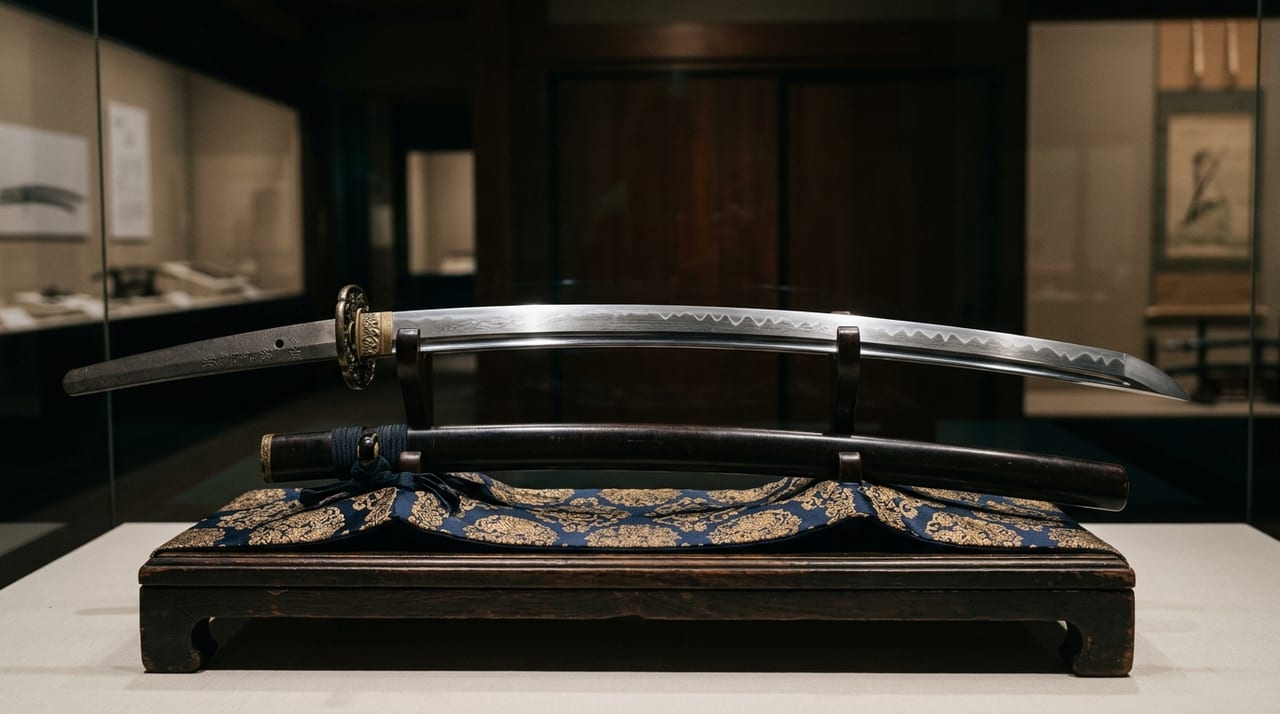
 * Image is for illustrative purposes only.
Kasen Kanesada
歌仙兼定
Also known as: Poetry Immortal
Description
Overview of the Blade
Celebrated as the beloved sword of Hosokawa Tadaoki (Sansai, 1563–1646), a renowned Sengoku-period daimyo and cultural patron. The blade was forged by Kanesada II (Nosada), the acclaimed smith of Seki in Mino Province. With an edge length of approximately 60.5 cm (one shaku, nine sun, nine bu, and a half), it is an uchigatana with a short tang, designed for one-handed striking.
Manufacturing and Characteristics
The tang bears the inscription "Nōshū Seki-jū Kanesada saku" (made by Kanesada, resident of Seki in Mino Province) on its omote side. The steel shows itame mixed with mokume, and the hamon has a large notare at the base (koshi), with a chū-suguha above it whose nioiguchi is tightly defined. Plain and practical in construction, the blade is valued for Tadaoki's deliberate choice of it as the sword he wore (sashiryō) and for the way he lavished his own aesthetic sense on its koshirae. The name "Kasen" (Poetry Immortal) is attributed to Tadaoki's execution of thirty-six of his retainers with this blade—evoking the Thirty-Six Poetry Immortals of the Heian period. The juxtaposition of the elegant name "Kasen" with its sanguinary origin perfectly encapsulates the paradox of Hosokawa Tadaoki himself: a figure in whom culture and violence coexisted. Tadaoki was one of the "Seven Disciples of Rikyu" (Rikyu Shichitetsu), the foremost disciples of Sen no Rikyu, and stood as the preeminent cultural figure of his era, with profound mastery of tea ceremony, poetry, and Noh drama. As a Sengoku general, he served as a principal commander of the Eastern Army at the Battle of Sekigahara and became daimyo of Buzen-Kokura Domain with a revenue of 399,000 koku. Tadaoki's wife was Gracia Hosokawa (Tama), daughter of Akechi Mitsuhide. Her rejection of Ishida Mitsunari's demand that she become a hostage, immediately before Sekigahara, and her ensuing tragic death constitute one of the most storied tragedies in Japanese history.
Provenance
In the Hosokawa family, the blade passed from Tadaoki to his fourth son Tatsutaka, then to fourth-generation Mitsuhisa and fifth-generation Tsunatoshi. It was then received from Tsunatoshi by the karō (chief retainer) Kashiwabara Sadatsune, and remained in the Kashiwabara family until 1897 (Meiji 30). After passing through several owners, it was repurchased by Hosokawa Moritatsu in the early Shōwa period, and is now held in the collection of the Eisei Bunko Museum (Bunkyo Ward, Tokyo).
Legends & Stories
Legend and Anecdotes
The legend of Kasen Kanedane is also a key to understanding Hosokawa Tadaoki, a figure of extraordinary complexity. Tadaoki married Tamako, the third daughter of Akechi Mitsuhide, in Tenshō 6 (1578), and it is said that a deep affection existed between the two. However, when Mitsuhide raised a rebellion in the Honnō-ji Incident of 1582, Tamako bore the stigma of being "the daughter of a traitor," and Tadaoki, for the sake of propriety, confined Tamako to Ajido in Tango. Two years later, when Tamako was pardoned and returned to the Hosokawa residence in Ōsaka Tamazukuri, she received baptism in the Christian faith and took the name Gracia; but it is said that Tadaoki did not receive this favorably. Tadaoki's love and jealousy toward Gracia were fierce, and the missionary Luís Fróis recorded that Tadaoki confined and imprisoned Gracia to an extreme degree. In the fifth year of Keichō (1600), as the Battle of Sekigahara loomed, Ishida Mitsunarī sought to take the wives and children of the great daimyō in Ōsaka as hostages. Gracia refused to become a hostage and commanded her retainer to assist in her death, meeting a magnificent end. As Gracia was a Christian, suicide was forbidden to her; it is said that her retainer Ogasawara Hideyo pierced her breast and ended her life. The anguish in Tadaoki's heart upon hearing this tragic news is beyond measure, yet Tadaoki fought like a demon god at Sekigahara, making a great contribution to the victory of the Eastern Army. The origin of the name "Kasen" traces back to a legend passed down in Kumamoto, which holds that after retiring, Tadaoki had thirty-six (by one account, six) of his retainers executed, believing that his son Tadatoshi's administration was failing to progress because of the disloyalty of his close attendants; however, the sword researcher Fukunaga Suiken points out that this incident cannot be found in the Hosokawa Tadaoki-kō Go-nenpu. However, Tadaoki's fierce temperament is corroborated by many historical records, and it is accepted as fact that his judgments upon his retainers were severe. The very act of naming a sword after the "Thirty-Six Poetry Immortals," the epitome of refinement, based on the number of retainers slain in bloody executions, directly expresses Tadaoki's spiritual world—where aesthetic sensibility and violence are unified as one. Kasen Kanedane is an existence that has locked within a single blade the duality of "beauty and violence," the core of Japanese Sengoku culture; and it is precisely its complexity and depth that continues to captivate so many people. In the video game Touken Ranbu, it is portrayed as an elegant blade of both literary and martial accomplishment, becoming a popular character embodying both learning and martial prowess.