New Arrivals — Browse our catalog for the latest authentic Japanese sword arrivals. Browse →
10th month, Tenshō 5 (1577)
Shigisan Castle, Heguri District, Yamato Province (present-day Shigihata, Heguri Town, Ikoma District, Nara Prefecture)
Forces
Oda Forces
Matsunaga Forces (Shigisan garrison)
About 13 min read
In the 10th month of Tenshō 5 (1577), at Shigisan Castle, built on the steep summit of Mount Shigi (Shigisan) in Yamato Province (present-day Heguri Town, Nara Prefecture), Matsunaga Hisahide, a Sengoku-period strategist counted among the 'Three Great Villains,' brought his eventful life to a close. It is said that he refused to give up the renowned tea kettle 'Hiragumo,' smashed it, set fire to the main keep, and took his own life. His final moments, a dramatic end staged to uphold the pride of 'the last strategist of the Sengoku period,' are still told to later generations.
Matsunaga Hisahide's birth year is unknown (according to various theories, the 1508 theory is the most likely), and he is said to have come from Settsu or Yamashiro. He rose to prominence as a retainer of the Miyoshi clan and eventually climbed to become a great daimyō wielding power surpassing that of his lord. In Sengoku history, his name is remembered especially for three points: 'the usurpation of the main house (the Miyoshi family),' 'the burning of the Great Buddha Hall of Tōdai-ji,' and 'involvement in the murder of the shogun (Ashikaga Yoshiteru).' These three 'great evil deeds' became the basis for portraying Hisahide as 'the greatest villain of the Sengoku period' in later lectures and novels, but recent research has also pointed out that each of them contains many exaggerations and misreported accounts.
On the other hand, what is certain is that Hisahide, as a 'tea master' (chajin), had outstanding aesthetic sensibility and collected many famous tea implements. The tea kettle 'Hiragumo,' named for its flat shape like a spider crouching on the ground, was Hisahide's most beloved famous piece, and it is said that Nobunaga also repeatedly requested it.
The relationship between Matsunaga Hisahide and Oda Nobunaga was complicated. When Nobunaga entered the capital in Eiroku 11 (1568), Hisahide quickly submitted to him and was recognized in his control of Yamato Province. However, during the Genki era he joined the anti-Nobunaga coalition and staged his first rebellion. At the end of Tenshō 1 (1573) he surrendered to Nobunaga by handing over Tamonyama Castle, and was pardoned.
In Tenshō 5 (1577), Hisahide staged his second rebellion. Nobunaga captured one after another of Hisahide's castles in Yamato Province and finally surrounded Shigisan Castle. Before this, Nobunaga had sent Matsui Yūkan as an envoy to ask the reason for the rebellion, but Hisahide reportedly would not even meet the envoy. According to the Kawasumi Taikōki, during the encirclement Sakuma Nobumori demanded that Hiragumo be brought out of the castle, but Hisahide refused, replying, 'Neither the Hiragumo kettle nor our heads will be shown to Lord Nobunaga.'
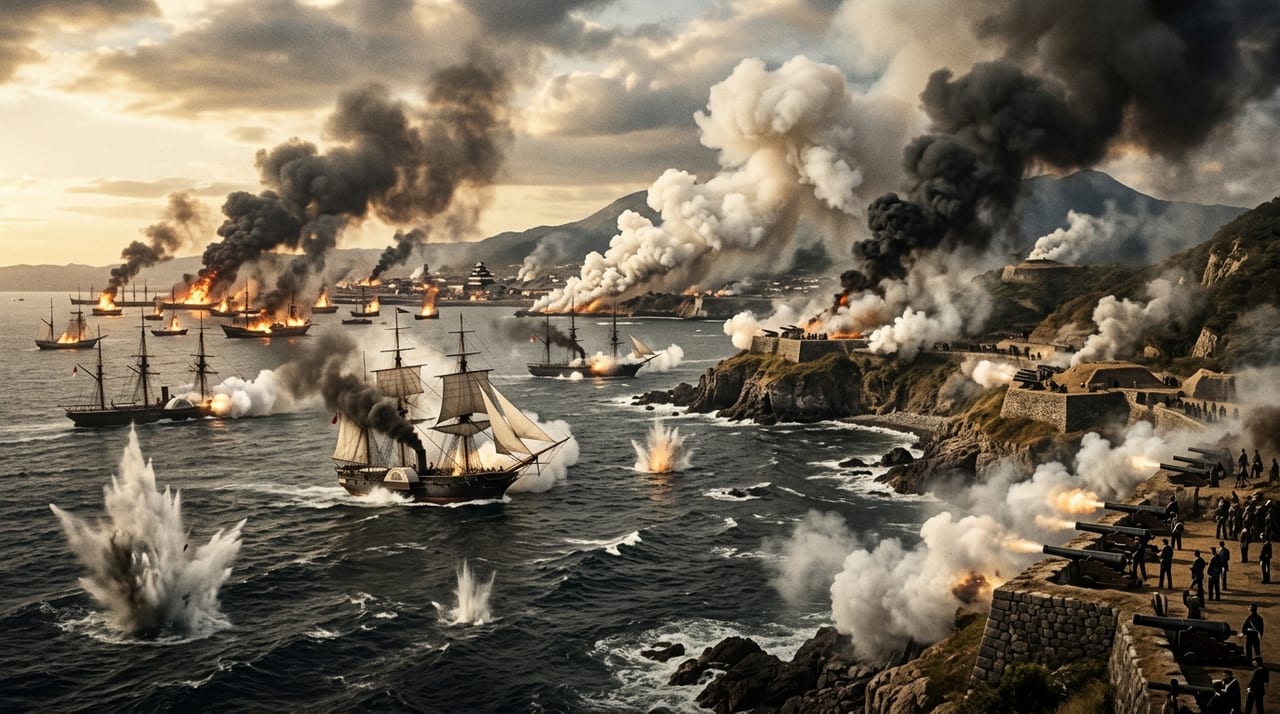
Shigisan Castle was a mountain castle built on the summit of Mount Shigi (Shigisan), at an elevation of 437 m, and was a strategic point linking Yamato and Kawachi. Hisahide holed up in this steep mountain castle together with many warriors and continued to hold out against the large army of Nobunaga and his son Nobutada.
The siege did not last long. The disparity in forces with the Oda army was overwhelming, and the defense of Shigisan Castle was a matter of time. It is thought that Hisahide had resolved from an early stage to bring the curtain down by his own hand at the end.
On the 10th day of the 10th month of Tenshō 5 (November 19, 1577), Shigisan Castle fell. There are several traditions regarding Hisahide's end. The most dramatic tradition holds that 'Hisahide packed his favorite Hiragumo with gunpowder and blew it up on top of the main keep, dying in the explosion along with it.' On the other hand, the Kanemi-kyō ki, the diary of a contemporary court noble, records that Hisahide and his son committed seppuku and set fire to the castle. The theory of death by explosion is regarded as a popular belief that spread through general history books after World War II and has little historical basis. The point that 'he did not hand over Hiragumo,' however, is one on which the various sources agree.
What stands out in Matsunaga Hisahide's end is that it is the 'tea kettle,' not the 'sword,' that takes the leading role. When one thinks of the end of a Sengoku daimyō, the image of a 'sword' used to cut the belly is strong. Yet Hisahide invested the meaning of his own end in the destruction of the famous tea implement 'Hiragumo,' rather than in seppuku with a sword.
This shows that, just as the Japanese sword was the 'soul of the samurai,' tea implements were the 'symbol of the samurai's aesthetic sense and cultural refinement.' For Hisahide, handing over 'Hiragumo' meant not mere surrender but yielding his spiritual core to the conqueror. This refusal may have been an expression of his final samurai pride, the same as, or even greater than, the act of cutting one's belly with a sword.
The warriors of Matsunaga's army holed up in Shigisan Castle are thought to have carried swords forged by the swordsmiths of Yamato. The Nara and Yamato region is known as the area that produced swordsmiths of the Tegai school, and it nurtured its own forging culture from the Kamakura to the Muromachi period. Tegai Kanenaga was a representative figure and was widely favored by the warriors of Yamato. It is highly likely that Hisahide himself, as a person who combined scheming and aesthetic sense, collected and used famous swords of Yamato.
The famous sword 'Heshikiri Hasebe' owned by Oda Nobunaga is a blade made by Hasebe Kunishige. Its name is based on the anecdote that Nobunaga cut through (heshikitta) a tea attendant who was hiding under a food-tray shelf with this sword. This sword is currently held by the Fukuoka City Museum.
Nobunaga sought famous tea implements along with famous swords, and 'Hiragumo,' which Hisahide loved, was also a famous piece that Nobunaga repeatedly requested. This final confrontation over the tea kettle was also a historical scene in which the two 'aesthetic senses of the samurai,' the Japanese sword and the tea implement, collided.
After Matsunaga Hisahide's fall, Yamato Province was placed under the control of Tsutsui Junkei, who had been appointed Yamato shugo by Nobunaga the previous year. Shigisan Castle was abandoned, and the land of Mount Shigi has continued to this day as a sacred site of faith in Bishamonten.
Hisahide's image as a 'fierce villain' spread on the basis of sources such as the Jōzan Kidan of the Edo period, and the story that he died in an explosion together with Hiragumo became established after World War II through general history books. In modern times he continues to be depicted as a typical 'strategist' in manga, games, and dramas.
The remains of Shigisan Castle still survive in Heguri Town, Nara Prefecture. They lie adjacent to Shigisan Chōgosonshi-ji and are preserved as a historic site designated by Nara Prefecture. Standing on the stage of this dramatic end, which the Sengoku strategist chose at last, 'to go to death together with a famous tea kettle,' one can feel the depth of spirit of 'attachment to beauty' that the warriors living in the age of the Japanese sword possessed. Hiragumo has been lost and most of the swords have been scattered, yet Hisahide's pride engraved on Mount Shigi has not faded and still lingers in the mountain air, nearly 450 years later.
Matsunaga Hisahide
Matsunaga Hisahide — the castle's defender who chose destruction over surrender of his prized Hiragumo tea kettle
Oda Nobunaga
Oda Nobunaga — who ordered the siege and demanded Hisahide surrender the Hiragumo
Oda Nobutada
Oda Nobutada — Nobunaga's eldest son who led the siege of Shigisanyama
Niwa Nagahide
Niwa Nagahide — senior Oda retainer who participated in the siege operations