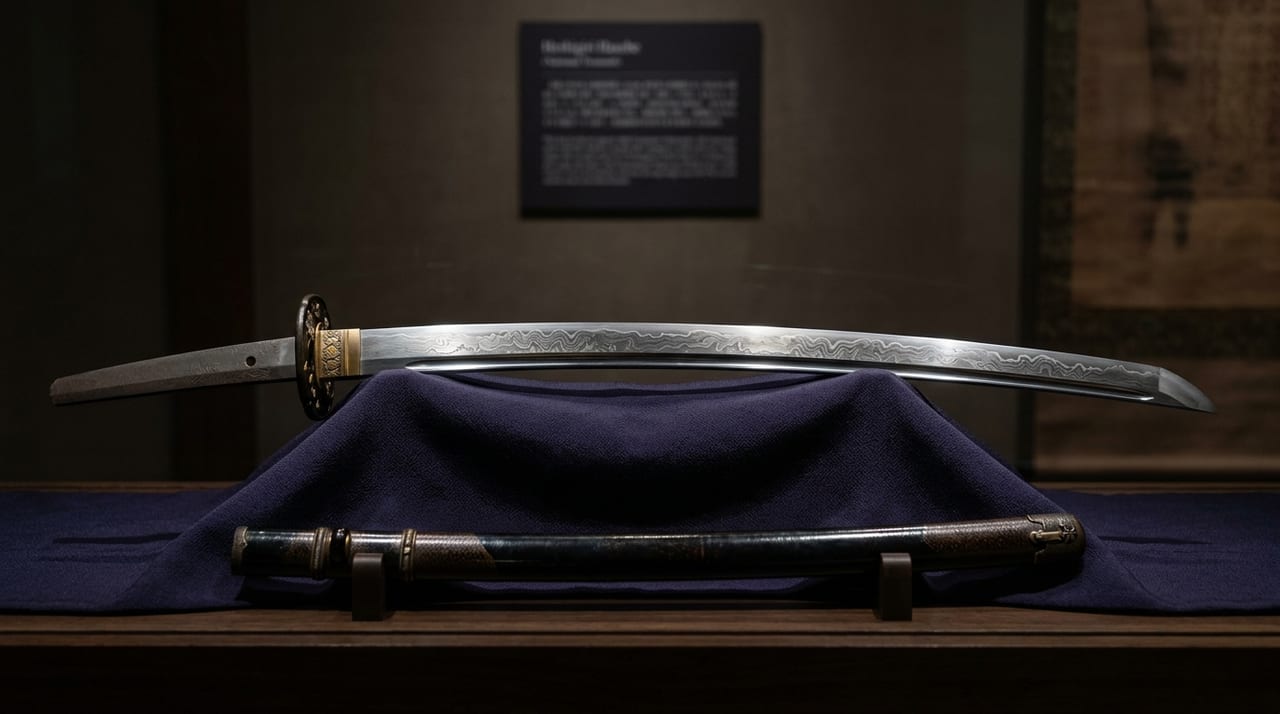
 * Image is for illustrative purposes only.
Heshikiri Hasebe
へし切長谷部
Also known as: The Pressing Cutter
Description
Overview of the Blade
Heshikiri Hasebe is a celebrated blade forged by Hasebe Kunishige, a master smith of the Nanbokuchō period, and was bestowed upon the Kuroda family by Oda Nobunaga. It stands as one of the greatest swords under heaven. The blade measures approximately 64.8 cm in length, with a curvature (sori) of about 0.9 cm, a broad blade width and a thin kasane, presenting a form typical of Nanbokuchō-period swords. Currently housed in Fukuoka City Museum, it is designated a National Treasure. This blade, transmitted through generations as the supreme treasure of the Kuroda family, possesses one of the most remarkable and storied provenance in Japanese sword history, simultaneously embodying the ruthless anecdotes of Nobunaga and the exceptional trust he placed in Kanbei.
The Master Smith
Hasebe Kunishige was a swordsmith active in Yamashiro (present-day Kyoto Prefecture) during the Nanbokuchō period and is regarded as the founder of the Hasebe school. He actively incorporated the techniques of the Soshu tradition, becoming renowned for his distinctive hitatsura (full-blade) hamon with intensely surging nie. Hitatsura is a technique in which the hamon spreads across the entire blade surface; whereas ordinary hamon is fired as a band following the edge, in hitatsura the tempering extends to the flat and ridge surfaces as well, appearing as if the entire blade surface is covered with tempering patterns. This extraordinary hamon possesses a power entirely distinct from conventional tempering, leaving a profound impression on the viewer. Kunishige's blades were characterized above all by this hitatsura, establishing a unique style that was raw, mysterious, and beautiful—distinct from the elegant Soshu tradition of his contemporary masters Masamune and Sadamune. Heshikiri Hasebe, as his masterwork, fully demonstrates the terrible beauty of hitatsura.
Oda Nobunaga and the Blade's Provenance
The anecdote that gave Heshikiri Hasebe its name speaks directly to Oda Nobunaga's bold and ruthless temperament. One of Nobunaga's tea servants incurred his master's wrath and, fearing punishment, hid beneath a shelving unit. In a fury, Nobunaga seized this blade and "press-cut" (heshi-kiri) the servant beneath the shelf—pressing the blade against him—killing him. The term "heshi" derives from the verb "hesu" (to press or thrust down), and the blade received its name from the awesome power displayed in this single stroke. The violence of press-cutting a man in hiding is wholly unacceptable by modern standards; yet this anecdote has been transmitted as an episode symbolizing Nobunaga's fearless audacity and capacity for sudden action, thereby conferring upon this blade an added prestige as a renowned object imbued with "Nobunaga's presence."
Bestowal Upon Kuroda Kanbei
After Nobunaga's death—or during his lifetime, as accounts vary—Heshikiri Hasebe was bestowed upon the Kuroda family. Accounts differ by source: some say it passed from Nobunaga through Hashiba (Toyotomi) Hideyoshi to Kuroda Nagamasa (Kanbei's son), others that Nobunaga gave it directly to Nagamasa, and others that Nobunaga gave it to the strategist Kuroda Kanbei (Kuroda Yoshitaka, known by his Buddhist name Josui). Kuroda Kanbei is celebrated as Toyotomi Hideyoshi's strategist. Even after enduring imprisonment in the Arioka Castle of Araki Murashige, Kanbei never wavered in his loyalty to Hideyoshi. As a reward for his outstanding military genius and steadfast character, Nobunaga (or his successor) is said to have bestowed this supreme sword upon him. Thereafter, Heshikiri Hasebe became the supreme treasure of the Kuroda family, passing to the Fukuoka domain, where it was carefully preserved through successive generations. Throughout the Edo period it was known as a treasure of the Kuroda family, and after the Meiji Restoration it remained in Kuroda hands before ultimately being donated to Fukuoka City, where it resides today.
The Beauty of Hitatsura and Its Present State
The hitatsura hamon spreading across the blade of Heshikiri Hasebe ranks among the most highly regarded masterworks of hitatsura in existence. Across the edge, flat, and ridge surfaces, small and large nie intertwine in complexity, creating a landscape as if flames envelop the entire blade. This hamon shifts in expression with the play of light and reveals entirely different facets depending on the viewing angle. Its intricate beauty, as if combining Nobunaga's fierce temperament with Kanbei's profound strategic vision, mirrors the tumultuous history this blade has traversed. Fukuoka City Museum displays it regularly, and during exhibition periods, sword enthusiasts from across the nation gather to view it.
Legends & Stories
Nobunaga's "Crushing Cut" Legend
The legend behind the name Heshikiri Hasebe is widely known as one of the most famous episodes in the history of the Japanese sword. A tea servant in Nobunaga's close retinue committed some offense, and upon sensing his lord's anger, quickly fled and concealed himself beneath a shelf. Nobunaga drew the sword at hand—the Heshikiri Hasebe—and cut down the servant hiding beneath the shelf by pressing the blade against him.
The term "heshikiri" means "to press-cut"—to cut by pressing the blade against the target. It is often said that he cut through the shelf as well, but this version is rejected on the grounds that cutting through the shelf would not fit the meaning of "press-cutting." The name Heshikiri Hasebe, born from the union of Nobunaga's fierce spirit and Hasebe Kunishige's unparalleled cutting power, stands as the supreme example of blade and wielder becoming one.
As the Treasure of the Kuroda Clan
The sword passed into the hands of Kuroda Kanbei, a brilliant strategist who had studied under Nobunaga. Bearing within it Nobunaga's fierce spirit, it endured the Sengoku era through Kanbei's profound strategy and measured foresight.
After Kanbei's son, Kuroda Nagamasa, distinguished himself fighting for the Eastern forces at the Battle of Sekigahara, the Kuroda clan prospered throughout the Edo period as daimyo of Fukuoka Domain, holding 520,000 koku of rice lands.
The Heshikiri Hasebe was treasured and carefully preserved by successive daimyo as the supreme heirloom in which dwelt the spirits of their ancestors who had founded their clan's prosperity. Hon'ami Kōtoku attributed it to Hasebe Kunishige and had a gold-inlaid appraisal inscription placed on its tang, and it became widely known as Fukuoka Domain's foremost treasure.
National Treasure Designation and the Modern Era
Designated a National Treasure in 1953 (Showa 28), the Heshikiri Hasebe is now regularly displayed to the public at Fukuoka City Museum.
In the game Touken Ranbu, it is portrayed as a sword with a stern expression, beloved by many fans as a character embodying both its fierce past serving under Nobunaga and the pride of being passed down as the supreme treasure of the Kuroda clan.