New Arrivals — Browse our catalog for the latest authentic Japanese sword arrivals. Browse →
1570–1580 (Genki 1 – Tenshō 8)
Ishiyama, Settsu Province (present-day Chūō Ward, Osaka City, Osaka Prefecture — site of present-day Osaka Castle)
Forces
Oda Forces
Ishiyama Hongan-ji / Ikkō-ikki
About 10 min read
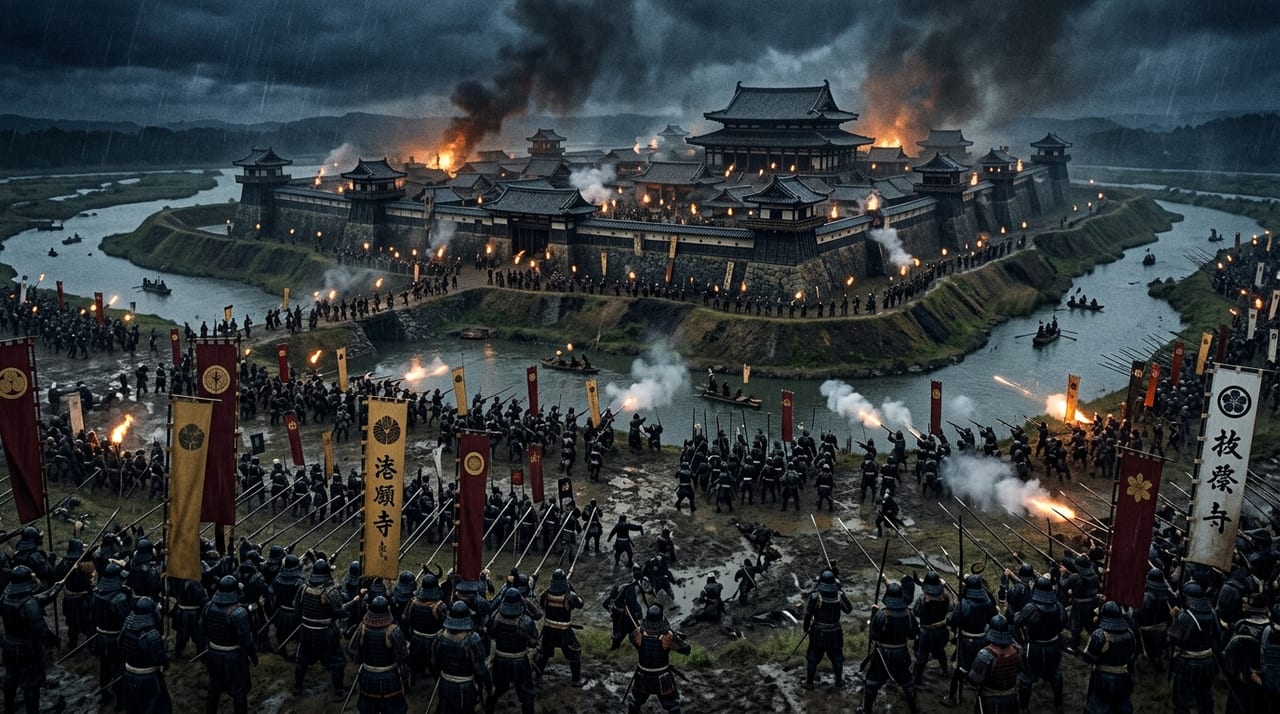
The Ishiyama Kassen — the Siege of Ishiyama Hongan-ji — was a prolonged military conflict between Oda Nobunaga and Ishiyama Hongan-ji spanning from Genki 1 (1570) through Tenshō 8 (1580). It stands as one of the most tenacious forms of resistance Nobunaga faced in Japanese history, and is remembered as a pivotal historical event in which faith and military force — the organizational power of the ikkō-ikki and the authority of a sengoku warlord — clashed directly.
Ishiyama Hongan-ji was the head temple of the Jōdo Shinshū sect (Ikkō sect), located on the plateau where Osaka Castle now stands. Situated at the northern tip of the Uemachi plateau, where the Yodo and the old Yamato rivers met just to the north, this location was strategically vital from a military perspective. The eleventh abbot Kennyo commanded both religious authority and military organization (the ikkō-ikki), and could mobilize adherents throughout Kii, Settsu, Ōmi, and Echizen — a figure who might be called a "religiously-based great daimyo."
Nobunaga's conflict with Ishiyama Hongan-ji arose because his expansionist vision of tenka fubu (spreading martial rule) was fundamentally incompatible with the ikkō-ikki uprisings across the country. In the ninth month of Genki 1 (October 1570), Kennyo launched military action against Nobunaga for the first time, calling on adherents in Ōmi and Settsu to rise. Thus began the Ishiyama Kassen.
The defining characteristic of the Ishiyama Kassen was its prolonged duration. Nobunaga besieged Ishiyama repeatedly, but the Hongan-ji maintained a marine supply line through the Mōri clan's navy, and could continue its defense as long as this sea route remained open.
In the seventh month of Tenshō 4 (August 1576), in the First Battle of Kizugawaguchi, the Mōri fleet utterly destroyed Nobunaga's naval forces through fire attack, opening the supply route to Ishiyama. In response, Nobunaga deployed newly-constructed large ironclad warships (iron-plated ōatakabune) at the Second Battle of Kizugawaguchi in the eleventh month of Tenshō 6 (December 1578), defeating the Mōri fleet. The use of these ironclad vessels is recorded as a watershed moment in Japanese naval warfare.
Within the besieged temple, a split developed between the hardline faction centered on Kennyo's eldest son Kyōnyo and those favoring negotiation. Ultimately, an imperial edict recommending peace was issued, and Kennyo accepted the truce in the intercalary third month of Tenshō 8 (April 1580) and departed Ishiyama in the fourth month (May 1580). However, his son Kyōnyo refused and continued the siege; he finally surrendered Ishiyama and departed in the eighth month of that year. This rift between Kennyo and Kyōnyo would later contribute to the division of Hongan-ji into Higashi (East) and Nishi (West) Hongan-ji.
A noteworthy aspect of sword culture in the Ishiyama Kassen is the question of "the bond between faith and the sword."
The armed adherents of the ikkō-ikki fought with an unwavering faith to "devote themselves to the teachings of the Ikkō sect (Jōdo Shinshū)." The spiritual motto transmitted through the ikkō-ikki — "those who advance will be reborn in paradise; those who retreat will fall into the hell of incessant suffering" — elevated their combat spirit to extraordinary levels. At the center of their armament stood swords, spears, bows, and firearms, and it is believed that sword smiths and blacksmiths were numbered among the adherents.
Sword smiths from Kii (present-day Wakayama Prefecture) and Settsu (present-day northern and central Osaka Prefecture and southeastern Hyōgo Prefecture) often maintained connections with Ikkō sect adherents, and it is likely that many of the blades supplied to Ishiyama were forged by local smiths. The works of sword smiths from Kii, Settsu, and surrounding Kinai regions geographically overlap with the territories where the ikkō-ikki were active.
Araki Murashige, a commander on Nobunaga's side who had been entrusted with the province of Settsu, participated in the siege of Ishiyama but suddenly rebelled against Nobunaga in Tenshō 6 (1578), withdrawing to Arioka Castle (the Battle of Arioka Castle). Murashige was also a man of tea, and this betrayal illuminates the complex political structure underlying the Ishiyama Kassen.
Nobunaga attacked Ishiyama Hongan-ji for a decade while simultaneously fighting other enemies, forcing him into a two-front war. From his confrontations with the Takeda clan (Mikatagahara, Nagashino), the elimination of the Asakura and Azai clans, conflicts with the Mōri, down to the Honnō-ji Incident of Tenshō 10 (1582), Nobunaga's life was a continuous succession of wars.
The resolute defense of Ishiyama Hongan-ji transcended mere military significance; it was revolutionary in demonstrating that a community bound by faith could stand as equals against political authority. The experience from this conflict is said to have been one factor behind Toyotomi Hideyoshi's later implementation of the Katanagari (Sword Hunt) in Tenshō 16 (1588), a policy that prohibited non-samurai from possessing swords.
On the site vacated by Ishiyama Hongan-ji, Nobunaga planned the construction of a castle, and after his death, Toyotomi Hideyoshi built the magnificent Osaka Castle. The field of the Ishiyama Kassen became the stage for the final great conflict between the Toyotomi and Tokugawa — the Siege of Osaka — forming one of the final chapters in the historical chain of the age of the Japanese sword and the samurai.
Oda Nobunaga
Sengoku daimyo who besieged Ishiyama Hongan-ji for nearly a decade
Araki Murashige
Participated in the siege as governor of Settsu, later defected from Nobunaga (Arioka Castle incident)
Kikkawa Motoharu
Mōri commander who supported naval supply operations to the besieged Hongan-ji
Mōri Terumoto
Mōri head who backed the Hongan-ji against Nobunaga