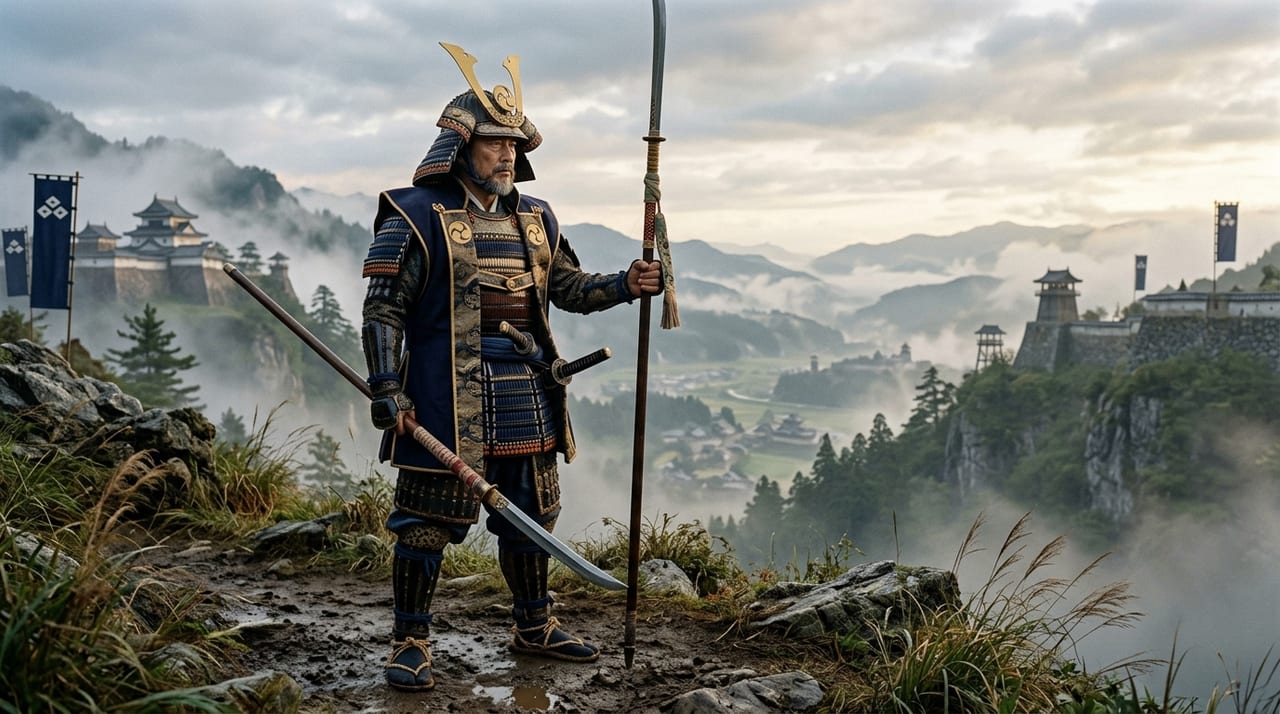
 * Image is for illustrative purposes only.
Kikkawa Motoharu
吉川元春
The Undefeated Right Arm of the Mōri Clan
Description
The Birth of an Undefeated General
Born in Kyōroku 3 (1530) as the second son of Mōri Motonari, Kikkawa Motoharu formed the “three arrows of the Mōri” together with his elder brother Mōri Takamoto and younger brother Kobayakawa Takakage. He was the greatest contributor who supported the Mōri clan’s conquest of the Chūgoku region militarily. Motoharu is known as a general who was undefeated for life, and his martial renown holds a special brilliance even in the Sengoku period. Motoharu was adopted into the Kikkawa family, led the military strength of the Kikkawa, and shouldered the defense of the Mōri family’s eastern flank. His martial renown, which is also said to have been undefeated for life, is still passed down in the San’in region.
The Three Arrows of the Mōri and Motoharu’s Role
The teaching of his father Motonari about the “three arrows” is famous, but what actually supported the Mōri’s territorial expansion militarily was most of all Motoharu’s martial prowess, which he displayed while continuing to fight at the front line. While elder brother Takamoto handled government affairs and younger brother Takakage was in charge of the naval forces and diplomacy, Motoharu commanded battles as the main force of the army. In the San’in provinces of Izumo, Iwami, and Hōki, Motoharu successively subdued the Mōri’s hostile forces and kept expanding the domain. This title of “undefeated general” was not merely a product of luck or chance, but the fruit of Motoharu’s outstanding tactical eye, overwhelming personal bravery, and superb command over his subordinates.
A Warrior’s Pride
The trait that best shows Motoharu’s character as a warrior lies in his relationship with Toyotomi Hideyoshi. After the Honnō-ji Incident in Tenshō 10 (1582), as Hideyoshi rapidly expanded his power, Motoharu handed the family headship over to his eldest son, Kikkawa Motonaga, and retired. It is said this was because he disliked serving Hideyoshi. (Some hold that the timing of his retirement was Tenshō 11 or later.)
The Kikkawa Family’s Tachi and the Taiheiki
The Kikkawa family, which Motoharu inherited, has passed down for generations as a family treasure the tachi “Kitsunegasaki” (National Treasure). It was made by the swordsmith Tametsugu of the Ko-Aoe school and is said to be the sword with which Kikkawa Tomokane slew Kajiwara Kagemochi in the Kamakura period. It is now kept by the Kikkawa Historical Museum in Iwakuni. Also, while on campaign to subjugate the Amago clan, Motoharu copied out the Taiheiki (40 volumes), and this “Kikkawa-bon Taiheiki” has been designated an Important Cultural Property.
The Warrior Culture of the Kikkawa Family
The Kikkawa family, which Motoharu led, was originally a kokujin, or local lord, of Aki Province, and it had a family tradition that valued the dignity and pride of a warrior house. Motoharu carried on and developed this warrior culture of the Kikkawa family, building a strong military group known for the high morale and cohesion of its retainers. The warriors of the Kikkawa household were devoted to Motoharu’s martial renown and character, and they had the spirit to fight to the end and follow their commander through any difficult situation. The fact that Motoharu was able to show a fighting record said to be undefeated for life was possible only because of this cohesion and trust within the household.
The Kyushu Campaign and Death
In Tenshō 14 (1586), during Hideyoshi’s Kyushu campaign, the Mōri family was ordered to join on Hideyoshi’s side. Motoharu had already retired, but in response to Hideyoshi’s request he set out alongside Mōri Terumoto. After capturing Kokura Castle in Buzen, he fell ill in camp and died in the second bailey (ni-no-maru) of Kokura Castle in the 11th month of the same year, Tenshō 14 (1586). He died at the age of 57. Motoharu’s death was in a foreign place during the campaign, and his final moment matched the life of a pure warrior. “The undefeated general died in camp during a campaign.” This final moment brought his life as a warrior to a close in the most fitting form.
Legacy of a Western Warlord
Kikkawa Motoharu’s legacy lies not only in having solidified the military foundation of the Mōri’s rule over the Chūgoku region, but also in embodying the ideal of the “undefeated general” in the warrior society of western Japan. The warrior’s pride that Motoharu embodied, refusing to submit to a powerful ruler and keeping the pride of the warrior’s way to the very end, has become one of the important models that later Japanese people consider when thinking about what a warrior should be.
Notable Swords
- Kikkawa family heirloom tachi "Kitsunegasaki" — a work of the Ko-Aoe school smith Tametsugu (National Treasure). Said to be the sword with which Kikkawa Tomokane slew Kajiwara Kagemochi in the Kamakura period, it was handed down for generations as a treasure of the Kikkawa family that Motoharu inherited. It is now kept at the Kikkawa Historical Museum